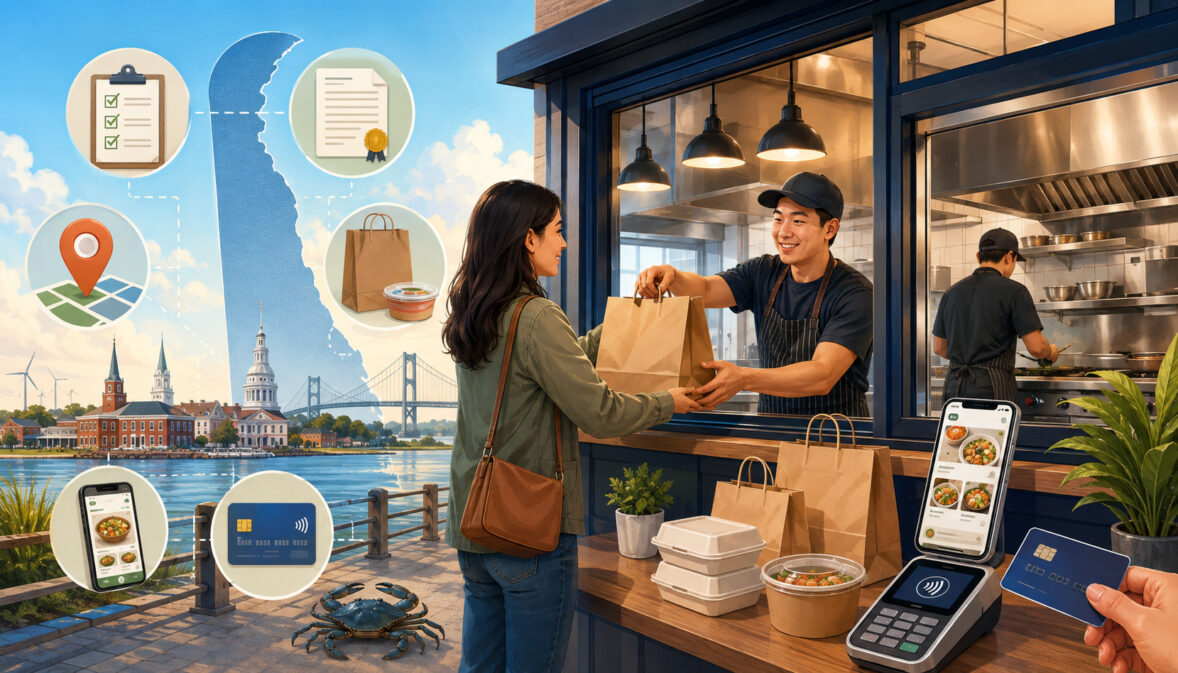
How to Open a Takeout-Only Restaurant in Delaware
Opening a restaurant without a traditional dining room can reduce some front-of-house complexity, but it does not make restaurant ownership simple.
A takeout-focused operation still needs a viable concept, an approved location, an efficient commercial kitchen, accurate ordering systems, suitable packaging, trained employees, and disciplined financial management.
Learning how to open a takeout-only restaurant in Delaware is especially important because the business model depends heavily on convenience. Customers expect food to be ready when promised, packed correctly, easy to collect, and still enjoyable after traveling home.
Unlike a full-service restaurant, a takeout-only restaurant has fewer opportunities to recover from a poor customer experience. There is no server available to correct a missing item at the table or replace food that has cooled during a long wait. Every menu item, container, order confirmation, pickup shelf, and customer message must work together.
This guide explains how to plan, launch, and manage a Delaware takeout restaurant. It covers concept development, market research, restaurant licensing in Delaware, kitchen setup, food safety, menu design, online ordering, payment processing, staffing, marketing, startup costs, and long-term growth.
The information is educational and should not be treated as legal, tax, accounting, employment, food safety compliance, insurance, real estate, investment, or financial advice.
Requirements may differ by location and business model, so owners should verify their plans with the appropriate agencies, local authorities, property professionals, and qualified advisers.
What Is a Takeout-Only Restaurant?
A takeout-only restaurant is a food establishment designed primarily to prepare meals for customers who will eat somewhere else. Orders may be collected from a counter, placed on a pickup shelf, delivered curbside, or handed to a third-party delivery driver.
Some takeout restaurants have a small waiting area or limited counter seating, but their layout and operating systems are built around off-premise consumption.
Instead of investing heavily in dining room furniture, table service, and guest seating, the owner generally places more emphasis on kitchen production, packaging, digital ordering, pickup access, and delivery coordination.
A takeout-only restaurant business can operate from a traditional storefront, a small commercial kitchen, a shared commissary kitchen, or a delivery-focused facility. The right format depends on the menu, anticipated order volume, customer expectations, local approvals, and whether customers need direct access to the premises.
Takeout-Only vs. a Traditional Restaurant
A traditional restaurant divides its attention between the kitchen and dining room. It must coordinate reservations, table turnover, servers, hosts, dish collection, guest seating, restrooms, and the atmosphere of the dining space.
A takeout restaurant concentrates more heavily on food production and order fulfillment. Its success depends on the ability to receive an order, prepare it accurately, package it effectively, and make it available at the promised time.
The staffing model is also different. A takeout operation may need fewer servers but more employees dedicated to order assembly, packaging, online customer communication, and delivery-driver handoffs. During busy periods, the packing station may be as important as the cooking line.
Technology plays a larger role because many customers never speak directly with an employee. The menu, modifiers, payment screen, confirmation message, pickup instructions, and digital receipt must answer the questions that a server would normally address.
Takeout-Only vs. a Ghost Kitchen
A takeout restaurant and a ghost kitchen both focus on food consumed away from the premises, but they are not always the same. A takeout restaurant generally maintains a visible location where customers can place or collect orders.
A ghost kitchen may operate with little public visibility and depend mainly on digital orders and delivery services. Multiple virtual restaurant concepts may also prepare food from the same facility.
Understanding what a ghost kitchen is can help an owner decide whether public pickup access is essential. A visible storefront can support local recognition, walk-in orders, direct pickup, and neighborhood marketing.
A delivery kitchen may reduce the need for a prominent customer-facing location, but it can create greater dependence on digital discovery and delivery platforms.
The choice should reflect the target customer. Office lunch customers may value fast counter pickup, while a delivery-focused dinner concept may function effectively from a less visible commercial kitchen.
Takeout-Only Restaurant Planning at a Glance
Before spending money on equipment or signing a lease, organize the project into manageable planning areas. Each decision influences several others.
For example, the menu determines cooking equipment, refrigeration capacity, preparation space, packaging, labor requirements, and expected ticket times. The location affects zoning, pickup access, delivery-driver flow, utilities, occupancy requirements, and customer visibility.
The following table provides a practical starting framework.
| Planning Area | What to Review | Why It Matters | Priority |
| Concept | Cuisine, target customer, service style and pricing | Shapes the entire operation | High |
| Market | Demand, competitors, reviews and menu gaps | Reduces unsupported assumptions | High |
| Location | Zoning, parking, utilities and pickup access | Affects convenience and approval | High |
| Licensing | Business, food service and local requirements | Supports lawful operation | High |
| Kitchen | Equipment, ventilation, storage and workflow | Controls capacity and consistency | High |
| Menu | Travel quality, preparation time and food cost | Protects the customer experience | High |
| Packaging | Temperature, texture, leakage and labeling | Maintains food quality | High |
| Technology | POS, online ordering and kitchen tickets | Connects ordering with production | High |
| Payments | Online, card and mobile-wallet acceptance | Supports convenient checkout | High |
| Staffing | Prep, cooking, packing and customer support | Reduces delays and mistakes | High |
| Marketing | Local search, website, reviews and community outreach | Builds order demand | High |
| Financial plan | Startup costs, expenses, margins and cash flow | Supports sustainability | High |
How to Use the Planning Table
Treat the table as a decision sequence rather than a list of independent tasks. Begin with the concept and market because they determine what kind of location, menu, kitchen, and staffing model the restaurant needs.
Document what has been confirmed, what remains uncertain, who is responsible for each decision, and when the issue must be resolved. A simple planning tracker can prevent important tasks from becoming buried beneath equipment quotes, menu tests, lease negotiations, and permit paperwork.
Owners should also identify dependencies. The final equipment list should not be approved before the menu is tested. A lease should not be signed before the intended use, utility capacity, and approval path are reviewed. Packaging should not be ordered in large quantities before food has been tested inside it.
Step One: Choose a Concept and Research Local Demand

A strong takeout restaurant concept has a specific customer, dining occasion, price point, and reason for existing. “Good food for everyone” is not a workable position because it does not guide menu development, location selection, staffing, or marketing.
Decide whether the restaurant will focus on office lunches, family dinners, late-night meals, healthy bowls, seafood, sandwiches, breakfast, baked goods, comfort food, or another defined need. Consider how often customers may order, what they are willing to spend, and how long they expect to wait.
Research should include nearby restaurants, residential areas, employment centers, schools, colleges, commuter routes, tourism patterns, and delivery coverage. A concept that performs well near offices may need a different menu and schedule than one serving a suburban dinner market.
Match the Takeout Restaurant Concept to the Market
Study competitors across several ordering channels. Review their menus, pickup instructions, operating hours, prices, customer photos, delivery coverage, and public feedback.
Customer reviews can reveal recurring problems that a new business may be able to solve. Common complaints include cold food, leaking containers, unclear pickup instructions, delayed orders, missing sauces, inconsistent portions, limited healthy choices, or confusing menu modifiers.
Look for evidence of unmet demand rather than assuming that limited competition automatically represents an opportunity. A neighborhood may have no late-night takeout because demand is weak, operating costs are high, or local restrictions make late hours difficult.
Speak with potential customers and observe activity at different dayparts. A location that appears busy at lunchtime may be quiet during dinner. Seasonal demand may also affect coastal communities, tourism areas, college neighborhoods, and business districts.
Choose Food That Travels Well
Food quality should be tested after realistic travel time, not only when a dish leaves the cooking station. Some items lose texture quickly, continue cooking inside sealed containers, release moisture, separate, or become difficult to present attractively.
Evaluate each item after ten, twenty, and thirty minutes. Check temperature, texture, leakage, appearance, portion stability, and ease of eating. Include sauces, garnishes, drinks, sides, and utensils in the test.
Foods that travel poorly are not automatically unsuitable, but they may require different cooking methods, vented containers, separated components, revised portioning, or limited delivery distances.
A focused menu of reliable items is usually stronger than a large menu with uneven travel performance. The objective is not to reproduce the dining-room experience exactly. It is to design food specifically for carryout, curbside pickup, and delivery.
Step Two: Write a Takeout Restaurant Business Plan

A takeout restaurant business plan converts the idea into a practical operating model. It should explain what the restaurant will sell, whom it will serve, how orders will be fulfilled, what the startup may cost, and how the operation could become financially sustainable.
The plan should cover the concept, target market, competitor research, menu strategy, location requirements, kitchen design, staffing, technology, online ordering, payment processing, marketing, startup budget, operating expenses, and financial assumptions.
It should also describe the risks. These may include rising ingredient costs, high delivery commissions, staffing shortages, equipment failure, inconsistent order volume, packaging price increases, or delays in obtaining approvals.
The plan is not only for lenders or investors. It can guide negotiations with landlords, equipment vendors, contractors, technology providers, and potential employees.
Build Realistic Startup and Operating Assumptions
Estimate costs by category rather than using one broad opening figure. Typical categories include:
- Lease deposits and initial occupancy costs
- Design, professional review and buildout
- Cooking, refrigeration and preparation equipment
- Ventilation, plumbing and electrical work
- Smallwares, shelving and storage
- Ordering, payment and kitchen technology
- Initial ingredients, beverages and packaging
- Insurance and professional services
- Recruiting, training and pre-opening payroll
- Photography, signage and launch marketing
- Working capital and contingency reserves
Ongoing expenses may include rent, utilities, payroll, ingredients, packaging, cleaning supplies, pest control, equipment maintenance, software, payment processing, marketing, insurance, delivery commissions, and professional services.
Resources covering restaurant financial projections in Delaware can help owners organize revenue, expense, cash-flow, and break-even assumptions. Figures should still be based on quotes and conditions specific to the proposed operation.
Use the Plan as a Working Management Tool
A business plan should change as the project becomes more concrete. Replace rough assumptions with actual vendor quotes, proposed lease terms, equipment specifications, staffing schedules, and menu cost calculations.
After opening, compare actual performance with the plan. If food costs, labor hours, packaging expenses, average order value, or daily order counts differ substantially from expectations, investigate the cause and revise the operating model.
The plan can also prevent impulsive expansion. Adding catering, delivery platforms, new menu categories, longer hours, or another location may appear attractive, but each option introduces additional costs and operational demands.
Schedule regular reviews of financial assumptions, market conditions, customer feedback, and production capacity. A plan that remains active can help the owner decide which opportunities support the concept and which ones create unnecessary complexity.
Step Three: Understand Delaware Requirements and Licenses
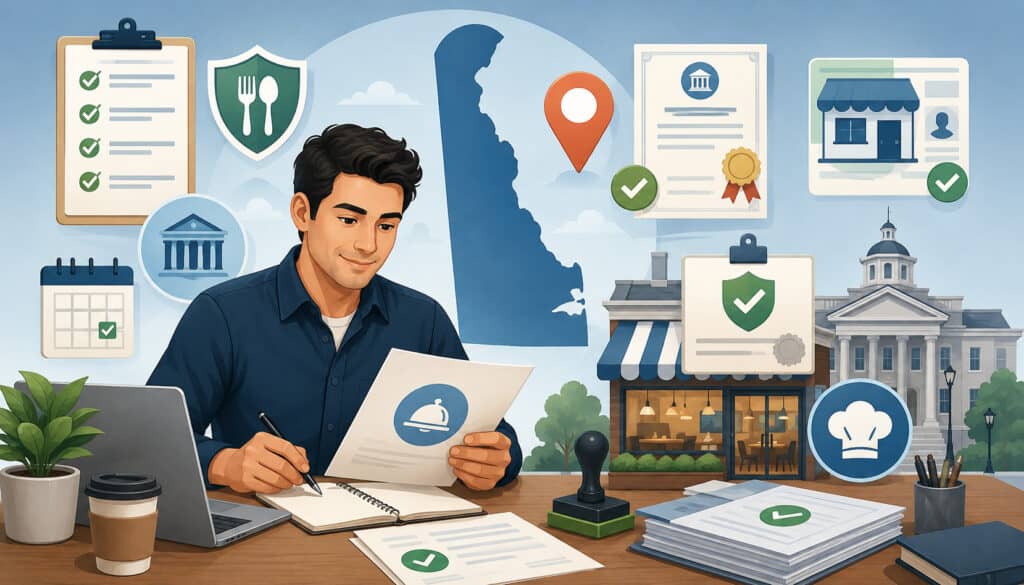
The requirements for opening a takeout restaurant in Delaware can involve several layers. Depending on the property and operating model, the business may need state registration, a business license, food establishment approval, plan review, inspections, local zoning or occupancy approval, fire-related review, signage approval, employer registrations, and other location-specific permissions.
Delaware’s official guidance defines food establishments broadly enough to include operations that prepare, package, serve, or provide food, including takeout and delivery activity. It encourages prospective owners to contact the Office of Food Protection early, particularly before purchasing, constructing, or modifying a facility.
State law also provides that a public eating place must receive sanitary approval and a permit, and plans may need approval before construction, alteration, or conversion work begins.
The exact sequence can depend on the location, prior use, menu, construction scope, equipment, and local jurisdiction. Confirm every requirement directly rather than relying on a generic restaurant checklist.
Review the Main License and Permit Categories
Common categories may include:
- Business formation or trade-name registration
- A Delaware business license
- Food establishment plan review and permit
- Plumbing, building, electrical or mechanical permits
- Zoning and approved-use confirmation
- Certificate of occupancy
- Fire and life-safety approvals
- Signage or exterior alteration permits
- Employer, withholding and unemployment registrations
- Food protection manager requirements where applicable
- Waste, grease, water or sewer-related requirements
- Alcohol licensing if alcohol will be sold
Delaware One Stop states that businesses with a location, employees, or sales activity in Delaware generally need to register with the Division of Revenue for a business license. The portal may also guide employers through related registrations.
A guide to obtaining a Delaware business license for restaurants may help organize the process, but official instructions should remain the final reference.
Verify Requirements Before Committing to a Property
Local requirements can differ between counties, cities, and towns. A building previously used as a restaurant may still need new approvals because of ownership changes, kitchen alterations, equipment replacement, revised customer flow, or a different menu.
Before signing a lease, ask for records related to the property’s approved use, occupancy, utilities, ventilation, grease management, fire systems, plumbing, accessibility, and previous food-service operation. Include appropriate contingencies in the lease review process where professional advisers recommend them.
The state’s food establishment guidance and inspection and plan-review information are useful starting points. The state also warns that its general licensing index may not include every requirement, making direct agency and local review important.
Step Four: Select a Location and Kitchen Format
For a carryout restaurant in Delaware, a large dining room may be less important than kitchen suitability and convenient pickup access. Evaluate the property based on how efficiently employees, customers, vendors, and delivery drivers can use it.
Customers should be able to find the entrance, park safely, collect orders quickly, and leave without blocking traffic. Delivery drivers need clear instructions and a designated waiting or pickup process.
Inside the premises, review utility capacity, ventilation, refrigeration, plumbing, drainage, grease handling, storage, waste removal, employee facilities, receiving access, and space for food preparation. A low rent may not compensate for a property that requires extensive upgrades.
Compare Storefront, Shared and Delivery-Kitchen Options
A storefront gives the restaurant public visibility and direct customer access. It can support walk-in orders, local recognition, branded signage, curbside pickup, and easier customer communication.
However, a storefront may require higher rent, buildout, exterior approvals, and customer-area maintenance. A second-generation food-service space may reduce some construction needs, but every system should still be inspected and reviewed.
A shared commercial or commissary kitchen may lower initial facility costs. It may also provide existing equipment, cleaning infrastructure, and flexible rental arrangements. Limitations can include restricted hours, shared storage, scheduling conflicts, weak customer visibility, and difficulty creating a convenient pickup experience.
A ghost kitchen may suit delivery-heavy demand, but dependence on outside delivery channels can affect margins and customer ownership. The best format is the one that supports the menu, order volume, brand strategy, licensing path, and financial plan.
Make Pickup Access Part of Site Selection
Test the location as a customer would. Visit during lunch, dinner, weekends, and poor weather. Look for parking availability, lighting, traffic congestion, building access, visibility from the road, and the distance between parking and the pickup counter.
Confirm whether curbside service is practical and permitted. A curbside process requires safe stopping areas, clear vehicle identification, reliable customer messaging, and staff who can leave the kitchen without disrupting production.
Review certificate of occupancy considerations for Delaware restaurants before assuming that an existing space can immediately support the intended operation.
Step Five: Design the Menu, Pricing and Packaging
The takeout restaurant menu should be focused enough to support speed, consistency, inventory control, and employee training. Each item should earn its place by meeting customer demand and fitting the available equipment and preparation process.
Avoid adding dishes only because competitors offer them. Every item increases purchasing, storage, preparation, allergen management, employee training, and packaging requirements.
Menu engineering should consider popularity, contribution margin, preparation time, ingredient overlap, travel performance, and waste. Items that sell frequently but generate weak margins may need repricing, portion adjustments, or cost improvements.
Calculate the Full Cost of Every Menu Item
Ingredient cost is only one part of takeout pricing. The price may also need to support labor, packaging, sauces, labels, utensils, payment processing, discounts, rent, utilities, spoilage, platform commissions, and other operating expenses.
Prepare a cost sheet for each item. Use measurable recipes and portion standards rather than estimates such as “a handful” or “one scoop.” Update costs when supplier prices or portions change.
Account for differences between direct pickup and third-party delivery economics. A menu price that works for an order placed directly with the restaurant may not produce the same margin when an outside platform charges additional fees.
Bundles, family meals, drinks, sides, and desserts can improve average order value when they match customer needs. Upsells should remain simple and relevant rather than making the checkout process confusing.
Match Packaging to the Food
Packaging should protect temperature, texture, appearance, portioning, and customer convenience. Different foods require different solutions.
Fried foods may need ventilation to release steam. Soups and sauces need leak-resistant containers. Salads may require cold components and dressings to remain separate. Hot and cold items should not always be packed in the same bag.
Test containers for stacking, transport, condensation, tipping, grease resistance, reheating instructions, and tamper evidence. Evaluate how easily employees can close, label, and store them during a rush.
Packaging inventory should also be standardized where possible. Too many container sizes can create storage problems and packing mistakes. Select versatile containers without compromising food quality.
Step Six: Build Kitchen Workflow, Technology and Payment Systems
A takeout restaurant kitchen setup should move orders through a predictable sequence: order acceptance, preparation, cooking, assembly, verification, packaging, staging, and handoff.
Designate stations for high-volume work and place ingredients, tools, containers, labels, and cleaning supplies where employees use them. The objective is to reduce unnecessary movement while keeping raw food, ready-to-eat food, allergens, clean equipment, and waste appropriately separated.
Ticket times should be based on actual production capacity. Accepting more orders than the kitchen can complete may increase sales briefly, but repeated delays damage reviews and customer trust.
Create a Dedicated Packing and Accuracy Process
Packing should not be treated as the final minor task after cooking. It is a quality-control station with its own procedures, equipment, and staffing requirements.
The packer or expediter should compare the ticket with the completed order and confirm:
- Main items and correct quantities
- Required sides and drinks
- Sauces, dressings and condiments
- Modifications and special instructions
- Labels and customer identification
- Hot and cold separation
- Utensils and napkins where requested
- Allergen-related instructions and controls
- Delivery or pickup destination
Use order numbers or another clear identification method instead of relying only on customer names. Similar names, duplicate orders, and delivery-driver pickups can create confusion.
During high-volume periods, separate cooking and packing responsibilities whenever staffing allows. A cook focused on several active tickets may not be the best final accuracy checker.
Choose Technology That Reduces Manual Work
The technology system may include a point of sale system, online ordering, kitchen displays or printers, payment processing, inventory tools, customer messaging, delivery integrations, and reporting.
Online ordering for takeout restaurants should display accurate descriptions, prices, modifiers, allergen notices, preparation times, availability, and pickup instructions. Customers should receive immediate confirmation and know what to do when they arrive.
Systems should connect orders directly with kitchen production whenever practical. Re-entering digital orders manually increases the risk of mistakes and delays.
Takeout restaurant payment processing may need to support online card payments, contactless transactions, mobile wallets, tips, refunds, receipts, chargeback records, user permissions, and daily reconciliation. Review pricing, security responsibilities, settlement schedules, contract terms, technical support, and integration compatibility.
Step Seven: Plan Pickup, Delivery and Staffing
Customer fulfillment should be fast, secure, and easy to understand. Decide whether customers will collect orders from a staffed counter, designated shelf, service window, curbside area, or another controlled location.
Unattended pickup shelves can reduce waiting, but they may create order security, temperature control, and mistaken-pickup risks. Staffed handoff offers more control but requires labor and can form a queue during peak periods.
Display clear instructions on the website, order confirmation, entrance, parking area, and pickup counter. Customers should know where to go, what information to provide, and how to report a delay or missing item.
Establish Delivery Handoff Controls
Delivery orders require extra verification because the restaurant has less control after the driver leaves. Confirm the driver, order number, number of bags, drinks, and special handling instructions.
Create a staging area that separates delivery orders from customer pickups. Organize it by promised time or order number and avoid placing cold drinks beside hot food.
Track when food is completed, when the driver arrives, and when the order leaves. This information helps distinguish kitchen delays from driver delays and can reveal whether promised preparation times need adjustment.
Set a realistic delivery radius for direct delivery, if offered. Longer distances may reduce food quality, increase labor, complicate scheduling, and create inconsistent arrival times.
Build a Cross-Trained Staffing Plan
Common roles may include prep cook, line cook, packer, expediter, cashier, dishwasher, shift leader, manager, and customer-support employee. A small operation may combine several roles, but responsibilities should still be clearly defined.
Cross-training helps employees respond to unexpected demand and absences. However, employees should not be moved into unfamiliar tasks without appropriate food safety and operational training.
Train the team on order accuracy, preparation standards, packaging, customer communication, refunds, cleaning, food handling, equipment use, rush-period priorities, and incident reporting.
Labor schedules should reflect order patterns rather than using the same staffing level all day. Preparation, receiving, service peaks, cleaning, and closing may each require different coverage.
Step Eight: Create Food Safety, Inventory and Vendor Procedures
Takeout food safety begins when ingredients are received and continues through storage, preparation, cooking, cooling, holding, packaging, transportation, and customer handoff.
The Delaware Office of Food Protection oversees permitting and inspection of food establishments and provides food safety resources for owners, managers, and employees. State inspection guidance emphasizes control of approved food sources, cooking, holding, equipment sanitation, and employee hygiene.
Owners should develop procedures that reflect the menu, equipment, facility, and applicable Food Code. Seek official or qualified professional guidance when determining specific temperature, cooling, allergen, sanitation, or specialized processing requirements.
Document Food Safety and Cleaning Routines
Written procedures help employees perform critical tasks consistently. Depending on the operation, documentation may cover:
- Approved receiving sources and delivery checks
- Refrigerated and frozen storage
- Date marking and product rotation
- Cooking, cooling, reheating and holding
- Handwashing and employee health
- Cleaning and sanitizing
- Chemical storage
- Pest prevention
- Allergen communication and cross-contact controls
- Equipment maintenance
- Waste handling
- Pickup and delivery holding times
Assign responsibility for completing and reviewing logs. A checklist that no one verifies may create paperwork without improving control.
The state’s food safety resources provide official information, forms, inspection materials, and links to additional guidance.
Treat Packaging as Essential Inventory
A restaurant can have enough food to operate and still be unable to serve takeout customers if it runs out of lids, bags, cups, labels, or containers.
Create reorder points for ingredients, beverages, packaging, cleaning chemicals, gloves, receipt paper, labels, and other service supplies. Account for vendor lead times, minimum quantities, storage capacity, and seasonal disruptions.
Track waste by category. Separate spoilage, preparation waste, returned food, overproduction, incorrect orders, and packaging damage. Each type has a different solution.
Vendor management should include approved products, specifications, alternative suppliers, delivery schedules, invoice review, and procedures for shortages or substitutions. A substitute container or ingredient should not be accepted automatically if it changes portioning, allergens, food quality, or cost.
Step Nine: Create a Local Marketing and Review Strategy
Takeout restaurant marketing should help nearby customers understand three things quickly: what the restaurant serves, why the food is worth ordering, and how to collect it.
Build a mobile-friendly restaurant website with the menu, ordering link, hours, address, parking instructions, pickup procedure, contact information, delivery area, and clear food photography.
Maintain accurate local map and business-directory listings. Incorrect hours or an outdated menu can cause lost orders and negative reviews.
Use social media to show finished food, packaging, kitchen preparation, daily availability, pickup instructions, new items, and community involvement. Avoid relying entirely on promotional discounts, which can attract price-sensitive customers without building sustainable demand.
Improve Local Search Visibility
Customers often search using immediate needs such as “takeout near me,” “family dinner,” “lunch pickup,” or a cuisine followed by a city or neighborhood.
Use consistent address, phone, hours, and menu information across the website and major listings. Create pages or content that answer real customer questions, but avoid producing repetitive location pages with little useful information.
Encourage satisfied customers to leave honest reviews without pressuring them or attempting to control the wording. Reviews can improve visibility and provide valuable operational information.
Local partnerships may also support discovery. Consider nearby offices, apartment communities, schools, community organizations, event coordinators, and complementary businesses where appropriate.
Use Reviews to Improve Operations
Review management is not only a marketing function. Repeated complaints can identify weaknesses in food quality, packaging, timing, portioning, order accuracy, pickup instructions, or employee communication.
Categorize feedback and track patterns. One complaint may reflect an isolated mistake, but several similar comments may indicate a system problem.
Respond professionally. Thank the customer, acknowledge the concern, avoid public arguments, and move account-specific details to a private channel when appropriate.
Do not promise changes that the restaurant will not implement. Use feedback to revise procedures, retrain staff, change packaging, adjust preparation times, or clarify menu descriptions.
Step Ten: Track Performance and Grow Carefully
A new restaurant does not need an overly complex reporting system, but it should track enough information to understand whether the concept is working.
Useful takeout restaurant operations metrics include:
- Orders by day and daypart
- Average order value
- Direct versus delivery-platform sales
- Food and packaging costs
- Labor hours and labor cost
- Ticket and pickup times
- Order accuracy and refund rate
- Cancelled or abandoned orders
- Best- and worst-performing items
- Customer review themes
- Repeat-order behavior
- Waste and spoilage
- Contribution margin by channel
Review the numbers in context. A high-volume promotion may produce impressive sales but weak profit after discounts, packaging, labor, and delivery costs.
Soft Launch Before Full Promotion
A soft launch allows the team to test the operation with controlled demand. Invite a limited group, restrict ordering hours, or release a reduced menu before beginning broad promotion.
Evaluate order routing, preparation times, equipment capacity, packaging, payment processing, customer messages, pickup flow, delivery handoffs, and employee communication.
Record problems after each service period. Correct the most serious bottlenecks before increasing volume.
A soft launch is not expected to be perfect, but customers should still receive safe food, accurate orders, and honest communication. Avoid accepting demand that exceeds the team’s ability to perform reliably.
Expand Only After Core Systems Are Stable
Growth opportunities may include catering, corporate lunches, family meals, seasonal menus, direct delivery, loyalty programs, subscriptions, extended hours, or additional locations.
Each opportunity should be tested against kitchen capacity, staffing, storage, packaging, customer demand, and margin. Catering may increase order value but create scheduling and production challenges. Longer hours may generate revenue but weaken labor productivity.
Repeat customers are usually built through reliable food, accurate orders, convenient pickup, and clear communication. Marketing cannot compensate indefinitely for inconsistent execution.
Before expanding, document the operation in a takeout playbook covering recipes, preparation, packing, food safety, customer service, refunds, cleaning, purchasing, inventory, technology, opening, and closing.
Takeout-Only Restaurant Startup Checklist
Use the following checklist during concept development, property review, licensing research, menu testing, technology setup, and launch preparation.
| Checklist Area | Question to Ask | Why It Matters | Priority |
| Concept | Does the concept solve a clear customer need? | Creates focused positioning | High |
| Market | Is there evidence of local demand? | Reduces guesswork | High |
| Property | Is the intended food use allowed? | Prevents site problems | High |
| Pickup | Can customers and drivers collect orders easily? | Improves convenience | High |
| Licensing | Have state and local requirements been verified? | Supports compliant opening | High |
| Kitchen | Does the layout support the menu and volume? | Reduces bottlenecks | High |
| Menu | Do items travel well and produce adequate margin? | Protects quality and finances | High |
| Packaging | Has every container been tested? | Reduces leaks and quality loss | High |
| Technology | Can customers order, pay and receive updates easily? | Supports efficient service | High |
| Staffing | Are roles, schedules and training documented? | Improves consistency | High |
| Food safety | Are procedures established and verified? | Protects customers and operations | High |
| Marketing | Can local customers find and understand the concept? | Supports demand | High |
| Finance | Is working capital available beyond opening day? | Helps manage the ramp-up period | High |
Records to Organize Before Opening
Keep records in secure, clearly labeled digital and physical files. These may include business registrations, licenses, permit correspondence, approved plans, lease documents, equipment records, insurance information, vendor agreements, menu cost sheets, food safety procedures, inspection reports, staff training records, technology contracts, and marketing plans.
Create reminders for renewals, inspections, equipment service, insurance review, vendor agreements, and required training. Assign responsibility to a specific person rather than relying on a shared assumption that someone will remember.
Maintain version control for menus, recipes, cost sheets, operating procedures, and employee documents. Outdated instructions can create inconsistencies when staff members refer to different versions.
Organized records also make it easier to investigate problems, respond to official requests, evaluate performance, and prepare for future expansion.
Common Mistakes and Best Practices
One of the biggest mistakes when starting a takeout restaurant in Delaware is assuming that the absence of a dining room makes the business easy to operate. Takeout reduces some service tasks but increases dependence on technology, packaging, preparation timing, labeling, and order accuracy.
Other common mistakes include choosing a location before confirming requirements, offering an oversized menu, underestimating buildout, ignoring packaging expense, setting unrealistic pickup times, accepting too many delivery orders, and launching without testing.
Avoid underpricing. A low menu price may attract orders while leaving insufficient margin to cover ingredients, packaging, labor, payment processing, occupancy, waste, and delivery expenses.
Test the Entire Customer Journey
Testing should begin when a customer discovers the restaurant, not when the kitchen receives a ticket. Review search listings, the website, menu descriptions, ordering, payment, confirmation, parking, arrival, pickup, packaging, travel, and post-order communication.
Ask testers to complete the process without assistance. Observe where they hesitate or become confused.
Run tests during a simulated rush with multiple orders, modifications, drinks, refunds, and delivery pickups. A process that works with one order may fail when several tickets arrive together.
Use the results to refine menu availability, staffing, ticket times, signage, shelf organization, customer messages, and packaging. Continue testing after launch because order patterns and customer expectations will change.
Create a Takeout Operations Playbook
A written playbook helps employees follow consistent procedures and reduces dependence on verbal instructions. Include:
- Opening and closing routines
- Preparation and recipe standards
- Order acceptance and ticket flow
- Packing and verification procedures
- Pickup, curbside and delivery handoffs
- Food safety and cleaning routines
- Refund and complaint procedures
- Customer message templates
- Inventory and receiving processes
- Equipment shutdown and emergency actions
- Staff roles during peak periods
- Manager review responsibilities
Review the playbook after operational changes, menu updates, equipment replacement, incidents, or recurring customer complaints.
Frequently Asked Questions
How do I open a takeout-only restaurant in Delaware?
Begin by defining the concept, researching local demand, developing a takeout restaurant business plan, and estimating startup and operating costs. Identify potential properties only after establishing the kitchen, utility, pickup, and storage requirements.
Before making a major commitment, verify business registration, food establishment, zoning, building, occupancy, fire, signage, employer, and other applicable requirements. Then finalize the location, kitchen, menu, packaging, technology, payment processing, staffing, food safety procedures, and local marketing plan.
Complete required reviews and inspections before opening. A controlled soft launch can help test the operation before full promotion.
What licenses are needed for a takeout restaurant in Delaware?
The licenses needed for a takeout restaurant in Delaware depend on the location, facility, menu, ownership structure, construction work, and services offered.
Common categories may include a Delaware business license, food establishment permit, plan review, local zoning or use approval, building-related permits, certificate of occupancy, fire approvals, signage approval, employer registrations, and other operation-specific permissions.
A business license does not replace food establishment approval or local requirements. Confirm the complete list with the relevant state agencies and the city, town, or county governing the proposed site.
What are the requirements for opening a takeout restaurant in Delaware?
Requirements may include selecting an approved commercial location, submitting food establishment plans, meeting food safety and sanitation standards, completing required inspections, registering the business, obtaining appropriate licenses, and confirming local building and zoning requirements.
The menu and preparation methods can affect equipment, ventilation, plumbing, refrigeration, storage, and food safety controls. Requirements may also change if the restaurant uses a commissary kitchen, provides delivery, remodels a property, serves alcohol, or operates in multiple jurisdictions. Verify requirements before signing a lease or beginning construction.
Is a takeout-only restaurant cheaper to open than a full-service restaurant?
It can be, particularly when the concept requires less dining space, furniture, tableware, décor, and front-of-house labor. However, lower dining-room costs do not guarantee a low-cost opening.
A takeout restaurant may still require substantial spending on commercial kitchen equipment, ventilation, refrigeration, plumbing, electrical capacity, packaging, ordering technology, payment processing, signage, permits, and working capital.
The condition of the property often has a greater impact on startup costs than the absence of seating. Build a detailed budget based on the actual menu and proposed site.
What menu items work best for a takeout restaurant?
Items that retain temperature, texture, appearance, and portion quality during travel generally perform best. Suitable foods vary widely and may include bowls, sandwiches, baked items, grilled dishes, family meals, salads with separated components, and carefully packaged comfort foods.
Every item should be tested after realistic pickup and delivery times. Evaluate condensation, leakage, sogginess, separation, reheating, and ease of eating. A smaller menu of dependable items is often easier to prepare, cost, package, and train than a large menu with inconsistent travel quality.
Do takeout restaurants need online ordering?
Online ordering is not necessarily the only way to accept orders, but it is central to many takeout concepts. Customers often expect to view the menu, choose modifiers, select a pickup time, pay digitally, and receive confirmation without making a telephone call.
A smooth system can reduce manual entry, improve order clarity, and connect directly with kitchen production. It should also support sold-out items, scheduled orders, refunds, customer messages, and realistic preparation times. Telephone and walk-in orders may still be useful, depending on the customer base and staffing model.
How can a Delaware takeout restaurant attract local customers?
Start with accurate local listings, a clear mobile-friendly website, useful menu information, appealing food photographs, visible pickup instructions, and consistent operating hours.
Use neighborhood partnerships, community involvement, social media, email or text communication where appropriate, and honest review requests. Focus marketing on specific customer needs such as quick lunches, family dinners, convenient pickup, or cuisine-specific demand.
The strongest marketing foundation is reliable execution. Accurate orders, consistent food, suitable packaging, and clear communication encourage repeat business and positive recommendations.
What mistakes should I avoid when starting a takeout restaurant in Delaware?
Avoid signing a lease before confirming that the property can support the intended use. Do not assume that an existing restaurant space automatically meets the needs of a new concept.
Other mistakes include offering food that travels poorly, creating an oversized menu, underestimating packaging and labor, accepting unrealistic order volume, ignoring delivery economics, failing to test pickup flow, and opening without adequate working capital.
Verify official requirements, document procedures, train employees thoroughly, test the complete customer journey, and use actual operating data to improve the business.
Conclusion
Learning how to open a takeout-only restaurant in Delaware requires more than removing tables from a traditional restaurant plan. The business must be designed specifically for off-premise ordering, production, packaging, pickup, and delivery.
A successful planning process begins with a clear concept and evidence of local demand. It continues with a realistic business plan, careful property review, official requirement verification, a focused menu, suitable packaging, efficient kitchen workflow, secure payment processing, and well-trained employees.
Food safety, order accuracy, customer communication, inventory control, and financial discipline remain essential after opening. Owners should track performance, review customer feedback, update cost assumptions, and improve one operating bottleneck at a time.
A takeout-only format can offer flexibility and reduce some dining-room expenses, but it still requires strong systems. By verifying requirements early, testing the concept thoroughly, maintaining organized records, and expanding only after the core operation is stable, an owner can build a practical foundation for long-term growth.