Delaware Health Department Rules for Restaurants
Operating a restaurant involves much more than preparing appealing food and delivering good service. Every food business must also maintain an environment where ingredients are sourced, stored, prepared, cooked, served, and discarded safely.
Delaware Health Department rules for restaurants establish the public health standards that help food establishments control contamination, prevent foodborne illness, maintain sanitary facilities, and prepare for inspections.
These requirements can affect full-service restaurants, cafés, bakeries, takeout businesses, food trucks, ghost kitchens, caterers, commissaries, markets, and temporary food vendors.
The Delaware Division of Public Health, primarily through the Office of Food Protection and environmental health staff, permits and inspects retail food establishments. Delaware defines food establishments broadly to include operations that store, prepare, package, serve, vend, or otherwise provide food for human consumption.
Restaurant operators should not treat health compliance as a task that begins shortly before an inspection. Food safety must influence the restaurant’s menu, kitchen layout, equipment choices, staffing, training, cleaning procedures, and daily management systems.
This guide explains Delaware restaurant health regulations in practical terms. It covers permits, opening requirements, inspections, temperature control, employee hygiene, cleaning, food storage, pest management, mobile operations, recordkeeping, and inspection preparation.
The information is general and educational. Requirements may vary based on the establishment, menu, location, processes, equipment, and customers served. Operators should verify their responsibilities through the Delaware Office of Food Protection inspection and permitting page and consult qualified professionals when necessary.
What Are Delaware Health Department Rules for Restaurants?
Delaware Health Department rules for restaurants are the standards that govern how food establishments are designed, permitted, operated, cleaned, and inspected. Their purpose is to safeguard public health, reduce foodborne illness risks, and ensure that food is safe, unadulterated, and honestly presented.
The Delaware regulatory framework incorporates the FDA Food Code with state-specific amendments. The rules address food sources, employee health, personal hygiene, food temperatures, contamination prevention, equipment, plumbing, waste handling, physical facilities, permits, inspections, and enforcement.
Operators should consult the current State of Delaware Food Code regulations, because general industry guidance does not replace the requirements applied to a particular establishment.
These rules apply throughout the food flow. That includes receiving deliveries, refrigerating ingredients, thawing meat, preparing produce, cooking menu items, cooling leftovers, reheating food, holding meals for service, packaging takeout orders, washing utensils, and disposing of waste.
Why Restaurant Health Rules Matter
Food safety problems are not limited to obviously spoiled food. Illness can result when food comes from an unsafe source, is undercooked, is held at an unsafe temperature, touches contaminated equipment, or is handled by an employee who does not follow hygiene and illness-reporting procedures.
Delaware’s inspection program focuses on active managerial control. This means management should identify food safety risks before they cause an incident and use defined procedures, monitoring, training, and corrective action to control them. Delaware specifically highlights unsafe sources, inadequate cooking, improper holding, contaminated equipment, and poor personal hygiene as important risk areas.
Effective health procedures also support consistent operations. When storage areas are organized, thermometers are available, hand sinks remain accessible, and employees understand their responsibilities, the restaurant is better positioned to handle busy service periods safely.
A strong system reduces dependence on memory. Employees follow the same procedures even when the manager is occupied, a new worker joins the team, or service volume unexpectedly increases.
Who Needs to Understand These Rules?
Responsibility for restaurant health compliance does not belong to one person alone. Owners and managers establish policies, purchase suitable equipment, schedule maintenance, approve suppliers, organize training, and correct recurring problems.
Chefs, cooks, prep workers, servers, bartenders, dishwashers, cashiers, delivery staff, and cleaning teams also affect food safety. A server may answer an allergen question, a dishwasher may test sanitizer, a cook may cool a large batch of food, and a receiving employee may decide whether to accept a questionable delivery.
Food truck operators, caterers, temporary vendors, and ghost kitchen teams need training that reflects their operating conditions. Limited space, off-site transportation, shared kitchens, outdoor service, and changing event locations can introduce risks that are less common in a conventional restaurant.
The person in charge must understand the operation well enough to recognize unsafe practices and take corrective action. Delaware generally requires permitted establishments to have at least one employee who is a Certified Food Protection Manager, with the person in charge at the time of inspection meeting that expectation unless an approved variance applies.
Delaware Restaurant Health Rules at a Glance
The following table summarizes major Delaware restaurant health requirements. It is a planning tool rather than a substitute for the Food Code, permit instructions, approved plans, or inspector guidance.
| Rule Area | What It Covers | Why It Matters | Priority |
| Food establishment permit | Approval to operate the food business | Operating without required approval can result in closure | High |
| Plan review | Layout, equipment, sinks, plumbing and food flow | Identifies problems before construction or remodeling | High |
| Health inspection | Review of food practices and facility conditions | Confirms ongoing compliance and identifies corrections | High |
| Temperature control | Cooking, cooling, reheating and holding | Limits pathogen survival and growth | High |
| Handwashing | Accessible sinks, supplies and correct use | Reduces contamination from employees’ hands | High |
| Employee illness | Reporting, restriction and exclusion procedures | Prevents sick workers from contaminating food | High |
| Cleaning and sanitizing | Food-contact surfaces, utensils and equipment | Removes soil and reduces harmful microorganisms | High |
| Food storage | Separation, labeling, date marking and protection | Controls contamination and inventory risks | High |
| Pest control | Prevention, monitoring and corrective action | Protects food and physical facilities | High |
| Equipment and plumbing | Refrigeration, sinks, water, drainage and ventilation | Supports safe and sanitary operations | High |
| Recordkeeping | Permits, logs, training and corrective actions | Demonstrates consistent management controls | Medium/High |
Delaware restaurant compliance requirements may be enforced through routine inspections, complaint investigations, follow-up visits, permit actions, and other procedures. State law also allows food preparation areas to be inspected without advance notice.
How to Use the Table
Restaurant owners can turn the table into an opening, training, and inspection-readiness checklist. Begin by identifying who is responsible for each area. For example, the general manager may oversee permits and employee illness reporting, while a kitchen manager monitors temperatures and a closing supervisor verifies cleaning.
Next, translate each category into observable tasks. “Maintain temperature control” is too broad for an employee checklist. More useful instructions include checking walk-in temperatures at opening, measuring cooked food with a calibrated thermometer, recording cooling progress, and verifying hot-holding equipment before service.
The table can also help managers prioritize corrective action. A loose storage shelf and an inaccessible handwashing sink may both require attention, but the blocked sink creates a more immediate food safety concern.
Review the table after menu changes, equipment replacement, remodeling, or expansion. A new reduced-oxygen packaging process, sushi program, catering service, or large-batch cooling procedure may introduce requirements that were not relevant to the previous operation.
Why Requirements Vary by Food Business Type
A small shop selling commercially packaged, shelf-stable products does not present the same risks as a restaurant that prepares raw poultry, cools sauces, reheats food, and serves a highly susceptible population. Inspection schedules and operational expectations can therefore reflect the establishment’s risk level and processes.
Delaware’s current regulations recognize very-low-risk, low-risk, medium-risk, and high-risk establishments. Risk can be influenced by factors such as the number of preparation steps, handling of time-and-temperature-controlled food, cooling, reheating, holding, and the population served.
Mobile units may need an approved servicing area or commissary arrangement. Caterers must plan for transportation and off-site holding. Temporary vendors must work within event-specific limitations. Ghost kitchens may share infrastructure but still need clearly defined storage, preparation, cleaning, and permit responsibilities.
Operators should describe their actual menu and processes accurately. A permit application for a simple café may no longer reflect the operation if the business later adds raw seafood, cook-chill production, vacuum packaging, or off-site catering.
Food Establishment Permits and Opening Requirements

Delaware law generally prohibits operating a public eating place until sanitary facilities have been approved and the required permit has been issued. Plans and specifications may also need approval before a building is constructed, altered, enlarged, reconstructed, or converted for use as a public eating place.
Operators should contact the Office of Food Protection early—ideally before purchasing a property, signing an inflexible lease, ordering equipment, or beginning construction. Delaware’s business guidance specifically encourages early contact before purchasing, constructing, or modifying a food establishment to reduce preventable delays and costs.
Restaurant approval is usually only one part of the opening process. Business licensing, zoning, building, fire, occupancy, plumbing, wastewater, signage, and alcohol-related approvals may also apply. The Delaware restaurant business licensing process can help operators understand how these approval areas fit together.
When to Review Permit and Plan Requirements
Review Delaware food service permit requirements before finalizing the menu or kitchen design. The menu determines what equipment, storage, sinks, ventilation, preparation space, and food safety procedures the operation needs.
A restaurant cooking raw proteins and cooling large batches may require more refrigeration, preparation space, and monitoring capacity than a bakery receiving finished products. Adding a bar, outdoor service area, mobile unit, catering program, or shared commissary may also affect the approval path.
Delaware’s regulations require applications to be submitted sufficiently in advance to allow review and approval. The regulatory authority may request additional information and issue approval-to-construct documentation during the process.
Operators should also review the food service permits required in Delaware and confirm details directly with the responsible agencies. A general guide can identify likely steps, but only the regulator can determine what applies to a specific menu, property, and operating model.
Facility Readiness Before Opening
Before an opening inspection, the facility should be complete enough to demonstrate safe operation. Refrigerators, freezers, hot-holding units, cooking equipment, dish machines, sinks, water systems, lighting, ventilation, and waste areas should be installed, operational, and clean.
Handwashing sinks must be accessible and supplied. Food-contact surfaces should be smooth, durable, and cleanable. Thermometers, sanitizer, test strips, labels, storage containers, cleaning tools, and employee hygiene supplies should be available.
The facility must support the menu under realistic conditions. A refrigerator that holds safe temperatures when empty may struggle during delivery day. A three-compartment sink may be correctly installed but unusable if large utensils do not fit. Storage may appear sufficient before opening but become unsafe when packaging, beverages, chemicals, and employee belongings arrive.
Health approval is also distinct from occupancy approval. Operators should understand how a certificate of occupancy for Delaware restaurants interacts with food establishment readiness, building safety, plumbing, and fire requirements.
Delaware Restaurant Health Inspections Explained
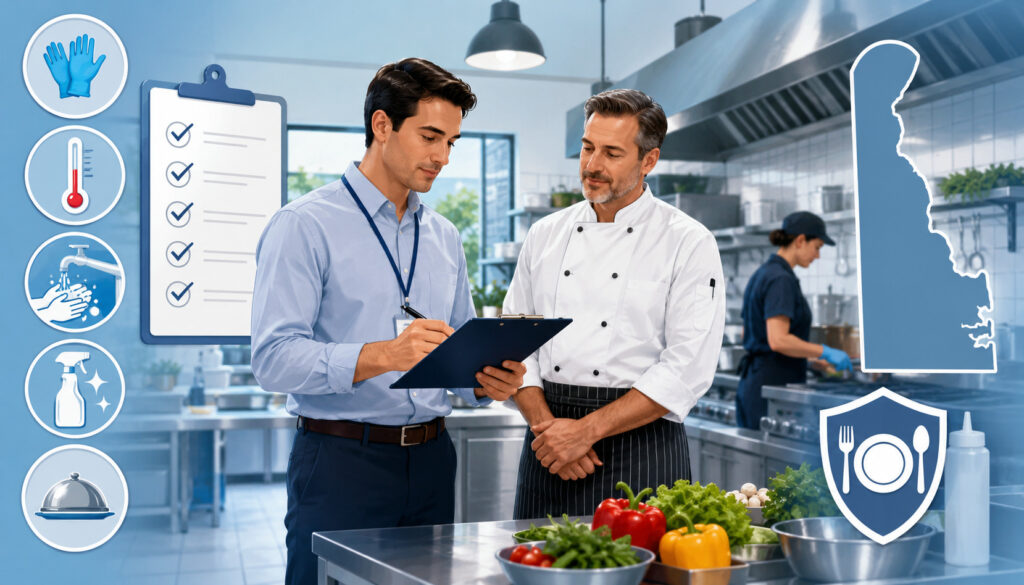
Delaware restaurant health inspections evaluate whether the establishment is operating in accordance with the Food Code and approved permit conditions. Inspectors may observe food handling, measure temperatures, examine equipment, review storage, assess employee hygiene, test sanitation controls, and discuss procedures with the person in charge.
An inspection is not limited to visible cleanliness. A kitchen can look orderly while still having unsafe cooling, inadequate date marking, incorrect sanitizer concentration, poor illness reporting, or cross-contamination risks.
Inspection frequency may vary according to the establishment’s risk category and regulatory schedule. Visits may include routine inspections, follow-up inspections, preoperational reviews, complaint investigations, or inspections connected to permit changes. Delaware maintains a public database containing recent food establishment inspection reports.
What Inspectors May Look For
Inspectors commonly evaluate whether food comes from approved sources and whether deliveries are wholesome, correctly labeled, and maintained at safe temperatures. They may observe raw food storage, thawing, preparation, cooking, cooling, reheating, hot holding, cold holding, and service.
Employee practices are another major focus. Inspectors may check whether staff wash their hands at required times, use gloves and utensils appropriately, keep personal items away from food, restrain hair, and report relevant illness symptoms.
Facility observations may include sanitizer concentration, wiping-cloth storage, cutting boards, ice machines, dishwashing equipment, plumbing, drains, restrooms, lighting, waste containers, pest evidence, and damaged surfaces.
The person in charge may be asked to explain procedures. An inspector may ask how soup is cooled, what happens when an employee reports vomiting, how thermometers are calibrated, or how allergen requests are handled. A confident answer should be supported by actual practice and records rather than a procedure created during the inspection.
How to Prepare for Inspections
The most effective inspection preparation is a daily management system. Opening checks should verify refrigeration, hand sinks, food storage, employee readiness, sanitizer, and facility condition. Shift checks should cover holding temperatures, cross-contamination, wiping cloths, and cleaning. Closing checks should address cooling, labeling, waste, warewashing, and equipment shutdown.
Managers should periodically walk through the establishment from the inspector’s perspective. Look under equipment, inside ice machines, around door seals, behind storage racks, above preparation areas, and inside rarely used cabinets.
Keep current permits, previous inspection reports, temperature logs, training records, pest-control reports, cleaning schedules, and maintenance documentation organized. Records should be easy to retrieve and should reflect real monitoring.
When an inspector identifies a problem, remain cooperative, ask clarifying questions, and correct the issue promptly when possible. Document the corrective action and determine why the condition occurred so it does not become a repeat violation.
Food Safety and Time-and-Temperature Control
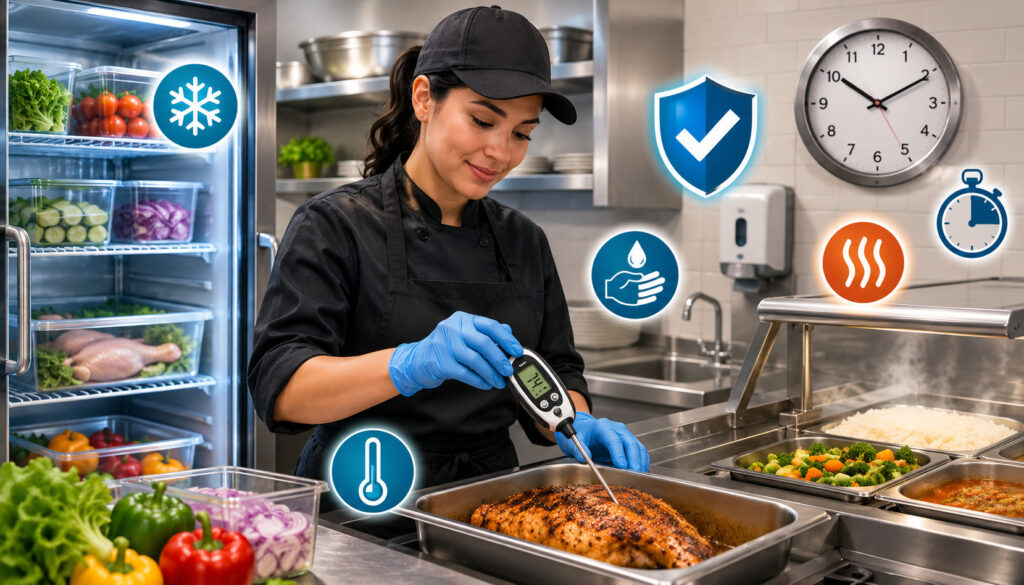
Food safety requirements for Delaware restaurants cover the entire journey from an approved supplier to the customer. Controls should be built into purchasing, receiving, storage, preparation, cooking, cooling, reheating, holding, packaging, transportation, and disposal.
The FDA Food Code provides the scientific model used by Delaware, with state amendments. Operators should verify exact requirements for their menu, especially when using specialized processes such as reduced-oxygen packaging, curing, smoking for preservation, acidification, sous vide preparation, or custom processing.
Time-and-temperature-controlled food requires particular attention because pathogens may grow when food remains too long within unsafe temperature ranges. Thermometers, suitable equipment, written procedures, employee training, and verification logs work together to reduce this risk.
Practical Temperature Control Standards
Cold food that requires temperature control is generally maintained at 41°F or below, while hot-held food is generally maintained at 135°F or above. Cooking temperatures depend on the food. Poultry commonly requires 165°F, while ground meats and intact cuts have different temperature-and-time combinations.
Cooked time-and-temperature-controlled food generally must cool from 135°F to 70°F within two hours and then reach 41°F or below within a total of six hours. Food reheated for hot holding generally must reach 165°F within two hours. Operators should verify the precise standard applicable to each product and process under the Food Code.
Use thin portions, shallow pans, ice baths, blast chilling, rapid-cooling equipment, or other approved methods rather than placing a large hot container directly into an overloaded cooler. Stirring, venting, portioning, and monitoring may also be necessary.
Check temperatures with a properly calibrated food thermometer. Equipment displays are useful, but they do not confirm the internal temperature of every food item.
Food Safety Before, During, and After Service
Food safety begins during receiving. Employees should examine delivery temperatures, packaging condition, expiration information, signs of thawing, contamination, pest damage, and evidence that food came from an approved source.
During preparation, keep raw animal food separate from produce and ready-to-eat items. Use clean utensils, sanitized surfaces, and properly stored ingredients. Prepare manageable quantities so food does not remain out of temperature control longer than necessary.
During service, monitor hot and cold holding units, replace contaminated utensils, protect food from customers, and avoid topping off old food with new food unless the procedure is permitted and safe.
After service, cool food promptly, label containers, store items correctly, clean and sanitize food-contact surfaces, and discard food that cannot be shown to have remained safe. Employees should never guess about food with an unknown time or temperature history.
CDC research emphasizes that time pressure, inadequate equipment, poor staffing, and inaccessible supplies can make safe food preparation more difficult. Managers should address these operational barriers rather than relying only on reminders.
Cross-Contamination, Handwashing, and Employee Hygiene
Cross-contamination occurs when harmful microorganisms or other hazards move from one food, surface, utensil, employee, or piece of equipment to another. Common examples include raw poultry dripping onto ready-to-eat food, an employee using the same cutting board for raw meat and salad ingredients, or a contaminated wiping cloth spreading germs across preparation tables.
Prevention requires separation, cleaning, sanitizing, handwashing, correct glove use, protected storage, and clear work procedures. CDC outbreak guidance identifies contaminated hands, equipment, utensils, cutting boards, and raw food contact as important routes through which pathogens can reach ready-to-eat food.
Raw and Ready-to-Eat Food Separation
Store raw animal foods below ready-to-eat foods and organize them according to required cooking temperatures. Use covered containers and prevent raw juices from leaking or dripping.
Whenever practical, assign separate preparation areas, utensils, or color-coded cutting boards to raw proteins, produce, allergens, and ready-to-eat food. Color coding is helpful only when employees understand the system and tools are cleaned correctly.
Clean and sanitize surfaces after raw food preparation and before ready-to-eat food is introduced. Remember that equipment handles, refrigerator doors, faucet controls, seasoning containers, and aprons can also transfer contamination.
Do not wash raw poultry in a preparation sink unless an approved procedure prevents splash contamination. Washing does not reliably remove pathogens and can spread contaminated droplets to nearby surfaces.
Workflow matters. Scheduling raw preparation before a complete cleaning and sanitizing step may be safer than switching repeatedly between raw and ready-to-eat tasks during a busy service period.
Handwashing and Glove Use
Handwashing sinks must remain accessible. They should not be blocked by boxes, used for dumping beverages, filled with utensils, or treated as general-purpose sinks. Soap, appropriate hand-drying supplies, and required signage should be present.
Employees should wash their hands before beginning food preparation and after activities that can contaminate them, including handling raw animal food, touching the face or body, using the restroom, handling dirty equipment, removing gloves, eating, drinking, taking out trash, or returning from a break.
Follow the complete handwashing procedure rather than briefly rinsing fingertips. Gloves do not replace handwashing. Hands should be washed before putting on gloves, and gloves should be changed when torn, contaminated, interrupted by another task, or used with raw food before handling ready-to-eat food.
CDC studies found that sink accessibility, adequate supplies, training, workload, and management emphasis influence whether restaurant workers wash their hands when needed.
Employee Illness and Food Protection Management
Employees experiencing certain symptoms or diagnoses can contaminate food, utensils, equipment, and surfaces. Restaurants therefore need a written illness-reporting policy that explains what workers must report, whom they should contact, and when work restrictions or exclusions apply.
Managers should review official employee-health requirements rather than creating their own symptom list. Vomiting, diarrhea, jaundice, sore throat with fever, infected wounds, and specified diagnoses or exposures may require management action depending on the circumstances.
Delaware provides employee health controls and reporting resources through its food protection program. CDC also advises restaurants to create strong written sick-worker policies and to ensure managers actively assess whether an employee can work safely.
Building an Effective Illness Policy
Give employees the illness policy during onboarding and review it regularly. Workers should know they will not be expected to decide alone whether their symptoms are relevant.
The policy should identify the manager or backup contact who receives reports. It should address what happens outside normal office hours and how the restaurant handles an employee who becomes ill during a shift.
Managers must respond consistently and maintain appropriate confidentiality. The purpose is to protect food and customers, not to diagnose the employee. When uncertain, consult the official employee-health guidance or regulatory authority.
Plan staffing so employees are not pressured to work while experiencing reportable symptoms. Cross-training and backup scheduling can reduce the operational pressure that encourages sick workers to remain on duty.
Document policy acknowledgments and manager training. Records help confirm that employees received the information before an incident occurred.
Certified Food Protection Manager and Person-in-Charge Duties
A Certified Food Protection Manager should be able to demonstrate knowledge of personal hygiene, contamination prevention, time and temperature control, receiving, storage, food safety systems, and corrective action. Delaware’s requirement is designed to place food safety knowledge within the operation rather than relying entirely on inspections.
The person in charge should actively supervise food operations. Duties may include confirming employee health, checking temperatures, monitoring handwashing, verifying sanitizer, reviewing receiving, responding to equipment failures, and correcting unsafe behavior.
Certification alone is not enough. A certificate displayed in an office has little value when managers do not apply the knowledge to daily decisions.
Restaurants should develop more than one knowledgeable manager whenever possible. Vacations, turnover, illness, and shift coverage can otherwise leave the establishment without adequate food safety leadership.
Managers should also know which processes require regulatory approval, a variance, or a HACCP plan. Specialized processes should never be introduced informally because a chef has used them elsewhere.
Cleaning, Sanitizing, and Warewashing Requirements
Cleaning and sanitizing are related but different. Cleaning removes food residue, grease, dirt, and other visible soil. Sanitizing follows effective cleaning and reduces microorganisms on a food-contact surface to safer levels.
A surface cannot be sanitized effectively when grease or food residue remains. Employees should therefore follow the correct sequence using appropriate detergent, rinsing, sanitizer, contact time, and air drying.
Restaurant sanitation requirements Delaware operators must address include preparation tables, cutting boards, slicers, mixers, beverage nozzles, ice machines, utensils, storage containers, sinks, dish machines, and other food-contact equipment.
Creating a Cleaning and Sanitizing System
Develop schedules that specify what must be cleaned, how it is cleaned, which chemical is used, how often the task occurs, and who verifies completion. Separate opening, during-service, closing, weekly, and deep-cleaning tasks.
High-touch areas such as refrigerator handles, faucet controls, touchscreens, and equipment switches need attention because employees may touch them between food-handling activities.
Sanitizer must be prepared and used according to the product label and Food Code requirements. Employees should use suitable test strips or testing devices rather than estimating concentration from color or smell.
Store chemicals in labeled containers away from food, utensils, single-service items, and preparation areas. Never place a chemical in an unlabeled beverage bottle or food container.
Clean-in-place equipment should have documented procedures. Slicers, beverage systems, ice machines, and complex equipment may require disassembly at defined intervals to reach hidden food-contact areas.
Warewashing and Dish Machine Monitoring
Manual warewashing commonly follows a wash, rinse, sanitize, and air-dry sequence. Sink compartments should be clean before use, and employees should scrape or pre-rinse items as appropriate.
The wash solution must remain effective, the rinse step must remove detergent, and the sanitizer step must meet required concentration or temperature conditions. Items should air dry completely rather than being towel dried.
Dish machines must be operated according to their design and manufacturer instructions. Staff should monitor wash conditions, final rinse or sanitizer performance, chemical supply, spray arms, curtains, screens, and general cleanliness.
Clean utensils should be stored where splash, dust, pests, dirty hands, and raw food cannot contaminate them. Do not stack wet containers in a way that traps moisture.
The warewashing area should not create cross-contamination. Dirty dish traffic and clean utensil storage should be separated as much as the facility allows.
Food Storage, Labeling, and Allergen Awareness
Proper storage protects food from contamination, deterioration, and misuse. Dry goods should be kept in clean, dry areas and protected from leaks, pests, chemicals, and floor contamination.
Refrigerated and frozen food should be organized so air can circulate and raw animal products cannot contaminate ready-to-eat food. Containers should be food grade, covered where required, and easy to identify.
Chemical products, employee belongings, maintenance tools, and personal food should be stored in designated areas away from restaurant ingredients and service items.
Labeling, Date Marking, and Stock Rotation
Labels help employees identify the product, preparation date, opening date, discard date, allergen concern, or special handling requirement. The exact information depends on the food and operation.
Ready-to-eat time-and-temperature-controlled food prepared and held for more than 24 hours generally requires date marking. Under the Food Code model, qualifying food held at 41°F or below is commonly limited to seven days, with the preparation day counted as day one. Operators should verify application to individual products and approved procedures.
Use a consistent first-in, first-out system. Place newer products behind older usable stock and check date marks during opening and closing inspections.
Never rely solely on appearance or smell to determine safety. Food may contain harmful microorganisms without visible spoilage.
Labels should remain readable under refrigeration, freezing, moisture, and handling conditions. Train employees not to transfer food into an unlabeled container “temporarily,” because temporary containers often remain in use longer than intended.
Allergen Communication and Cross-Contact
Employees should never guess when a customer asks about an allergen. They must know how to review ingredient information, involve a manager, and communicate limitations honestly.
Allergen cross-contact can occur through shared fryers, grills, utensils, gloves, cutting boards, storage containers, preparation surfaces, garnishes, or airborne powders. Cleaning that controls microorganisms may not always remove allergenic proteins effectively.
Create a procedure for receiving an allergen request, confirming ingredients, notifying the kitchen, preparing the order, identifying the finished meal, and delivering it to the correct customer.
Store ingredient labels and product specifications where managers can access them. Recheck information when suppliers or recipes change.
FDA research emphasizes the importance of effective surface cleaning in reducing allergen transfer. However, a restaurant should not promise an allergen-free meal unless it can reliably control every relevant source of cross-contact.
Pest Control, Water, Waste, and Commercial Kitchen Equipment
Food establishments must maintain physical conditions that support sanitation. Even strong employee practices can be undermined by leaking plumbing, failed refrigeration, pest entry points, damaged surfaces, inadequate hot water, or poorly managed waste.
Preventive maintenance should be part of Delaware restaurant health requirements, not a reaction after equipment fails. Managers should maintain a repair log and identify temporary food safety controls when a problem cannot be corrected immediately.
Pest, Water, Plumbing, and Waste Controls
Pest prevention begins by removing food, moisture, shelter, and entry points. Keep doors closed or protected, seal gaps, maintain screens, clean drains, rotate stock, and remove waste regularly.
Inspect deliveries for insects or rodent damage before products enter storage. Keep food off the floor and leave enough access around storage racks for cleaning and inspection.
Use an appropriately qualified pest-control service when needed, and retain service reports and corrective-action documentation. Pesticides must be stored and used safely.
Potable water, sufficient hot water, functioning hand sinks, proper drainage, and approved sewage disposal are essential. Plumbing problems that create backups, cross-connections, or unavailable water may represent an immediate health concern.
Trash containers should be covered as required, cleaned, and located to reduce odor and pest attraction. Grease, cardboard, food waste, and outdoor storage areas need regular attention.
Equipment and Facility Maintenance
Commercial refrigeration should maintain required temperatures under actual operating loads. Check door gaskets, condensation, airflow, shelving, drain lines, and thermometer placement.
Food-contact equipment should be durable, smooth, nonabsorbent where required, and accessible for cleaning. Cracked cutting boards, chipped containers, corroded shelving, damaged seals, and deeply scored surfaces can retain soil and microorganisms.
Delaware’s state amendments generally require a dedicated food-preparation sink, while allowing the regulatory authority to recognize limited exceptions for certain minimal-risk operations or operations receiving prewashed and prepared foods from a commissary.
Ventilation should control heat, steam, grease, smoke, and condensation without creating contamination. Lighting should allow employees to clean, inspect food, read thermometers, and identify pests.
Maintain thermometer calibration records, refrigeration service reports, hood cleaning documentation, dish machine maintenance, and repair notes where relevant.
Mobile Food Units, Temporary Events, and Catering
Mobile and temporary operations follow the same basic food safety principles as brick-and-mortar restaurants, but they must apply them in limited spaces and changing environments.
Food trucks need adequate handwashing, potable water, wastewater storage, refrigeration, hot holding, food protection, utensil cleaning, power, ventilation, and waste capacity. The menu should be realistic for the equipment and available workspace.
Delaware’s regulations classify mobile food establishments and certain catering arrangements as alternative food establishments. A signed servicing-area agreement may be required so the operation has approved support for preparation, storage, cleaning, water, wastewater, or restocking.
Mobile Units and Commissary Kitchens
A commissary or servicing area should complement the mobile operation rather than exist only on paper. The agreement should reflect where food is prepared, equipment is washed, water is obtained, waste is discharged, supplies are stored, and the unit is serviced.
Mobile operators should document their routine for returning to the servicing area. Food, utensils, wastewater, and cleaning supplies should not be handled at an unapproved home or location.
Plan for equipment failure. A generator problem, low water supply, full wastewater tank, or refrigerator failure can make continued operation unsafe.
Protect service openings and exterior areas from dust, insects, customers, and weather. Keep raw materials and packaging off the floor and secure items during movement.
The menu should minimize unnecessary complexity. Each additional cooking, cooling, or assembly step consumes space and increases the chance of cross-contamination or temperature loss.
Temporary Events and Off-Site Catering
Temporary food establishment applications generally must be submitted at least 10 days before an event. Delaware’s minimum requirements also call for an informed person in charge, approved food sources, and preparation either on-site or at a permitted food establishment.
Event planning should address handwashing, sanitizer, potable water, waste, weather protection, food transport, cooking, hot holding, cold holding, lighting, power, and backup equipment.
Caterers must maintain safe temperatures during loading, transportation, setup, service, and return. Use insulated equipment or powered holding units suitable for the duration and conditions.
Outdoor heat, cold, wind, rain, and uneven ground can change how equipment performs. Build weather contingencies into the event plan.
Limit the menu when infrastructure is constrained. A smaller menu that can be handled safely is preferable to a complex menu that exceeds the available refrigeration, cooking, handwashing, or service capacity.
Restaurant Health Inspection Checklist and Records
A restaurant inspection checklist Delaware operators use should focus on observable conditions and actions. It should not be so long that managers stop using it or so general that unsafe practices remain hidden.
| Inspection Area | What to Check | Why It Matters | Priority |
| Permits | Current, valid and accessible | Confirms authorization to operate | High |
| Person in charge | Knowledgeable and available | Supports active managerial control | High |
| Employee health | Reporting policy followed | Reduces contamination from illness | High |
| Handwashing | Sinks accessible and stocked | Prevents hand contamination | High |
| Temperatures | Cooking, cooling and holding verified | Controls pathogen growth and survival | High |
| Food storage | Covered, separated and off floor | Protects ingredients | High |
| Date marking | Labels accurate and readable | Controls ready-to-eat food storage | High |
| Sanitizer | Correct concentration and test method | Supports effective sanitizing | High |
| Warewashing | Correct sequence and air drying | Protects utensils and equipment | High |
| Pest control | No evidence or entry conditions | Protects food and facility | High |
| Equipment | Clean, working and maintained | Supports safe preparation | High |
| Waste | Trash, grease and cardboard controlled | Reduces sanitation and pest problems | Medium/High |
| Records | Logs and corrective actions current | Demonstrates management control | Medium/High |
Common Problems and Corrective Action
Common inspection problems include blocked hand sinks, missing soap or towels, unsafe holding temperatures, incomplete date marking, food stored on the floor, raw food above ready-to-eat products, weak sanitizer, dirty equipment, pest evidence, missing thermometers, chemical storage near food, and employees using gloves incorrectly.
Many problems develop through routine shortcuts. A box is placed in front of a sink during delivery, an unlabeled pan is left for the next shift, or a cooler temperature is ignored because service is busy.
Corrective action should address both the immediate condition and its cause. Move the box, then change the receiving procedure. Discard unsafe food, then repair the cooler and strengthen temperature monitoring.
Record what happened, what was corrected, who completed the action, and what will prevent recurrence. Repeat violations may indicate that the restaurant’s training, supervision, equipment, staffing, or written procedure is inadequate.
Records, Training, and Standard Operating Procedures
Useful records may include permits, inspection reports, temperature logs, cooling records, sanitizer checks, pest-control reports, employee training, illness-policy acknowledgments, maintenance reports, supplier information, and corrective-action notes.
Not every routine task requires a complicated form. Records should focus on meaningful safety controls and should be reviewed by management. A log that nobody checks can document a recurring problem without correcting it.
Develop standard operating procedures for receiving, storage, thawing, preparation, cooking, cooling, reheating, holding, cleaning, allergen requests, employee illness, pest reporting, and closing.
Train new employees before they work independently. Demonstrate the task, observe the employee performing it, correct mistakes, and document completion.
Repeat training after inspection findings, menu changes, equipment replacement, or recurring errors. Managers should review procedures monthly and compare them with actual kitchen practices.
Best Practices for Ongoing Delaware Restaurant Compliance
The strongest food safety programs connect regulatory expectations to everyday restaurant operations. Health compliance influences purchasing, staffing, menu planning, prep schedules, equipment capacity, delivery timing, and labor allocation.
Use the following practices to support consistent compliance:
- Verify requirements through current Delaware public health resources.
- Keep permits and inspection records organized.
- Train staff before they handle food independently.
- Maintain accessible, fully stocked handwashing sinks.
- Check hot and cold holding temperatures throughout service.
- Use calibrated thermometers.
- Separate raw food from ready-to-eat food.
- Label and date-mark food consistently.
- Clean and sanitize food-contact surfaces at required intervals.
- Store food, chemicals, and personal belongings correctly.
- Review employee illness procedures regularly.
- Maintain refrigeration, ventilation, plumbing, and dishwashing equipment.
- Document corrective actions and recurring problems.
- Prepare for inspections every day.
Permit responsibilities also continue after opening. Calendar renewal dates and review the restaurant permit renewal process before deadlines approach.
Build a Food Safety Culture
A food safety culture exists when employees understand that safety procedures are part of their jobs, not optional tasks added when time permits.
Managers create that culture through their own behavior. When leaders wash their hands, use thermometers, correct unsafe practices, and provide adequate supplies, employees see that food safety is a genuine priority.
Avoid rewarding speed at the expense of safe procedures. If employees are expected to complete an unrealistic amount of preparation, they may skip cooling steps, reuse gloves, block sinks, or delay cleaning.
Recognize employees who identify a malfunction, reject an unsafe delivery, report illness, or stop service to correct a food safety issue. Reporting problems should lead to action rather than blame.
Food safety also affects customer trust. Consistent cleanliness, knowledgeable staff, careful allergen communication, and reliable food quality contribute to a professional dining experience.
Review Health Procedures Regularly
Conduct a structured internal review each month. Examine temperature records, sanitizer checks, cleaning schedules, training documentation, equipment repairs, pest reports, and inspection findings.
Look for patterns rather than isolated marks. Repeatedly high cooler temperatures during delivery hours may indicate overloading or a damaged door. Repeated missing date marks on one shift may indicate inadequate supervision.
Review the menu whenever equipment, volume, or staffing changes. The process approved at opening may no longer match a restaurant that has added catering, delivery, new proteins, or large-batch preparation.
Periodically consult the CDC restaurant food safety resources and official Delaware materials for training support. National guidance can help explain why controls matter, while Delaware sources identify the requirements applied locally.
Frequently Asked Questions
What are Delaware Health Department rules for restaurants?
They are the food safety, sanitation, facility, permitting, inspection, and management requirements that apply to food establishments regulated by the Delaware Division of Public Health.
The rules cover approved food sources, employee health, handwashing, temperature control, contamination prevention, cleaning, sanitizing, equipment, water, plumbing, waste, physical facilities, and operational records.
The requirements come primarily from the State of Delaware Food Code and related laws, permit conditions, approved plans, and agency procedures. Operators should use the current official materials rather than relying on an old checklist or another state’s rules.
What health requirements should a restaurant review before opening?
An operator should review food establishment permitting, plan review, kitchen layout, handwashing sinks, food-preparation sinks, refrigeration, hot holding, warewashing, plumbing, ventilation, storage, waste handling, pest prevention, employee health, manager certification, and inspection procedures.
The menu and facility must match. A restaurant that cooks, cools, reheats, or transports food needs enough equipment and workspace to complete those processes safely. Contact the Office of Food Protection before construction, remodeling, equipment purchases, or major menu commitments.
What happens during a Delaware restaurant health inspection?
An inspector may observe employee practices, measure food temperatures, examine storage, check sanitizer, review equipment, assess cleaning, look for pest evidence, inspect plumbing and waste areas, and question the person in charge.
The inspector records conditions observed during the visit and may require immediate correction, follow-up action, documentation, or further regulatory response depending on the seriousness of the findings. Delaware publishes recent inspection information through its food establishment inspection report system.
How often are Delaware restaurants inspected?
Inspection frequency can vary by risk category, food processes, operational history, and regulatory scheduling.
An establishment performing several high-risk processes, such as cooking, cooling, reheating, and holding time-and-temperature-controlled food, may receive a different inspection schedule from a very-low-risk operation.
Additional visits may occur because of complaints, follow-up requirements, ownership changes, permit issues, or suspected foodborne illness.
What food safety temperatures should restaurants follow?
Common Food Code benchmarks include cold holding at 41°F or below and hot holding at 135°F or above. Cooking requirements vary by product, and cooling generally follows a two-stage process.
Because exact temperature-and-time combinations depend on the food and process, restaurants should use the current Food Code and approved procedures rather than a single simplified temperature chart.
Employees should measure food with calibrated thermometers and document critical cooling, reheating, and holding processes.
Do Delaware restaurants need a Certified Food Protection Manager?
Permitted food establishments generally need at least one employee who is a Certified Food Protection Manager, with the person in charge at the time of inspection meeting the requirement unless an approved variance applies.
Certification should come from an accredited food protection manager program. The manager must also apply the knowledge through supervision, monitoring, training, and corrective action. A certificate alone does not demonstrate effective management.
Do food trucks and mobile food units follow health department rules?
Yes. Mobile food operations are food establishments and must follow applicable permitting, inspection, food safety, water, wastewater, handwashing, equipment, storage, and sanitation requirements.
A mobile operation may need a servicing-area or commissary agreement for preparation, storage, cleaning, water, waste disposal, or restocking. Operators should complete the mobile plan-review process and confirm local operating-location requirements before beginning service.
How can restaurants prepare for a health inspection?
Managers should inspect the facility daily, keep permits available, maintain temperature and sanitation logs, ensure hand sinks are stocked, check food storage and date marking, review employee illness procedures, and repair equipment promptly.
Walk through coolers, preparation areas, dishwashing stations, restrooms, dry storage, waste areas, and exterior entry points. Review previous inspection findings and verify that corrective actions remain effective rather than merely completed once.
What are common restaurant health inspection problems?
Common problems include improper food temperatures, blocked hand sinks, weak sanitizer, incomplete date marking, cross-contamination, dirty equipment, pest evidence, missing thermometers, damaged surfaces, unsafe chemical storage, poor employee hygiene, and incomplete records.
Many arise from daily operational drift rather than a lack of written rules. Regular supervision and simple checklists help identify these issues before they become persistent.
Conclusion
Delaware Health Department rules for restaurants protect customers by establishing consistent expectations for food sources, temperature control, employee hygiene, contamination prevention, sanitation, equipment, and facility maintenance.
Restaurant owners should address permit and plan-review requirements before investing heavily in a location or buildout. The kitchen must support the actual menu, including receiving, storage, preparation, cooking, cooling, reheating, holding, cleaning, and waste management.
After opening, inspection readiness should become part of normal operations. Managers should monitor temperatures, maintain handwashing stations, train employees, manage illness reporting, label food, verify sanitizer, control pests, maintain equipment, and document corrective action.
The most reliable approach is active managerial control: identify risks, establish procedures, observe performance, record meaningful information, and correct problems before they affect customers.
This article provides general educational information and is not legal, food safety compliance, employment, tax, accounting, insurance, real estate, investment, or financial advice.
Restaurant operators should always verify current requirements with official Delaware public health resources and consult qualified professionals for guidance concerning their specific establishment.