
How to Handle Dietary Restrictions When Dining Out
Dining out should feel enjoyable, not like a high-stakes test. But if you live with dietary restrictions—whether they’re caused by food allergies, celiac disease, diabetes, kidney disease, religious rules, food intolerances, pregnancy guidelines, or personal choices—restaurants can create uncertainty.
Menus are short. Ingredients are long. And cross-contact can happen even when a dish “should” be safe.
This guide is built to help you handle dietary restrictions when dining out across Delaware—whether you’re grabbing breakfast in Wilmington, meeting friends in Newark, or planning a beach-day dinner downstate.
You’ll learn how to communicate clearly, reduce risk, order with confidence, and recover quickly if something goes wrong. You’ll also see what’s changing in the food industry and what the next few years may bring.
Why Dining Out Feels Harder With Dietary Restrictions
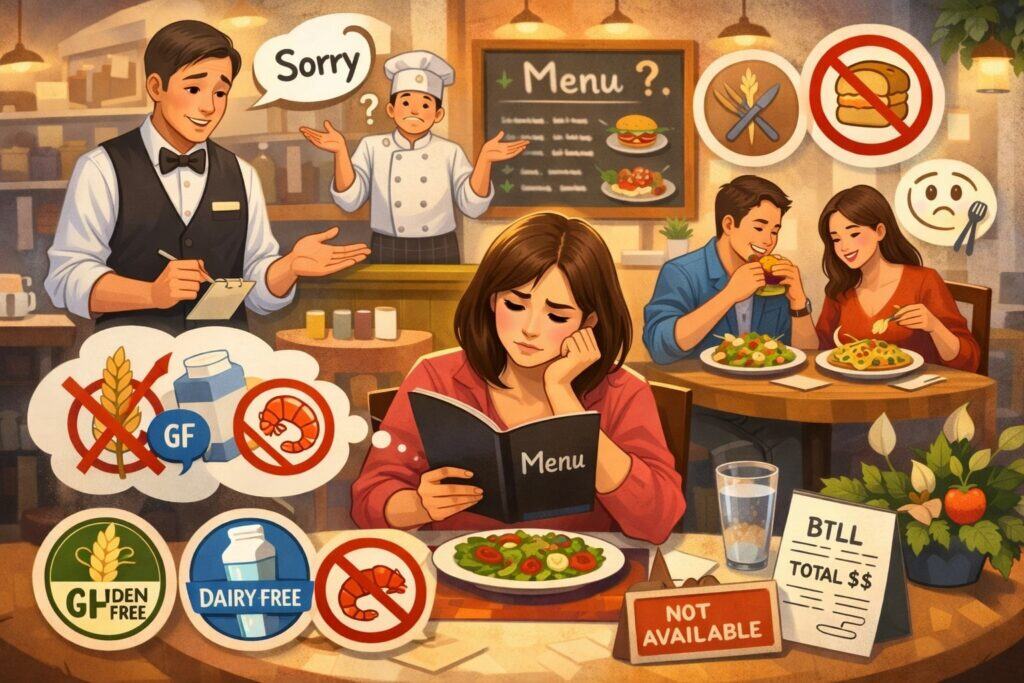
When you have dietary restrictions, you’re not just choosing what you like—you’re choosing what your body can tolerate or what you must avoid.
That extra layer changes everything: how you read menus, how you ask questions, and how you decide whether the risk is worth it. The biggest challenge is that restaurants are optimized for speed and consistency, while dietary restrictions require customization and verification.
A common misconception is that “allergy-friendly” and “healthy” are the same thing. They aren’t. Someone avoiding gluten for medical reasons needs different safeguards than someone ordering “low-carb.”
Likewise, lactose intolerance isn’t the same as a milk allergy. With dietary restrictions when dining out, the language matters because it determines how seriously staff treat your request and how the kitchen responds.
The other big issue is hidden ingredients and shared equipment. Sauces, marinades, spice blends, soup bases, and fry oil can include allergens or restricted ingredients, and they’re not always listed.
Even when ingredients are safe, cross-contact can occur through cutting boards, grills, fryers, tongs, gloves, or prep surfaces. Public health guidance recognizes the seriousness of allergic reactions in restaurant settings and emphasizes prevention steps such as staff awareness and cross-contact controls.
In Delaware, your dining options range from major chains to independent spots and seasonal beach restaurants. That variety is great—but it also means food safety practices and staff training can vary.
The goal isn’t to be fearful. The goal is to be prepared, consistent, and clear—so you can handle dietary restrictions when dining out without turning every meal into a negotiation.
Know Your Dietary Restriction Category (It Changes Your Strategy)
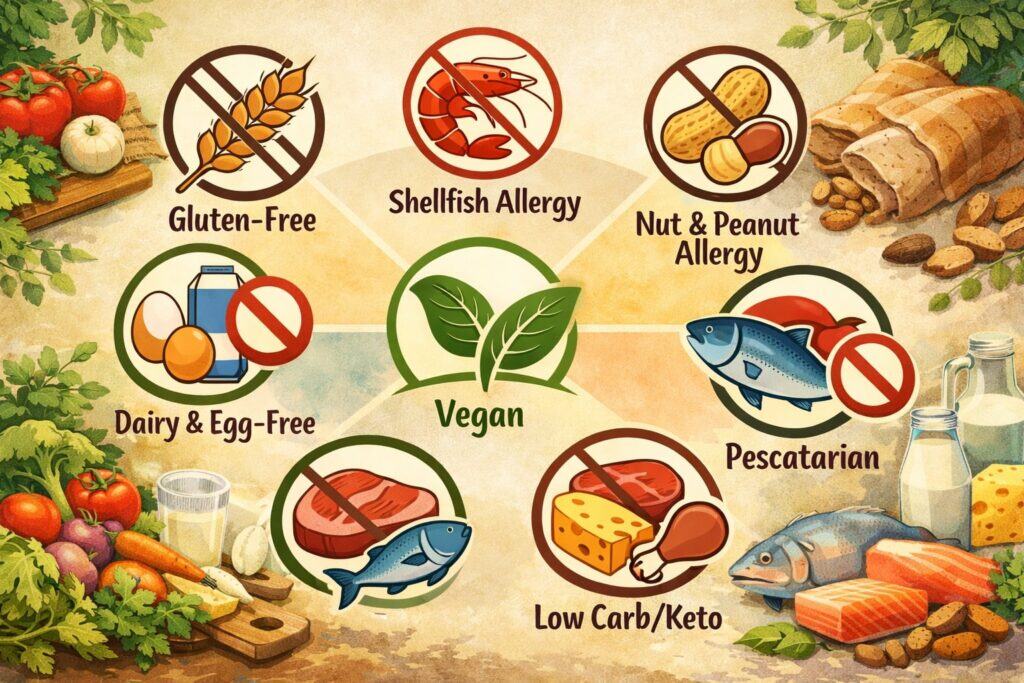
Not all dietary restrictions carry the same risk, and your ordering approach should match your category. The first step to handling dietary restrictions when dining out is understanding which “bucket” you’re in—because it changes what questions you ask and how firm you need to be.
Life-threatening food allergies (anaphylaxis risk)
If you have a true food allergy (peanut, shellfish, milk, egg, sesame, etc.), your top priorities are ingredient accuracy and cross-contact prevention. In recent years, allergen awareness has expanded—most importantly with sesame recognized as a major allergen under federal rules, which affects labeling and allergen controls.
This matters because sesame shows up in buns, dressings, tahini, spice mixes, and “natural flavors,” and it can be hard to detect without asking.
Celiac disease / medically required gluten-free
Celiac disease isn’t an “allergy,” but it requires strict gluten avoidance and cross-contact control similar to allergy protocols. For a celiac, it’s not enough that a dish has “gluten-free ingredients”—it must be “gluten-free preparation.”
Intolerances (lactose, FODMAP triggers, etc.)
Intolerances can cause severe discomfort, but tiny traces may be manageable depending on the person. Your strategy is usually to identify the main sources (cream sauces, onions/garlic, certain sweeteners) and choose simpler dishes. Cross-contact often matters less than direct ingredients—unless your sensitivity is extreme.
Medical nutrition restrictions (diabetes, kidney, low-sodium, low-fat)
These dietary restrictions are about thresholds and trade-offs: sodium limits, carbohydrate planning, phosphorus/potassium control, or avoiding certain fats. Here, your best tools are portion control, sauce-on-the-side, and substitutions.
Ethical/religious restrictions (vegetarian, vegan, halal, kosher)
These may involve ingredient rules and preparation rules. For example, a “vegetarian” dish cooked in beef broth may violate your dietary restriction. Asking about broths, sauces, and fryers is key.
When you can name your category clearly, you can communicate it quickly. That improves outcomes because staff can treat your request like a safety requirement instead of a preference. And that’s the foundation of handling dietary restrictions when dining out successfully.
Do the “Pre-Plan” That Makes Restaurants Safer and Easier

The easiest way to handle dietary restrictions when dining out is to do your homework before you’re hungry. Pre-planning sounds boring, but it saves you from rushed decisions and reduces the chance you’ll settle for “maybe safe.”
Start with menu reconnaissance. Look for restaurants that list allergens, offer gluten-free preparation notes, or provide ingredient transparency. If the online menu looks vague (“chef’s seasonal sauce”), that’s a signal you may need to call ahead.
Chain restaurants often have standardized allergen documentation and training; independent restaurants may be more flexible but less standardized. Your best option depends on your restriction.
Next: pick your timing. Off-peak dining (early dinner, late lunch) can dramatically improve safety for dietary restrictions when dining out. Kitchens are less rushed, and staff have more time to check ingredients, change gloves, or use clean pans.
If you’re at a beach-area restaurant in peak season, pressure increases and mistakes become more likely—so timing matters.
Calling ahead is underrated. A 60-second phone call can reveal whether they can safely accommodate you. Ask:
- “Do you have a separate fryer or clean pan options?”
- “Can the kitchen avoid cross-contact for [allergen/gluten]?”
- “Is there a manager or chef available to confirm ingredients?”
You’re not asking them to “promise perfection.” You’re asking whether they have the systems and willingness to try. Public health and advocacy sources emphasize that food service managers should understand allergens and cross-contact prevention as part of modern food code expectations.
If you’re new to Delaware or traveling within the state, pre-planning is even more important because you don’t yet know which spots treat dietary restrictions seriously. A little preparation turns dining out from risky to routine.
How to Communicate Dietary Restrictions Clearly (So Staff Understand)

Communication is the skill that most determines your success with dietary restrictions when dining out. The trick is to be calm, specific, and consistent—because restaurants respond best to clarity.
Start with a single sentence that labels the seriousness:
- “I have a severe allergy to peanuts and need strict avoidance and cross-contact prevention.”
- “I have celiac disease—I can’t have gluten, and I need gluten-free prep, not just gluten-free ingredients.”
- “I’m lactose intolerant, so I need no milk/cream/cheese. Butter is sometimes okay—can you confirm what’s used?”
- “I’m on a low-sodium diet for medical reasons—can sauces and seasoning be minimized?”
Then follow with your “no-go list” and your “safe list.” Servers can relay details, but the kitchen needs concrete instructions. If you have multiple dietary restrictions when dining out, prioritize the most dangerous one first.
Avoid vague phrases like “I’m sensitive” or “I’d prefer.” Those sound optional. Use “I need” and “I can’t.” Also, don’t assume staff know every ingredient synonym. Instead of “no dairy,” say “no milk, cheese, cream, whey, casein, butter” when it matters.
Ask for a manager or chef when risk is high. That’s not being difficult—it’s being safe. Many allergic reactions happen because the message gets watered down between the table and the kitchen. The fewer handoffs, the better.
Finally, keep your tone friendly. Your job is to be precise, not tense. When people feel respected, they try harder. That human factor is a big part of handling dietary restrictions when dining out in real life.
Ordering Strategies That Reduce Risk in Any Restaurant
Even in restaurants that mean well, the safest path is often the simplest. If you want to handle dietary restrictions when dining out consistently, rely on ordering patterns that naturally reduce uncertainty.
Choose dishes with fewer components. Grilled protein + plain vegetable + rice is easier to verify than a “chef’s special” with layered sauces and garnishes. Ask for sauces and dressings on the side; they’re common hidden sources of allergens, gluten, dairy, and sugar.
Avoid shared-fryer foods unless you’ve confirmed fryer safety. Fries may be cooked in the same oil as breaded items (gluten), seafood (shellfish), or battered foods (egg, milk). If you’re managing dietary restrictions when dining out related to allergens or celiac, fryer questions are essential.
Be cautious with:
- Soups (often contain flour, dairy, bouillon, or thickening agents)
- Baked goods (cross-contact is common; sesame and nuts may appear unexpectedly)
- “Spice blends” and “seasoning” (can include allergens or gluten via anti-caking agents or shared processing)
- Vegan cheese substitutes (may contain nuts)
- “Gluten-friendly” menu labels (sometimes marketing, not kitchen protocol)
When possible, order items that are cooked to order. Pre-made components increase cross-contact risk because they were prepared earlier with unknown tools. Cook-to-order gives the kitchen a chance to start fresh.
Also, be mindful of new allergen realities: sesame is now treated as a major allergen under federal rules, which increases awareness but also means it may show up more explicitly in ingredient statements and restaurant supply ingredients.
A smart order doesn’t just avoid your restricted ingredient—it reduces the number of places your restricted ingredient could hide.
Cross-Contact: The Hidden Risk Most People Miss
If you want to truly handle dietary restrictions when dining out, you have to understand cross-contact. This is different from “cross-contamination” (often used for bacteria). Cross-contact is when an allergen or restricted ingredient unintentionally transfers to your food through surfaces, tools, oil, or hands.
Common cross-contact sources in restaurants include:
- Shared cutting boards and knives
- Shared grills where buns or pancakes touch the same surface
- Shared fryers and fryer baskets
- Shared pasta water
- Shared condiment bins (mayo, salsa, hummus) where utensils get mixed
- “Garnish hands” touching multiple plates
- Flour dust in kitchens (major issue for gluten)
Your role is to request a process, not just a substitution. For example:
- “Can the kitchen use clean gloves and a clean pan?”
- “Can the food be prepared on a clean section of the grill or in a sauté pan instead?”
- “Can you confirm the fryer is dedicated?”
Public health guidance highlights that restaurants can reduce allergic reactions with practical controls—training, procedures, and consistent kitchen practices.
If a restaurant can’t control cross-contact, it may still be fine for an intolerance, but not for a severe allergy or celiac. Knowing that difference is what turns “hope” into a repeatable strategy for dietary restrictions when dining out.
Delaware-Specific Notes: What Helps You Ask Smarter Questions
Delaware follows a state food code that regulates food establishments and inspections, and it’s designed to support safe food service practices across the state.
While the code itself isn’t a “guarantee” that every restaurant will accommodate every dietary restriction, it’s useful because it reflects modern expectations: safe handling, accurate presentation, and oversight through permitting and inspections.
In practical terms, here’s how to use Delaware context when handling dietary restrictions when dining out:
1) Don’t be shy about asking for a manager: In many Delaware restaurants—especially locally owned spots—managers are close to the kitchen and can confirm ingredients faster than a busy server can.
2) Expect seasonal staffing shifts: Downstate and beach-area locations often staff up seasonally. New staff may be less familiar with dietary restriction protocols, so clear communication becomes even more important.
3) Watch for “honestly presented” cues: Delaware’s food code emphasizes honest presentation and safe service. If a place seems dismissive (“we can’t guarantee anything” without offering options) or overly confident without checking, that’s a red flag.
4) Use grocery+restaurant hybrids wisely: Delaware has many cafés inside markets and specialty shops. These can be great for ingredient transparency because packaged items have labels, but cross-contact can be higher if deli tools are shared.
Delaware doesn’t require you to disclose medical details to eat safely. But knowing that restaurants operate under statewide food safety rules can give you confidence to ask direct questions and request safe handling steps without feeling like you’re making an unreasonable demand.
Handling Multiple Dietary Restrictions Without Overwhelming the Staff
Many people aren’t dealing with just one restriction. You might be gluten-free and dairy-free. Or diabetic and low-sodium. Or allergic to nuts and avoiding sesame. Handling dietary restrictions when dining out gets harder as complexity increases, but it’s still manageable if you structure the conversation.
Start by ranking your restrictions:
- Life-threatening (anaphylaxis)
- Medically strict (celiac, severe IBS triggers, kidney restrictions)
- Preference/ethical (vegetarian, vegan, etc.)
Tell the server the top priority first and keep it short. Then ask them to repeat it back to you. This isn’t about “testing” them—it’s about confirming that your dietary restrictions when dining out were heard accurately.
Next, choose one “anchor dish” you can modify easily. Trying to create a custom meal from scratch increases the chance of confusion. A better approach is selecting something naturally compatible (grilled chicken salad without cheese + oil/vinegar) and then applying minimal modifications.
If your restrictions are extensive, consider using a printed allergy card (wallet-sized) listing allergens and cross-contact needs. Restaurants process written info well—especially during busy times.
Also, be realistic about what a kitchen can do. A restaurant may be able to handle gluten-free OR nut-free, but not both safely if they bake in-house with flour and nuts. The best skill is knowing when to walk away. Successful dietary restrictions when dining out includes choosing the right venue, not just ordering the right plate.
What to Do If You Have a Reaction While Dining Out
Even with great planning, reactions can happen. That’s why handling dietary restrictions when dining out includes a safety plan for emergencies—not just prevention.
If you have a severe allergy:
- Carry your prescribed medication (including epinephrine if you have it).
- Tell a companion what to do if you react.
- If symptoms suggest anaphylaxis (trouble breathing, throat tightness, widespread hives, dizziness, repeated vomiting), treat it as an emergency and seek immediate help.
If you have celiac disease or intolerance:
- Stop eating immediately.
- Document what you ate and any staff conversations (helpful for future decisions).
- Hydrate and follow your personal recovery plan.
Also, inform the restaurant manager calmly. The goal isn’t confrontation—it’s prevention for the next guest and a clearer understanding of what went wrong. Restaurants may be able to identify an ingredient or prep error (shared fryer, wrong sauce, mislabeled bun). That information helps you refine your future approach to dietary restrictions when dining out.
Public health agencies recognize that allergic reactions in restaurants are a serious issue and emphasize prevention steps. Having a plan doesn’t make you anxious—it makes you free to enjoy the meal because you’re prepared.
Future Trends: How Dining Out May Get Easier for Dietary Restrictions
The next few years are likely to bring more transparency and standardization—good news for dietary restrictions when dining out. Here are the most relevant trends.
1) More allergen disclosure expectations
Sesame’s inclusion as a major allergen has already raised awareness and improved labeling expectations in supply chains. As manufacturers and distributors adapt, restaurants will have clearer ingredient documentation for many items they purchase.
2) Menu allergen labeling laws expanding
Some states are pushing restaurant allergen disclosure requirements for menus—especially for larger chains. That direction suggests a broader future where allergy information is easier to access before you order.
Even if Delaware doesn’t adopt identical rules immediately, national chains may standardize allergen menu practices across locations to reduce complexity.
3) Better training and digital kitchen systems
Restaurants increasingly use digital recipe management and POS systems that track ingredients and modifiers. As these systems improve, “no dairy” and “gluten-free prep” can become structured workflow steps instead of verbal notes—reducing mistakes.
4) More “free-from” product availability—with a caution
The market for gluten-free, dairy-free, and allergen-friendly products keeps expanding. That’s helpful, but it can also introduce new risks (like nut-based substitutes or “may contain” supply chain issues). Future dining will likely be easier—but still requires smart verification.
The direction is positive: more awareness, more regulation pressure, and better tools. But the core skill won’t change: clear communication and smart ordering remain the heart of handling dietary restrictions when dining out.
FAQs
Q1) What should I say first when I have dietary restrictions when dining out?
Answer: Lead with seriousness in one sentence: “I have a severe allergy to X” or “I have celiac disease and need gluten-free prep.” Then ask if the kitchen can accommodate and prevent cross-contact. This reduces confusion and makes staff take your dietary restrictions when dining out seriously.
Q2) Is “gluten-free” on the menu enough for celiac disease?
Answer: Not always. “Gluten-free” can mean ingredients only, not preparation. Ask about dedicated prep space, clean pans, and shared fryers. For celiacs, dietary restrictions when dining out require process control, not just ingredient swaps.
Q3) How do I handle dietary restrictions when dining out with a big group?
Answer: Pre-select a restaurant with clear options, call ahead, and plan what you’ll order before arriving. Once seated, ask for a manager early—before the rush of group ordering. Group meals are doable, but they require extra structure.
Q4) What’s the most overlooked risk for food allergies at restaurants?
Answer: Shared fryers and shared tools. Fries, chips, and fried “safe” items can become unsafe due to fryer oil shared with breaded or allergen-containing foods. Cross-contact is one of the biggest issues in dietary restrictions when dining out.
Q5) Does sesame really matter that much now?
Answer: Yes. Sesame is now treated as a major allergen under federal rules, which increased labeling and awareness, but it’s also widely used in buns, dressings, and spice blends. If sesame is your restriction, ask explicitly—even when it’s not obvious.
Conclusion
Handling dietary restrictions when dining out is a skill set—not a personality trait. You don’t need to be “difficult.” You need to be clear, consistent, and prepared. Know your restriction category, choose restaurants strategically, communicate in precise language, and prioritize cross-contact prevention when the risk is high.
In Delaware, you can use the same approach whether you’re at a local café or a busy seasonal spot: ask smart questions, simplify your order, and confirm the kitchen can meet your needs.
The good news is that trends point toward better allergen awareness and more transparency over time. Sesame’s recognition as a major allergen is one example of how policy shifts can improve safety and documentation.
And as menu labeling expectations expand and restaurant systems become more digital, dietary restrictions when dining out should gradually get easier.