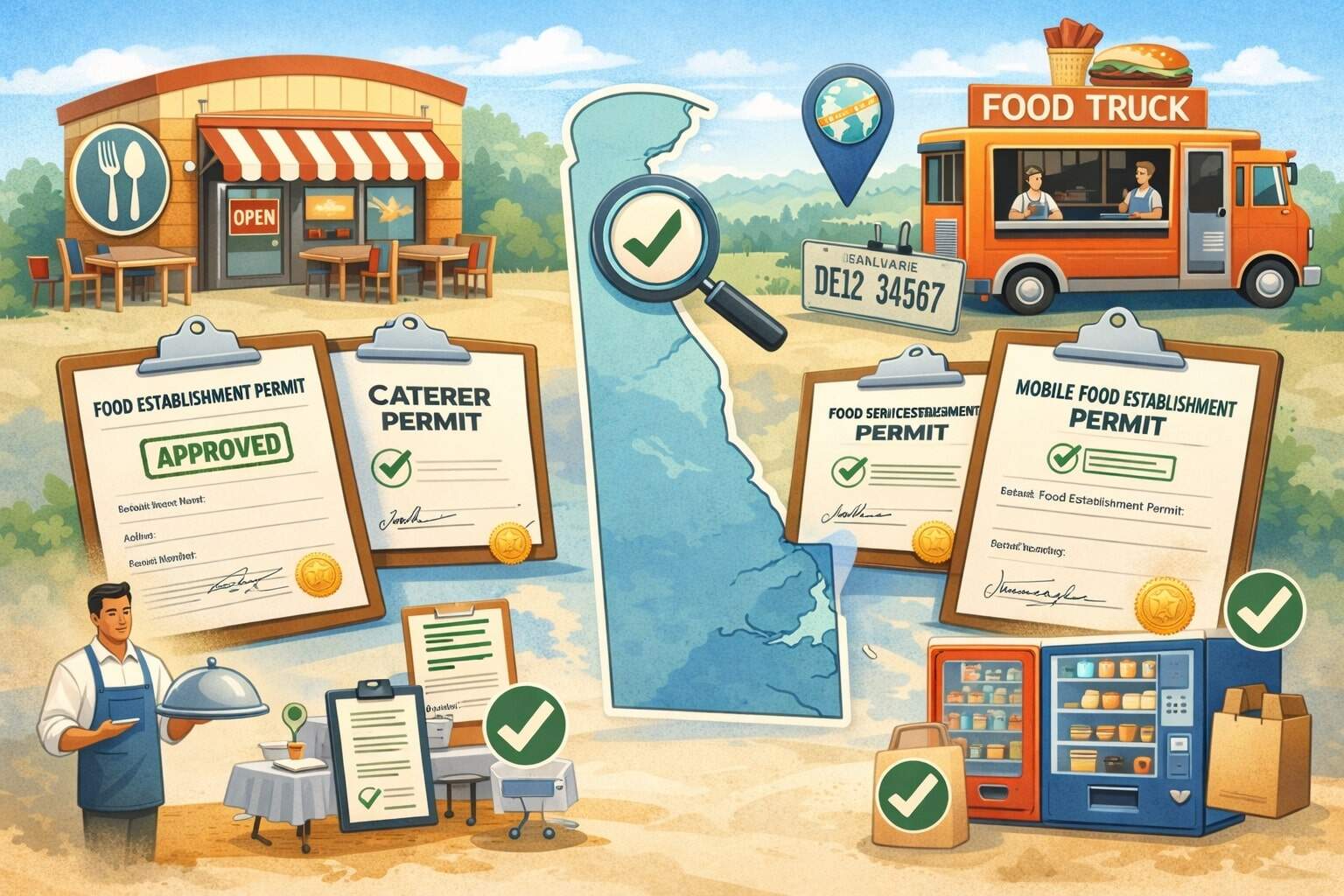
Food Service Permits Required in Delaware (2026 Updated Guide)
Launching (or expanding) a restaurant, café, catering company, bakery, commissary, food truck, or pop-up means you’ll be navigating food service permits required in Delaware from multiple angles: public health, business registration, alcohol (if applicable), fire safety, and sometimes environmental permitting.
The good news is Delaware’s process is predictable once you understand who regulates what and the order to tackle it.
At the center of most approvals is the Delaware Division of Public Health (DPH), Office of Food Protection (OFP), which permits and inspects retail food establishments and enforces the Delaware Food Code.
This guide explains the permits, approvals, and compliance steps that typically apply—plus practical tips to avoid delays, and what to expect as rules continue evolving through 2026 and beyond.
Understanding the Delaware Food Permitting Landscape (Who Regulates What)

Before you apply for anything, it helps to map the agencies you’ll deal with. For most operators, the main “food license” is a Food Establishment Permit issued through Delaware’s public health system.
Delaware’s Food Code lays out the standards for facilities, food operations, plan review, permit issuance, inspections, and enforcement actions like suspension.
Alongside that, nearly every operator must also handle business licensing/registration through Delaware’s systems (often via Delaware One Stop and the Division of Revenue).
Delaware’s One Stop is designed to guide businesses through registration and licensing steps online, and the Division of Revenue confirms licensing and renewal rules (including calendar-year issuance and renewal options).
Then come the “often forgotten” approvals that can slow openings if you ignore them:
- Fire protection and suppression requirements for commercial cooking (hoods, suppression systems, inspections, plan submittals).
- Alcohol licensing if you serve beer/wine/spirits—handled by the Delaware Office of the Alcoholic Beverage Control Commissioner, including online licensing and renewals.
- Environmental permits in certain scenarios (wastewater, discharge, special operations), often through DNREC’s permitting pathways.
Thinking of these as one coordinated project—not separate chores—makes “food service permits Delaware” compliance much easier, faster, and cheaper.
The Core Permit: Food Establishment Permit (Delaware Division of Public Health)
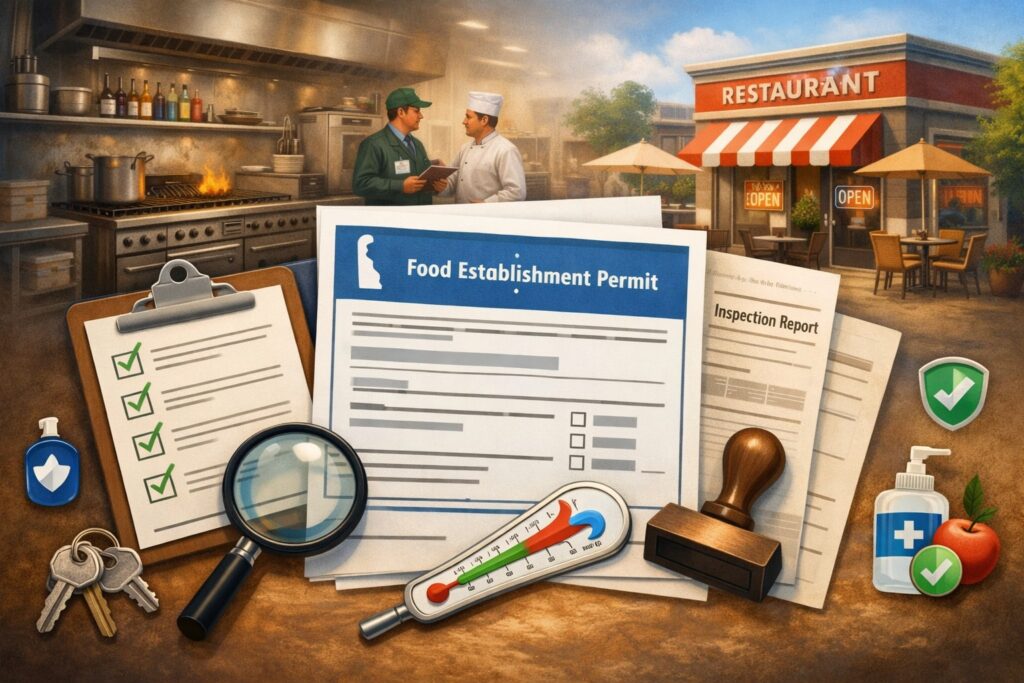
For most brick-and-mortar food businesses, the key approval is the Food Establishment Permit issued by the Division of Public Health, Office of Food Protection. This is the permit that allows you to legally prepare and serve food to the public—and it’s also the permit tied to health inspections and ongoing compliance.
Delaware’s Food Safety program materials emphasize that permitting and inspection of restaurants, mobile units, and other food establishments are part of OFP/CEHS enforcement and consumer protection activities.
What businesses typically need this permit?
If you are operating a restaurant, diner, café, bakery with retail sales, coffee shop, deli, market with prepared foods, commissary kitchen, catering base kitchen, or similar, you should assume you need this permit.
Delaware’s Business First Steps portal also highlights food establishments broadly and encourages contacting OFP early in the process to understand licensing procedures—especially before purchasing, constructing, or amending a facility.
How the permit works (validity, changes, compliance)
A common operational detail people miss: permits are not “set it and forget it.” A plan review packet used in Delaware food permitting explains that a permit is valid for one year from issuance, and that ownership/management changes can trigger permit invalidation or require a new permitting action.
Even if your physical location is unchanged, significant changes in menu/process (adding specialized processes, extensive remodeling, changing establishment type) can trigger additional review and inspection requirements.
Why this matters for ranking + real-world success
Search engines reward helpful, accurate content—but in the real world, what matters is avoiding shutdown risks. If you operate without the correct food establishment permit, you can face enforcement actions.
Delaware’s system is built on risk reduction, inspection, and corrective action. When you treat the food service permits required in Delaware as part of your operational plan, you reduce opening delays and create a smoother path to scaling.
Plan Review in Delaware: The Step That Prevents Expensive Rework

If you are opening a new location, converting a space into a food establishment, remodeling, or changing the type of operation, plan review is the part that saves (or costs) the most money. Delaware’s Food Code explicitly provides for plan review and permits as part of the regulatory system.
What “plan review” really means
Plan review is not just submitting a floor plan. It’s your chance to prove the facility design supports safe food operations:
- proper handwashing and warewashing
- separation of raw and ready-to-eat handling
- adequate cold and hot holding
- ventilation and commercial cooking safety
- safe water supply and waste disposal
- appropriate surfaces, equipment, and storage
Delaware’s Food Establishment Plan Review materials emphasize permit compliance and allowing authorized inspection access under Delaware regulations.
When plan review usually applies
Plan review is commonly required for:
- new construction
- converting a non-food space into a food business
- major remodeling (kitchen layout, plumbing, ventilation)
- adding processes like reduced oxygen packaging, smoking for preservation, or other specialized methods
- changing operation type (e.g., convenience store → deli/food service)
How to avoid the most common delay
The number one avoidable delay is designing the space first and asking compliance questions later. Delaware’s own business guidance urges operators to contact the Office of Food Protection early—before purchasing, constructing, or amending a premises.
That simple step can prevent needing to move sinks, add drains, upgrade ventilation, or rebuild a walk-in layout after equipment arrives.
Certified Food Protection Manager (CFPM) Requirement: A Compliance “Must-Have”
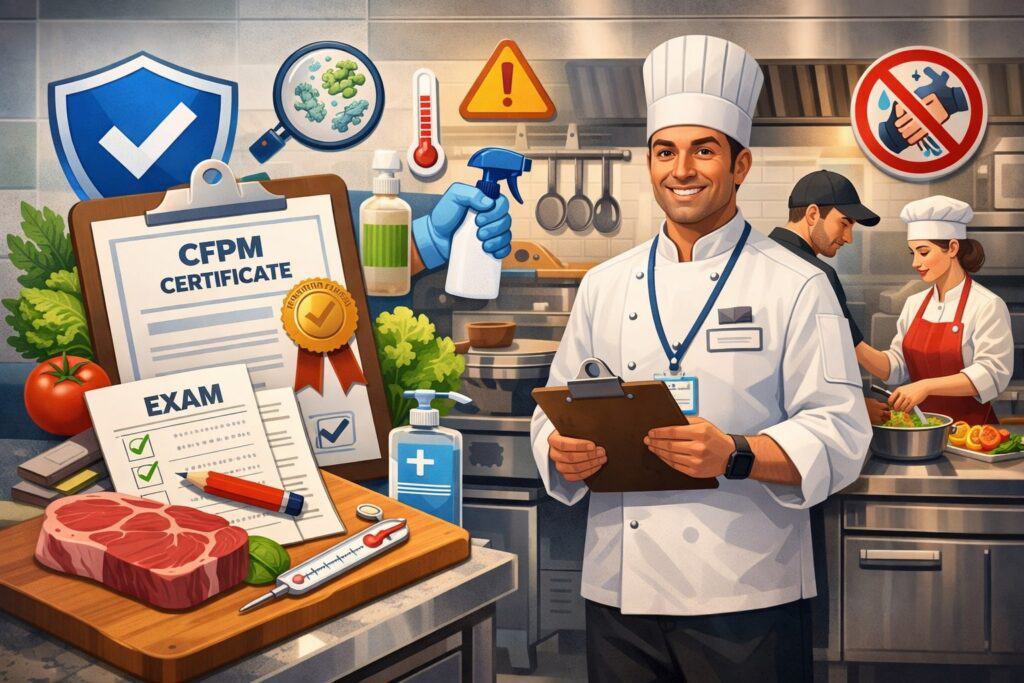
A frequent question in food service permits Delaware planning is whether you need a certified manager. Delaware has a clear expectation around this topic.
Delaware’s CFPM FAQ states that the 2014 Delaware Food Code requires that at least one employee—the Person in Charge at the time of inspection—must be a Certified Food Protection Manager who has passed a test from an accredited program (unless a variance is approved).
Why CFPM matters beyond “passing inspection”
This is not just a paper requirement. Inspectors want to see active managerial control—someone who can explain:
- safe cooking, holding, cooling, and reheating
- cross-contamination prevention
- allergen awareness and labeling controls
- cleaning and sanitizing procedures
- employee health policies (exclude/restrict when needed)
When CFPM is treated as a leadership role rather than a box to check, inspection outcomes tend to improve—and so does customer safety.
Practical implementation tip
Don’t schedule certification after your build-out. Put CFPM into your opening timeline early, because the “Person in Charge” expectation applies at inspection time. If your manager is absent or not certified, you can lose valuable opening days while you reschedule.
Future outlook
Expect continued emphasis on food safety leadership rather than just facility conditions. Across the industry, regulators increasingly focus on repeat risk factors (time/temperature control, hygiene, allergen handling). Delaware’s documented CFPM expectation aligns with that trend, so it’s wise to assume CFPM enforcement will remain steady or tighten over time.
Temporary Food Establishment Permits: Festivals, Fairs, Pop-Ups, and Short-Term Events
If you sell food at events, you’re often dealing with a different permit path: a Temporary Food Establishment (TFE) permit.
Delaware’s Business First Steps guidance for temporary food establishments states that the Office of Food Protection issues temporary permits, with temporary operation up to 14 days per year, and that applications must be submitted at least 10 days prior to the event.
Delaware’s temporary permit application PDF also notes that if food prep occurs outside Delaware, you may need to provide proof of that facility’s valid operating permit and recent inspection, and that commissary arrangements may be required.
What the temporary permit typically covers
A temporary permit generally evaluates whether you can safely:
- store food at safe temperatures
- cook and hold safely
- provide handwashing (and sometimes warewashing) in a temporary environment
- prevent contamination from dust, pests, or public contact
- use approved water/ice sources
- manage waste and wastewater properly
Why temporary permits are strict
Short-term events create higher risk: limited infrastructure, outdoor temperatures, rushed prep, and inconsistent staffing. That’s why the process often requires details about food sources, prep steps, equipment, temperature controls, and where cooking/prep occurs.
Future prediction: more digital submissions, stricter traceability
Over time, many jurisdictions are shifting temporary permits toward more standardized digital submissions, stronger documentation of food sources, and stricter allergen labeling at public events. If Delaware expands online intake options further, operators who already document recipes, ingredient sources, and temperature logs will adapt fastest.
Cottage Food Establishment Program in Delaware: Selling Approved Foods From Home
If your business model is home-based (cookies, shelf-stable baked goods, certain jams, etc.), Delaware’s Cottage Food Establishment (CFE) Program may apply.
Delaware’s Office of Food Protection explains that the Cottage Food Establishment Program establishes basic food safety requirements for operations and allows preparation of a limited type of food products made in residential kitchens.
This is a major pathway for small entrepreneurs to test demand without renting commercial space.
What cottage food can (and cannot) do
Cottage food generally applies to non-potentially hazardous foods (items that do not require strict temperature control for safety). Each program has product limitations, labeling expectations, and registration rules.
If your product requires refrigeration for safety, includes certain high-risk ingredients, or involves specialized processing, you may be pushed into a fully permitted commercial model.
Why cottage food is a “permit strategy,” not just a legal category
If you want to build a brand, cottage food can be a stepping stone:
- start with approved products
- validate market demand
- build a following
- transition into a permitted commercial kitchen for expansion
Future prediction: expanding cottage food demand, tighter labeling expectations
Cottage food continues to grow due to consumer preference for local brands and low startup costs. At the same time, regulators tend to increase focus on truthful labeling, allergen declarations, and consumer transparency. If you plan to scale, build your labels, ingredient lists, and basic batch records as if you’ll be audited—because eventually, you might be.
Business Licensing and Registration: Delaware One Stop and Division of Revenue
Even with public health approval, most operators also need to handle state business licensing.
Delaware’s One Stop system is built to guide businesses through online registration and licensing steps, and the Division of Revenue confirms that businesses can obtain a Delaware business license and register online via One Stop.
The One Stop renewal flow also emphasizes that Division of Revenue licenses are issued by calendar year, with options to renew annually or choose a multi-year renewal option.
Why this matters for food businesses
Food operations are inspected and permitted through public health, but business licensing impacts your:
- ability to legally operate as a business entity
- tax registration and filing requirements
- hiring setup (withholding, unemployment insurance, workers’ compensation if you add staff)
Common mistake: opening prep before business registration is settled
Operators sometimes secure a lease, buy equipment, and even build a menu—then discover their business licensing and tax registrations aren’t aligned with their opening date. That can delay vendor accounts, payroll setup, and even merchant services underwriting.
Best practice workflow
For the smoothest path through food service permits required in Delaware, do these in parallel:
- set up your legal structure and registrations via One Stop where applicable
- begin food plan review discussions early
- schedule CFPM training
- plan for inspections and final approvals
This reduces the “last mile” risk where everything is ready except the paperwork.
Alcohol Permits (If You Serve Beer, Wine, or Spirits)
If you plan to serve alcohol—whether as a restaurant, bar, tasting room, or event operator—you’ll likely need licensing through the Delaware Office of the Alcoholic Beverage Control Commissioner.
The OABCC site states the Commissioner considers liquor license applications, performs inspections, grants renewals, and conducts hearings when needed. OABCC also provides an online licensing pathway for new applicants and renewals, with uploaded documentation and application materials.
Why alcohol licensing affects your food permit timeline
Alcohol licensing can introduce:
- added inspection expectations (occupancy, serving layouts, compliance posting)
- longer lead times (especially where hearings or public interest concerns arise)
- operational rules that impact your menu and sales reporting
Even if your food establishment permit is ready, alcohol approval can delay your “grand opening” if alcohol is central to your concept.
Notable future-looking detail
OABCC’s site notes that Delaware’s direct shipment of wine program becomes effective August 2026. While that’s not a restaurant permit itself, it signals ongoing regulatory modernization.
Operators in wine retail, tasting rooms, or hybrid models should watch for rulemaking updates that affect sourcing, shipping partnerships, and compliance documentation.
Fire Safety, Hood Suppression, and Building-Related Approvals
A hidden blocker for food businesses is fire compliance—especially if you do grease-producing cooking (fryers, grills, ranges, woks, etc.). Delaware’s State Fire Marshal resources highlight plan review and inspection services, including kitchen hood and suppression plan submittals.
When hood suppression requirements show up
If your cooking produces grease-laden vapors, you should expect:
- Type I hood requirements
- hood suppression plan submittals
- final acceptance requirements before use
Delaware’s Fire Marshal guidance on kitchen hood suppression plan submittals states that plan submittal is required for commercial cooking producing grease-laden vapors and that final acceptance is required prior to use.
Why this is part of “food service permits Delaware” planning
Even though hood suppression is not issued by the health department, it can completely block your ability to pass final opening checks. Many delayed restaurant openings aren’t caused by recipes or menus—they’re caused by failed hood inspections, missing suppression documentation, or late plan submissions.
Best practice: align kitchen design with both health and fire requirements
Your build-out decisions should be reviewed through two lenses:
- food safety flow (handwash, prep, storage, sanitation)
- fire safety systems (hood, suppression, extinguishers, inspection access)
Planning both together reduces redesign risk and helps you open faster.
Environmental and Wastewater Considerations (DNREC and Local Utilities)
Not every food business needs a DNREC permit, but many do need to understand environmental compliance—especially around wastewater, grease, and any operations that could be considered “potentially polluting activities.”
DNREC describes its environmental permitting process as the pathway commercial/industrial facilities use when opening or changing operations that may create pollution risks.
DNREC also publishes guidance and links to regulations through its regulations portal.
Where food establishments commonly run into environmental issues
Food businesses often encounter environmental requirements through:
- grease management (fats, oils, grease controls)
- wastewater discharge rules (especially for certain processing or high-volume operations)
- stormwater impacts during construction
- specialty operations (smokehouses, manufacturing-like food processing)
Sometimes, requirements are primarily enforced through local utilities or municipal codes, but DNREC becomes relevant depending on the operation and discharge impact.
Practical compliance approach
To protect your opening timeline:
- ask your landlord/property manager what grease trap and wastewater expectations apply
- confirm municipal utility requirements early
- if you’re doing unusual processing, consult DNREC’s permitting pathways
Future prediction: more e-permitting and documentation
DNREC indicates applications are being moved into online ePermitting systems over time, which usually means more standardized submissions and clearer tracking—but also less flexibility for “informal” documentation.
Operators who keep accurate maintenance records (grease trap service, waste hauling receipts, equipment specs) tend to handle these shifts smoothly.
Inspections, Renewals, and Ongoing Compliance in Delaware
Getting approved once is only half the job. Delaware’s framework is built around inspections and ongoing compliance. The Delaware Food Code includes inspection and permit suspension concepts as core enforcement tools.
Delaware’s food safety program description also emphasizes permitting and inspection as ongoing activities to protect consumers.
What inspectors usually focus on
While exact inspection priorities vary by operation risk level, common focal points include:
- employee hygiene and handwashing compliance
- time/temperature control (cold holding, hot holding, cooling)
- cross contamination prevention
- sanitizer setup and correct concentrations
- clean food-contact surfaces and proper warewashing
- pest prevention and food storage controls
- allergen awareness and labeling where applicable
Renewals: don’t let “paperwork drift” become a shutdown risk
Annual renewals and renewals tied to other business licensing systems should be calendared like payroll—non-negotiable. Delaware provides an online platform for food establishment permit payments, and One Stop provides renewal workflows for business licenses.
Future prediction: more emphasis on documentation + digital records
Across public health, compliance increasingly includes documentation expectations—especially after outbreaks or complaints. Building basic systems now (temperature logs, cleaning schedules, training records, supplier lists) helps you respond quickly if inspectors request evidence during a complaint investigation.
Step-by-Step Checklist: Getting Food Service Permits Required in Delaware (Fastest Safe Path)
This section puts the entire food service permits Delaware process into a realistic order. The exact order can vary, but this sequence reduces expensive backtracking.
Step 1: Lock your concept (menu + processes)
Your menu determines your risk profile. A coffee and pastry concept is not regulated the same way as a raw bar or a high-volume fried chicken kitchen. Write down your intended processes (cook, cool, reheat, sous vide, vacuum seal, etc.). This becomes your compliance blueprint.
Step 2: Start business registration and licensing setup
Use Delaware One Stop where appropriate to register and license your business and align tax registrations. Even if your physical build-out is months away, this step helps you set up vendors, banking, payroll planning, and insurance.
Step 3: Engage DPH Office of Food Protection early
Delaware’s Business First Steps guidance encourages contacting OFP early—before building or modifying a premises—to understand the procedure. This is where you confirm plan review needs and expected inspection steps.
Step 4: Submit plan review materials (if applicable)
If you’re building, converting, remodeling, or changing operation type, plan review helps you avoid rework. Delaware’s Food Code includes plan review and permit issuance as core mechanisms.
Step 5: Address fire suppression and hood compliance (if cooking)
Submit required kitchen hood suppression plan materials and plan for final acceptance before use if grease-laden vapors are involved.
Step 6: Complete CFPM certification planning
Ensure at least one Person in Charge at inspection time is a CFPM as required by Delaware’s Food Code (per CFPM FAQ).
Step 7: Prepare for inspection, then open with renewal systems in place
Once approved, set renewals and compliance logs as ongoing operations—not “admin tasks.”
FAQs
Q.1: Do I need a food establishment permit to sell food in Delaware?
Answer: In most cases, yes—if you are preparing or serving food to the public through a restaurant, mobile unit, commissary, or similar model, the Division of Public Health’s Office of Food Protection is the central permitting authority. Delaware’s food safety program emphasizes permitting and inspection as core functions.
Q.2: How early should I contact the Office of Food Protection?
Answer: As early as possible—especially before construction, purchase, conversion, or major remodeling. Delaware’s Business First Steps guidance strongly encourages calling the Office of Food Protection early to understand the full process.
Q.3: Are temporary food event permits different from regular restaurant permits?
Answer: Yes. Temporary Food Establishment permits are designed for short-duration operations and require event-specific applications and timing rules (including submitting at least 10 days prior and limits around total operating days).
Q.4: Do I need a Certified Food Protection Manager in Delaware?
Answer: Delaware’s CFPM FAQ states that the Delaware Food Code requires at least one employee (the Person in Charge at the time of inspection) to be a Certified Food Protection Manager from an accredited program unless a variance is approved.
Q.5: If I want to sell alcohol, is that part of my food permit?
Answer: No. Alcohol licensing is handled by the Office of the Alcoholic Beverage Control Commissioner. They manage applications, inspections, renewals, and provide online licensing pathways.
Q.5: Do I need fire marshal approvals for a restaurant kitchen?
Answer: If you use commercial cooking equipment that produces grease-laden vapors, you should expect hood and suppression requirements, plan submittals, and final acceptance prior to use through Delaware’s State Fire Marshal processes.
Q.6: Can I run a food business from my home kitchen in Delaware?
Answer: Possibly, if your products fit within the Cottage Food Establishment program rules. Delaware’s CFE program allows a limited set of products prepared in residential kitchens with basic safety requirements.
Conclusion
The fastest way to succeed with food service permits required in Delaware is to treat permitting as an operational design project—not a paperwork chore. Delaware’s system is built around the Delaware Food Code’s standards, plan review, permits, and inspections, anchored by the Division of Public Health Office of Food Protection.
To protect your timeline and budget:
- contact OFP early (before build-out decisions become expensive)
- plan for CFPM coverage at inspection time
- separate “food permit” work from business licensing, alcohol licensing, and fire safety requirements—but manage them in one coordinated timeline
- build simple documentation systems now (training, temps, cleaning, supplier records) so you’re ready for more digital and documentation-driven compliance trends ahead
Delaware continues modernizing systems (from online licensing to evolving alcohol program changes), and the broader regulatory direction favors clear documentation, consistent managerial control, and traceable food safety practices.
If you plan with that future in mind, you won’t just open—you’ll stay open, scale faster, and build the kind of operational reliability that customers (and regulators) trust.