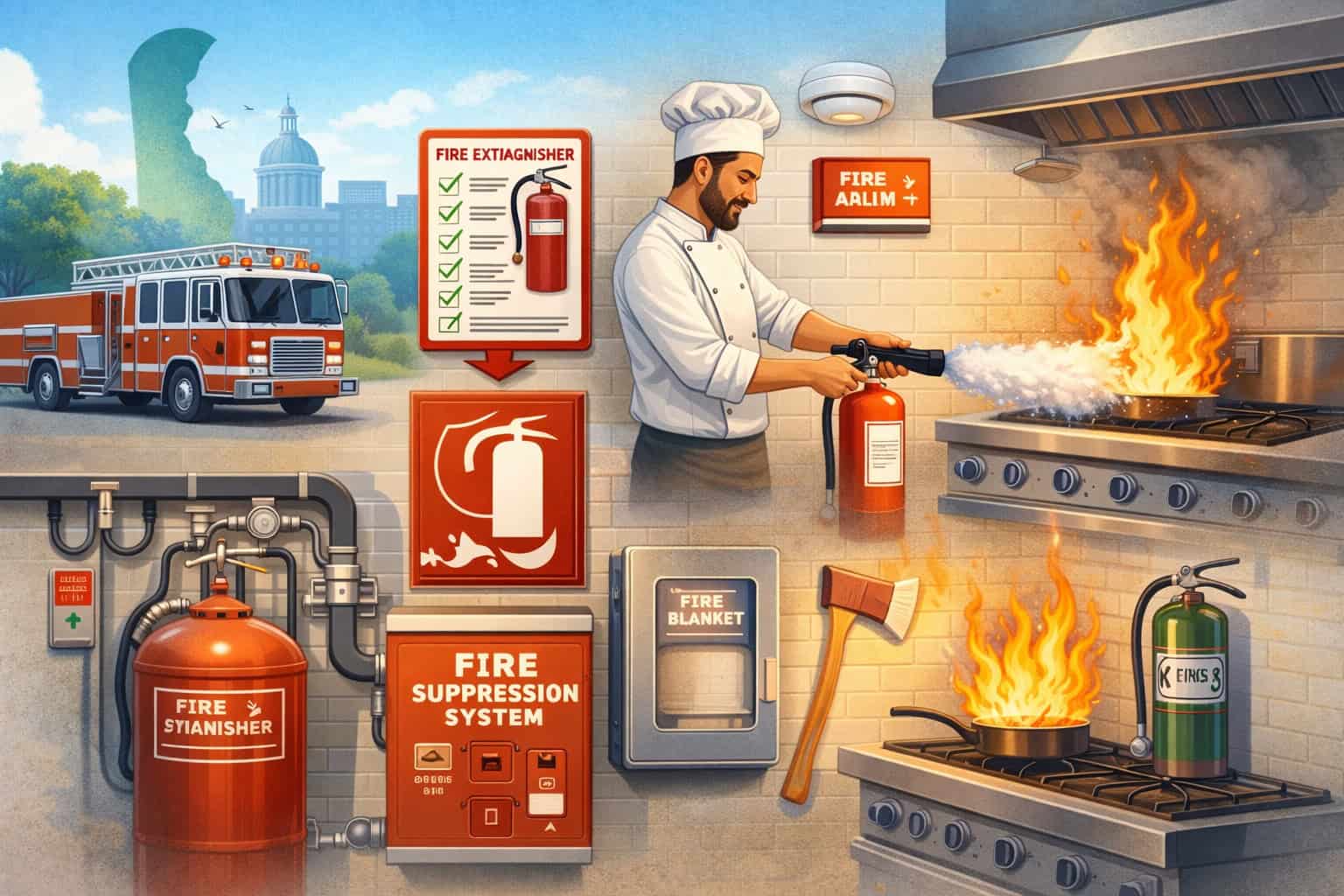
Fire Safety Requirements for Delaware Commercial Kitchens
Commercial kitchens are one of the highest-risk environments in any building. Open flames, high-heat appliances, grease-laden vapors, electrical loads, and fast-paced operations create the perfect conditions for a small problem to become a major fire.
For Delaware restaurant owners, food truck operators, caterers, property managers, chefs, and commercial kitchen operators, fire safety is also a compliance issue. Delaware’s fire and life safety rules are enforced through the Delaware Office of the State Fire Marshal (OSFM) and local authorities having jurisdiction (AHJs).
Delaware also updates its statewide fire prevention regulations over time—most recently, Delaware adopted a new edition of its Delaware State Fire Prevention Regulations (Regulation 701) effective January 1, 2026.
Below is practical, people-first guidance on fire safety requirements for Delaware commercial kitchens—what inspectors look for, how to build an inspection-ready program, and how to reduce real-world risk without getting buried in legal jargon.
Why Fire Safety Matters in Delaware Commercial Kitchens
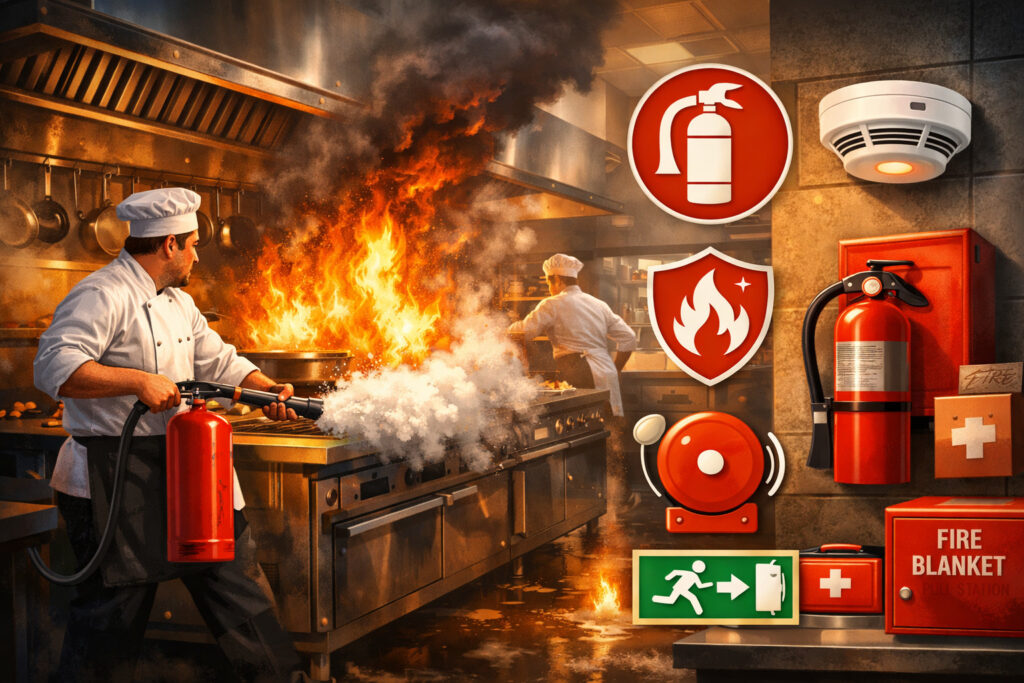
Kitchen fires don’t usually start as dramatic events. They start as grease residue, a blocked filter, an unmaintained hood, a frayed cord, or a pan left unattended. The danger is that commercial kitchens combine ignition sources and fuel sources in the same tight workspace.
From a compliance perspective, Delaware restaurant fire safety regulations are designed to do two things:
- Prevent ignition (good ventilation, controlled grease, safe equipment layout, safe fueling practices)
- Control a fire quickly if it starts (automatic suppression, alarms, extinguishers, egress, emergency lighting)
Delaware enforcement generally flows through OSFM processes such as plan review, acceptance testing, and inspection programs. For example, Delaware requires plan submittals and acceptance before certain commercial kitchen systems can be used—especially Type I hoods and hood suppression systems.
OSFM specifically notes that a kitchen hood suppression plan submittal is required for commercial cooking producing grease-laden vapors, and final acceptance is required before using a Type I hood.
Overview of the Delaware Fire Code Framework for Restaurants
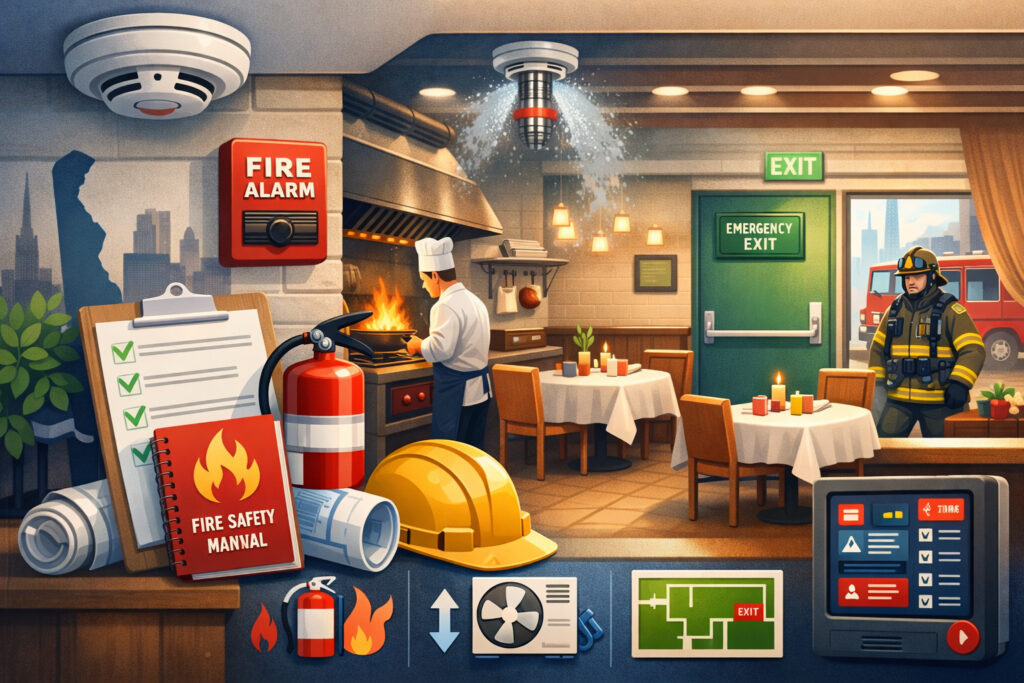
Delaware’s fire and life safety framework is a mix of statewide regulations, adopted model codes/standards, and local enforcement practices. When people search for the Delaware fire code for restaurants, what they usually need is clarity on three layers: the state regulations, the model codes referenced by those regulations, and how local AHJs interpret and enforce them.
How Delaware uses statewide regulations and adopted standards
Delaware’s statewide rules are issued through the Delaware State Fire Prevention Regulations. The Administrative Code for Delaware’s fire prevention regulations describes statewide adoption and enforcement authority.
Delaware also updates its rules periodically. OSFM published an update stating that the State Fire Prevention Commission adopted a new edition of the Delaware State Fire Prevention Regulations (Regulation 701) effective January 1, 2026.
Why this matters: When regulations update, inspection emphasis and documentation expectations can shift. If you are opening, remodeling, changing equipment, or changing occupancy, always verify the currently enforced edition and the AHJ’s requirements.
Delaware and the International Fire Code (IFC)
Many jurisdictions use versions of the International Fire Code (IFC) as a base fire code framework. Code adoption can vary by state and by time period. Delaware is commonly listed as using a fire code based on the 2018 IFC with state/local amendments.
NFPA 96 and why it’s central to commercial kitchens
For commercial cooking operations, NFPA 96 ventilation standards (ventilation control and fire protection of commercial cooking operations) are the backbone for:
- Type I hood systems and grease-laden vapor control
- Exhaust duct construction and access
- Cleaning and inspection intervals
- Responsibilities for inspection/maintenance and documentation
OSFM’s plan review pages directly reference NFPA 96 concepts like leakage testing and acceptance prior to use for Type I hood/duct systems.
Local enforcement differences: Wilmington, Dover, Newark, and beyond
Even with statewide regulations, enforcement can differ in practice because:
- Some cities have their own inspection cadence and local coordination requirements
- A building may fall under different AHJ interpretations (state, city, county, fire company district)
- Older and historic buildings may have alternative compliance pathways if approved by the AHJ
Commercial Kitchen Fire Suppression Requirements in Delaware
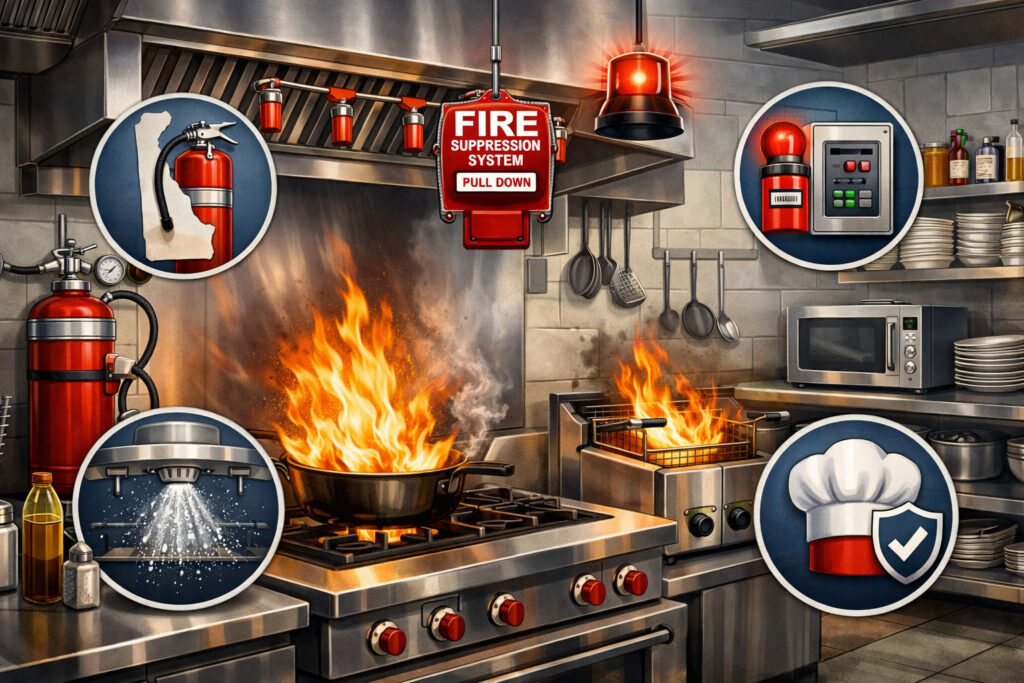
When operators ask about commercial kitchen fire suppression requirements Delaware businesses must follow, they are usually dealing with Type I hoods, automatic suppression, and the inspection/testing/documentation chain that proves the system works.
Type I hood systems and when they’re required
A Type I hood is generally required over appliances that produce grease-laden vapors, such as fryers, griddles, charbroilers, ranges, and woks.
Delaware OSFM is explicit about the process: for commercial cooking that produces grease-laden vapors, a kitchen hood suppression plan submittal is required, and a Type I hood must be submitted prior to submitting for a hood suppression system. OSFM also states final acceptance is required prior to the use of the Type I hood.
Automatic fire suppression systems: what inspectors expect
Most grease-producing commercial cooking lines require an automatic fire suppression system (often wet chemical, listed for commercial cooking). Inspectors commonly focus on:
- Correct nozzle placement and coverage for each protected appliance
- Appliance lineup matching the approved design (no “extra fryer added later”)
- System condition, accessibility, and signage
- Interlocks (fuel/electric shutoff, hood exhaust operation) where required by the system design and AHJ
- Proper agent type and current service tags
Delaware also provides a specific pathway for commercial cooking hood suppression licensing and quality assurance forms through OSFM.
Manual pull stations: placement and usability
Many commercial cooking suppression systems include a manual pull station (manual activation) that must be:
- Clearly visible and accessible
- Unblocked at all times
- Located where a staff member can activate it while maintaining a safe exit route
Inspection, servicing, tagging, and documentation
Your suppression system is not “set it and forget it.” A compliance-ready program typically includes:
- Routine servicing by qualified personnel
- Documentation of inspections and maintenance
- A binder or digital folder that stores:
- Approved plans (as-built if required)
- Acceptance test documentation
- Service/inspection tags and reports
- Deficiency repairs and close-out documentation
For hood/duct mechanical systems, Delaware OSFM notes that plan submittal is required for new/altered Type I hoods and that a leakage test is required per NFPA 96, and final acceptance testing is required prior to use.
Ventilation and Grease Control: Hoods, Ducts, Traps, and Cleaning Records
Ventilation isn’t just comfort—it’s the core of grease fire prevention. Grease accumulation inside hoods and ducts is one of the most common fire hazards in restaurants, food halls, and commissaries.
Hood installation and NFPA 96 ventilation standards
A compliant Type I hood setup typically includes:
- Proper hood size and capture area for the appliances beneath
- Grease filters installed correctly and maintained
- Exhaust airflow that matches the system design
- Makeup air balanced to avoid back-drafting and smoke rollout
Delaware OSFM ties commercial kitchen hood/duct work to plan review and NFPA 96 expectations, including leakage testing and acceptance.
Practical example:
If your kitchen smokes up during peak service or you see grease “dripping” from hood edges, don’t treat it as an annoyance. Treat it as a red flag that your system may be underperforming or overdue for cleaning.
Duct construction, access panels, and “cleanable to bare metal”
Commercial exhaust ducts must be constructed and arranged so they can be inspected and cleaned. From an operational standpoint, your goal should be:
- Clear access to cleanout panels
- No “sealed-in” duct runs that can’t be serviced
- Cleaning that reaches the full system—not just the visible hood
Common failure point: A hood cleaning contractor cleans the hood canopy and filters but doesn’t adequately clean the duct to the discharge point. If a fire starts in the duct, surface-level cleaning won’t help.
Grease trap maintenance: fire risk meets health compliance
While grease traps are usually driven by plumbing/environmental requirements, poor grease trap management can contribute to:
- Grease spills near ignition sources
- Slippery floors that complicate emergency response
- Improper storage of grease waste (combustible load)
Good practice checklist:
- Maintain a schedule (based on volume)
- Store waste oil in approved containers
- Keep oil containers away from cooking appliances and electrical panels
- Train staff on spill response and disposal procedures
Cleaning frequency guidelines and how to set your schedule
NFPA 96 inspection/cleaning intervals vary by cooking type/volume. A widely referenced schedule includes:
- Monthly: solid fuel cooking operations
- Quarterly: high-volume cooking operations (e.g., 24-hour, charbroiling, wok cooking)
- Semiannually: moderate-volume cooking
- Annually: low-volume cooking
You should confirm the required interval with your AHJ, but these categories are commonly used as the baseline for inspection planning.
Practical way to apply this:
If you run fryers and a charbroiler, assume you’re at least “moderate” and likely “high-volume” during busy seasons. Adjust your schedule based on reality, not what’s cheapest.
Recordkeeping expectations that actually work
A record system doesn’t have to be fancy. It has to be consistent:
- Keep hood cleaning certificates (date, scope, who performed it)
- Store suppression inspection/service reports
- Track deficiencies and repairs
- Keep photos after cleaning (optional but helpful)
- Maintain a one-page “inspection snapshot” for quick review
Pro tip for property managers: If you manage multiple tenants, create a standardized “restaurant fire inspection checklist” packet you require each tenant to maintain. It reduces liability and confusion.
Fire Extinguishers, Alarms, and Emergency Equipment in Delaware Kitchens
This is where many otherwise well-run operations fail inspections: not because they lack equipment, but because equipment is expired, blocked, missing signage, or undocumented.
Class K fire extinguishers: what they are and why kitchens need them
Class K fire extinguishers are designed for cooking media fires (hot oils and fats) common in commercial kitchens. NFPA provides general public guidance explaining what Class K extinguishers are and why they matter.
In practice, many jurisdictions require Class K extinguishers where commercial cooking involves vegetable/animal oils and fats, typically within a short travel distance. A common model-code reference is a 30-foot travel distance for portable extinguishers serving commercial cooking equipment hazards.
Practical placement tips:
- Place Class K extinguishers near the cooking line but not so close that you must reach through a fire to grab it
- Mount at a visible height, with clear signage
- Ensure nothing blocks access (no boxes, no carts, no “temporary storage”)
Inspection schedules and tag basics for extinguishers
Most compliance programs include:
- Monthly visual checks (in-house): gauge, pin/seal, access, condition
- Periodic servicing (by qualified provider): per applicable standards and AHJ expectations
- Replacement or recharge after any use—even partial discharge
Common violation: “It’s there, but the tag is expired” or “It’s there, but it’s behind the mop sink.”
Fire alarm systems in Delaware commercial buildings
If your building requires a fire alarm system (or if you’re modifying it), Delaware OSFM notes that a fire alarm plan submission is required for new systems, additions, or changes, and a final acceptance test is required prior to occupying the structure or tenant.
Emergency lighting and exit signage
Even the best suppression system won’t matter if staff and customers can’t get out quickly.
A compliance-ready approach includes:
- Clearly marked exits (no missing signs, no burned-out letters)
- Emergency lighting that functions during power loss
- Exit paths kept clear at all times (no stacked chairs, no storage in corridors)
Operational rule that works: “If it’s in the exit path, it’s not allowed—ever.”
Commercial kitchen fire inspection in Delaware: what to expect and how to pass
A commercial kitchen fire inspection Delaware operators face is usually a mix of life safety, fire protection systems, and operational readiness. Passing isn’t about perfection—it’s about demonstrating control of the hazards and maintaining required systems.
What inspectors commonly evaluate
Expect inspectors to look at:
- Hood, duct, and suppression system condition
- Service tags and inspection documentation
- Extinguisher presence, placement, and inspection status
- Egress: exits unlocked, paths clear, exit signs lit
- Electrical: no hazardous daisy chains, cords not damaged
- Gas: shutoff accessibility, appliances installed properly
- Housekeeping: grease buildup, storage near ignition sources
- Alarm/sprinkler interface and system readiness (where applicable)
Common violations that cause delays and re-inspections
These come up repeatedly across restaurant types:
- Grease accumulation in hood/duct or missing cleaning records
- Suppression system not serviced on schedule, missing tags, or unapproved modifications
- Class K extinguisher missing or inaccessible
- Exits blocked, locked, or used as storage
- Extension cords used as permanent wiring
- Suppression pull station blocked or not clearly identified
- Staff unaware of emergency procedures
How to prepare: a realistic 7-day inspection plan
7 days out
- Pull your documentation binder (or build one)
- Confirm last hood cleaning and suppression service dates
- Verify extinguisher inspections and access
- Do a walkthrough with a “fresh eyes” manager
3 days out
- Deep clean behind/under cooking equipment
- Confirm filters are installed correctly
- Clear all exits and mark “no storage” zones
Day before
- Test emergency lighting (where test controls exist)
- Verify exit signs illuminated
- Stage a quick staff reminder: pull station, extinguishers, evacuation routes
Re-inspection procedures and consequences of non-compliance
Re-inspections are common when deficiencies are not corrected or documentation isn’t provided. Consequences can include:
- Written deficiencies with deadlines
- Required re-inspection fees (varies by jurisdiction and circumstance)
- Delays in opening, occupancy, or continued operation in serious cases
Important: The safest approach is to treat violations as an operations problem, not an inspector problem. Fix the root cause—usually scheduling, training, or documentation.
Special considerations: food trucks, catering, shared kitchens, and historic buildings
Not every “commercial kitchen” looks like a full-service restaurant line. Delaware operators often work in mobile units, commissaries, multi-tenant kitchens, and older buildings—each with unique fire safety friction points.
Food truck fire safety in Delaware
Food truck fire safety Delaware operators should plan for three categories of risk:
- Cooking suppression and ventilation (especially if producing grease-laden vapors)
- Fuel systems (propane/LPG, generator fuel, electrical distribution)
- Egress and shutdown procedures (tight spaces, quick evacuation)
NFPA provides public guidance emphasizing permits, suppression, extinguisher readiness, and fuel safety practices for food trucks. While local enforcement details vary, the risk controls are consistent across jurisdictions.
Practical food truck checklist:
- Class K extinguisher for cooking oil/fat hazards
- ABC extinguisher (as appropriate for electrical/general fires)
- Suppression over protected appliances if required by AHJ
- LPG cylinders secured, protected, and inspected
- Generator and fuel storage managed to prevent ignition and spill hazards
- Staff trained to shut off fuel and power quickly
Catering operations: “temporary kitchen” doesn’t mean temporary rules
Caterers often fail inspections at event venues because they assume the venue’s safety systems cover them. Inspectors may look at:
- How cooking equipment is positioned (clearances from combustibles)
- Whether extension cords and power strips are used safely
- How fryers and hot oil are handled (spill control, extinguisher access)
- Whether exits remain clear despite staging and equipment
Practical rule: If you bring the hazard, you bring the controls—extinguishers, safe power, safe placement, and trained staff.
Shared commercial kitchens and commissaries
Shared kitchens introduce responsibility confusion: who cleans what, who schedules which inspections, and who keeps the records?
NFPA 96 responsibility concepts are often summarized as placing responsibility for inspection/maintenance/cleanliness on the system owner unless transferred in writing. In shared spaces, written agreements are essential.
What to put in writing (minimum):
- Who schedules hood/duct cleanings
- Who schedules suppression inspections and repairs
- Who keeps the documentation binder
- What happens if one tenant creates excessive grease buildup
- How equipment changes are approved and documented
Historic buildings converted to restaurants
Older buildings can create challenges with:
- Routing ducts to the exterior
- Adding access panels for cleaning
- Upgrading alarm/egress features without damaging historic elements
Most AHJs will focus on outcomes: safe egress, effective suppression, and maintainable ventilation. If constraints exist, ask about approved alternatives early—before you sign a lease or start construction.
Staff training and operational fire safety that inspectors notice
Equipment matters, but people and habits determine whether you prevent fires—or respond effectively when something goes wrong.
Employee fire safety training essentials
At minimum, staff should know:
- How to activate the hood suppression system (manual pull)
- How to call 911 and what to say (address, cross street, type of fire)
- How to use extinguishers appropriately (and when not to)
- Where gas/electric shutoffs are (if assigned by policy)
- Evacuation routes and meeting points
Practical method: Use “first day,” “30-day,” and “quarterly refresher” training instead of one annual session nobody remembers.
Emergency evacuation plans in real kitchens
A plan isn’t a binder on a shelf. It’s a practiced routine:
- Who leads customers to exits?
- Who checks restrooms (if safe)?
- Who shuts down cooking equipment (only if safe and assigned)?
- Where does staff assemble?
Make the plan visible in staff areas and incorporate it into onboarding.
Cooking oil handling and fryer safety
Hot oil is a leading cause of severe kitchen fires and injuries. Your safety program should cover:
- Never leaving fryers unattended during busy periods
- Filtering and disposing oil safely (cool-down procedures)
- Keeping combustibles (towels, boxes) away from fryers
- Using lids and proper tools, not improvisation
- What to do during a flare-up (shut off heat, use Class K if appropriate, pull suppression if escalating)
Safe equipment spacing and housekeeping
Most operational hazards are spacing issues:
- Keep appliance clearances from combustibles (including temporary items like cardboard)
- Avoid storing anything on top of ovens or near open flames
- Manage cords so they don’t cross hot zones or get pinched
- Clean behind equipment on a schedule (not “when we have time”)
Common mistakes to avoid in Delaware commercial kitchens
These are the patterns that repeatedly cause failures under Delaware restaurant fire safety regulations and similar enforcement programs.
Mistake 1: Skipping hood cleanings or relying on “light cleaning”
If your hood system is due quarterly and you push it to twice a year, you’re not just risking a violation—you’re stacking fuel inside your ductwork. Use the NFPA 96 inspection frequency framework as your baseline, and verify the interval with your AHJ.
Mistake 2: Blocked exits and “temporary storage” in egress paths
This is one of the fastest ways to get cited because it’s visible and dangerous. Most kitchens develop “temporary” habits—boxes in corridors, chairs near exit doors, deliveries staged in exit paths. Make “no storage zones” a non-negotiable policy.
Mistake 3: Expired extinguisher tags and missing Class K coverage
An extinguisher without current inspection/service status might as well not exist during an inspection. Make monthly in-house checks part of a manager’s routine and keep records.
Mistake 4: Unapproved suppression system modifications
Adding an appliance, moving a fryer, swapping a charbroiler—these changes can break the suppression design. If the suppression system no longer matches the appliance layout, you can fail inspection and increase real risk.
Mistake 5: Poor documentation (even when the work was done)
Many operators clean hoods and service systems but can’t prove it. Keep:
- Invoices and certificates
- Service reports
- Deficiency repair documentation
- Acceptance test documents where applicable
Delaware OSFM’s plan review process highlights acceptance and plan submittals for key systems—paperwork matters.
Practical compliance checklist for Delaware commercial kitchens
Use this as a step-by-step “inspection-ready” framework. Adjust details based on your AHJ’s direction and your specific kitchen setup.
Step 1: Confirm your governing authorities and required submissions
- Identify the AHJ (OSFM, city, county, fire district, etc.)
- Confirm whether you need plan review for:
- Type I hoods and ductwork
- Hood suppression systems
- Fire alarm system changes
- Store approvals and acceptance documentation in a single folder/binder
Step 2: Build your “kitchen fire safety binder” (or shared digital folder)
Include:
- Approved plans and permits (as applicable)
- Hood cleaning certificates and schedules
- Suppression inspection/service reports and tags
- Extinguisher inspection/service documentation
- Fire alarm acceptance/testing documentation (if applicable)
- Training logs (onboarding and refreshers)
- A one-page emergency plan
Step 3: Ventilation, grease control, and cleaning program
- Assign responsibility for:
- Filter cleaning/replacement
- Hood/duct professional cleaning schedule
- Grease trap maintenance and waste oil handling
- Set an inspection/cleaning interval aligned to cooking volume categories (confirm with AHJ)
- Take dated photos after major cleanings (optional but helpful)
Step 4: Suppression system readiness
- Verify nozzle coverage matches your appliance lineup
- Keep pull stations accessible and labeled
- Confirm interlocks (as designed) function properly
- Schedule service per the required cadence and retain reports
- Never modify the line without involving qualified suppression professionals
Step 5: Extinguishers and emergency equipment
- Provide Class K extinguishers where cooking oils/fats are used; ensure accessible placement
- Add additional extinguishers as needed for general hazards
- Monthly in-house check log (simple initial-and-date sheet)
- Keep exit routes clear and exit signage/emergency lighting functional
Step 6: Staff training and drills (simple, consistent, documented)
- Train on:
- Pull station and suppression activation
- Extinguisher basics and limitations
- Evacuation routes and meeting point
- Refresh quarterly in 10-minute huddles
- Document training attendance
Step 7: Self-audit before inspections
Use a “restaurant fire inspection checklist” walkthrough:
- Are all exits clear and operable?
- Are extinguisher tags current and units accessible?
- Are hood/duct and suppression records complete and current?
- Are there any “temporary” hazards (cords, storage, combustibles near heat)?
- Can a line cook explain what to do in a grease fire?
Frequently asked questions (FAQs)
Q1) How often are commercial kitchen fire inspections required in Delaware?
Answer: Inspection frequency can vary by jurisdiction, occupancy type, risk level, and local policy. Some locations may inspect annually, while others inspect on different cycles or in response to permits, complaints, renovations, or licensing events.
Your most reliable answer comes from your AHJ (often OSFM and/or local fire officials). Delaware updates and administers statewide regulations through OSFM and related state fire prevention structures, so it’s smart to confirm the current cycle when you renew permits or change operations.
Q2) What type of fire suppression system is required in a Delaware commercial kitchen?
Answer: If your cooking produces grease-laden vapors, you will typically need a Type I hood and a listed automatic fire suppression system designed for commercial cooking hazards.
Delaware OSFM indicates that a hood suppression plan submittal is required for commercial cooking that produces grease-laden vapors and that acceptance is required prior to use.
Q3) Are Class K fire extinguishers mandatory in restaurants?
Answer: In many commercial cooking environments involving cooking oils and fats, Class K extinguishers are required or expected as part of the protection strategy. NFPA provides general guidance on what Class K extinguishers are and why they’re used for cooking media fires.
Always verify the exact placement and quantity with your AHJ because requirements can depend on your appliances and layout.
Q4) How often must hoods and grease ducts be cleaned?
Answer: Cleaning and inspection intervals depend on cooking type and volume. A commonly referenced NFPA 96-based schedule is monthly (solid fuel), quarterly (high-volume), semiannually (moderate), annually (low-volume). Confirm your required interval with the AHJ and document every cleaning.
Q5) Who enforces fire codes for restaurants in Delaware?
Answer: Enforcement typically involves the Delaware Office of the State Fire Marshal and local AHJs (which may include municipal or fire district authorities depending on location and building type). Delaware’s fire prevention regulations are promulgated at the state level and enforced through the applicable authorities.
Q6) What happens if I fail a fire inspection?
Answer: Outcomes vary by severity. You may receive a deficiency notice with correction deadlines and may require a re-inspection. Serious hazards (blocked exits, inoperable suppression, extreme grease buildup) can lead to escalated enforcement. The best way to reduce disruption is to maintain documentation and fix issues immediately.
Q7) Do food trucks need suppression systems in Delaware?
Answer: Many food trucks with grease-producing cooking operations may be required to have suppression and specific extinguishers, but the exact requirement depends on your equipment, fuel type, and local AHJ rules.
NFPA public resources highlight suppression and fire prevention as key components of food truck safety. Always verify with the AHJ that inspects your mobile operation.
Q8) Do I need a plan review if I replace a hood or change my cooking line?
Answer: Often, yes—especially if you are adding or altering a Type I hood, ductwork, suppression system, or fire alarm components. Delaware OSFM describes plan submittals for hood/duct mechanical and hood suppression systems, with testing and acceptance requirements prior to use.
Q9) What documents should I have ready for a commercial kitchen fire inspection?
Answer: Keep a single binder or digital folder with:
- Hood/duct cleaning certificates
- Suppression inspection/service reports
- Extinguisher inspection/service documentation
- Approved plans/acceptance tests (where applicable)
- Fire alarm acceptance/testing (if applicable)
- Training logs and emergency plan
OSFM plan review/acceptance expectations make documentation especially important when opening or modifying operations.
Q10) What are the most common fire-code violations in commercial kitchens?
Answer: Common issues include grease accumulation, missing or expired service tags, blocked exits, unapproved appliance changes under a hood, and poor documentation. These are preventable with scheduling, training, and a monthly self-audit process.
Q11) Can I do hood cleaning in-house to save money?
Answer: You can and should do routine filter cleaning and visible degreasing as part of daily/weekly housekeeping. But duct and hood system cleaning to meet NFPA 96 expectations is often performed by trained, qualified professionals—especially when ducts must be cleaned thoroughly and documented. Confirm what your AHJ accepts for your system and volume.
Q12) If my suppression system is “automatic,” do staff still need training?
Answer: Yes. Automatic systems can activate, but staff still need to know:
- Where the manual pull is and when to use it
- How to call emergency services
- When to use a Class K extinguisher vs. evacuate
- How to evacuate customers safely
Training and drills are a key part of operational safety and reduce injury risk.
Q13) How do I handle compliance in a shared kitchen or commissary?
Answer: Put responsibilities in writing—who schedules cleanings, who pays, who keeps records, and how equipment changes are approved. Shared kitchens fail when everyone assumes “someone else” is responsible.
Q14) What should I do if my building is historic and upgrades are difficult?
Answer: Engage the AHJ early and document constraints. Historic buildings can often meet safety goals through approved alternatives, but you need that approval before construction or occupancy decisions. Start the conversation during site selection, not after buildout.
Q15) Where can I verify the most current Delaware fire prevention regulations?
Answer: Use OSFM’s official regulations and updates page and confirm requirements with your AHJ—especially after regulatory updates become effective.
Conclusion
Delaware commercial kitchens are safest—and easiest to keep compliant—when fire prevention is treated as a routine operating system. The big levers are consistent: maintain your hood/duct and grease controls, keep suppression systems and extinguishers service-ready, protect egress routes, and document everything.
Action steps you can take this week:
- Identify your AHJ and confirm the current expectations for your location and kitchen type.
- Build a single “fire safety binder” (physical or digital) and put all tags, reports, and approvals in it.
- Set your hood/duct inspection and cleaning cadence based on cooking volume categories, then verify with the AHJ.
- Walk your egress routes and remove anything that doesn’t belong there—today.
- Run a 10-minute staff refresher on: suppression pull, Class K extinguisher basics, and evacuation roles.
If you’re opening, remodeling, adding appliances, or moving equipment, treat plan review and acceptance as part of the project timeline—not an afterthought. Delaware OSFM’s plan submittal and acceptance expectations for kitchen hoods/suppression and fire alarms make early coordination one of the best ways to prevent costly delays.