Delaware Liquor License Requirements: What You Need to Know
Starting (or expanding) a business that sells or serves alcohol in Delaware is exciting—but it’s also tightly regulated. Delaware liquor license requirements affect everything from your location and floor plan to your ownership structure, advertising, hours of sale, and ongoing compliance.
Getting it right up front can save you months of delays, unexpected costs, and enforcement problems after you open.
In Delaware, liquor licensing is handled at the state level by the Delaware Office of Alcoholic Beverage Control Commissioner (OABCC). The OABCC reviews and grants (or denies) license applications, approves certain changes to licensed premises, conducts inspections, and oversees renewals.
The Commissioner also conducts hearings on protested applications and adjudicates violations that are brought forward by Delaware Alcohol and Tobacco Enforcement (DATE).
This guide is designed for entrepreneurs, restaurant owners, bar owners, liquor store operators, event organizers, and small business owners who need clear, practical direction.
You’ll learn the main license types, eligibility basics, the Delaware liquor license application process, common pitfalls, typical fees, and what to expect after approval—so you can plan confidently and move forward with fewer surprises.
Why Liquor Licensing Matters in Delaware
Liquor licensing is not just a “box to check.” In Delaware, your license determines:
- What alcohol you may sell (spirits vs. beer/wine only)
- Where you may sell or serve (on-premise vs. off-premise, indoor vs. patio, temporary extensions)
- When you may sell (including whether you’re permitted for Sunday sales)
- How you must operate (posting requirements, training expectations, recordkeeping, promotions/advertising rules)
From a business perspective, alcohol privileges can significantly affect revenue models (dine-in vs. events, bar seating, private parties, catering, tastings). From a compliance standpoint, liquor rules are enforced through inspections and administrative hearings, and penalties can range from fines to suspension or revocation.
The practical takeaway: treat your alcohol license like a core business asset. Plan your entity structure, real estate, build-out, and operating procedures around the license you need—not the other way around.
The Delaware Office of Alcoholic Beverage Control Commissioner (OABCC)
The OABCC is the primary authority for Delaware alcohol licensing. It evaluates applications, handles transfers, approves certain changes to existing licensed premises, conducts (or schedules) hearings when needed, and processes renewals.
How the OABCC works in practice
Most applicants encounter the OABCC at three key stages:
- Pre-application and submission: You choose a license type, gather documentation, and submit through the OABCC’s preferred online licensing portal (Salesforce) or via email.
- Review, notice, and (sometimes) hearing: Some applications require public notice and may be protested, which can lead to a hearing. Delaware’s process includes rules about who can protest and what can trigger a formal hearing process.
- Operations and renewal: Once licensed, you must follow Delaware ABC regulations and administrative rules—especially around hours of service, Sunday permissions, premises changes, and advertising.
Online licensing and where to start
Delaware encourages applicants and licensees to use the OABCC’s Online Licensing system:
- New applicants can submit new on-premises and off-premises applications online.
- Transfers can be initiated online.
- Existing licensees can pay renewals, decals, and fines through the system.
The OABCC also publishes application forms, checklists, and templates (including public notice instructions) under “Forms & Application Materials.”
Types of Liquor Licenses in Delaware and Who They’re for
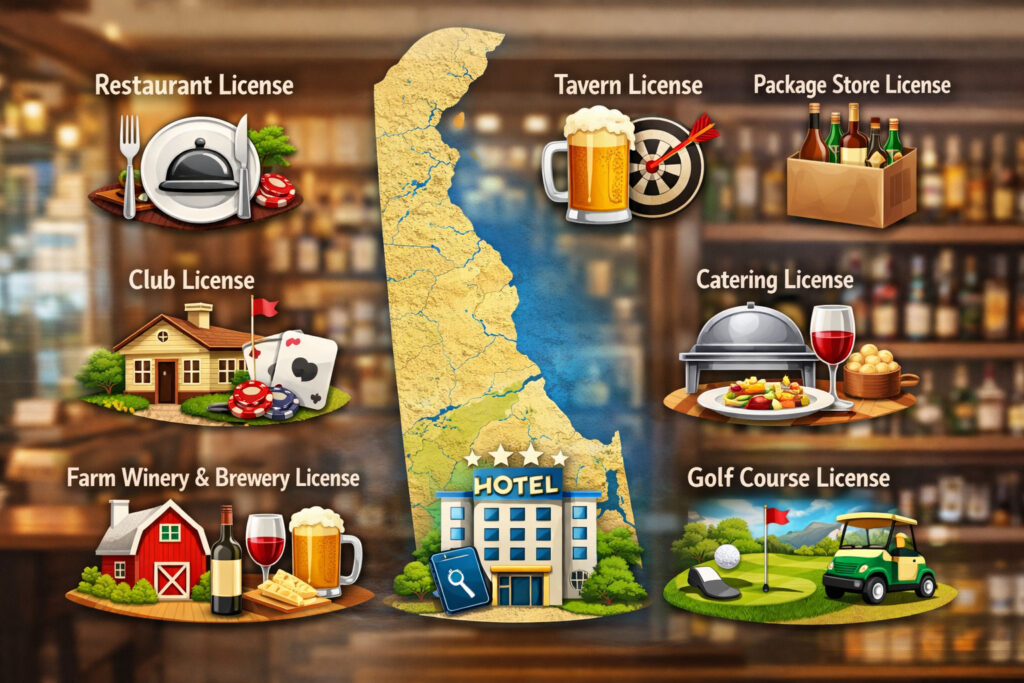
Choosing the right license category is one of the most important decisions you’ll make, because Delaware’s licensing rules are tied closely to how your business operates and where alcohol is consumed.
Delaware recognizes a range of on-premises and off-premises retail licenses, plus special categories for events and specific business models.
Below is a practical breakdown of common license types and who they fit best.
On-premise licenses
On-premise licenses are for businesses where alcohol is sold for consumption at the licensed location—think restaurants, bars, hotels, and similar venues.
Delaware’s on-premise application form lists many eligible categories, including Restaurant, Brewpub, Taproom, Hotel, Club, Bottle Club, Multiple Activity Club, Caterer (on/off), Dinner Theater, Bowling Alley, Movie Theater, Concert Hall, Beer Garden, and more.
Typical use cases:
- Restaurant liquor license Delaware: full-service restaurants that want beer, wine, and spirits with meals.
- Bar license Delaware / tavern-style operations: businesses focused primarily on alcoholic beverage service.
- Hotels and entertainment venues: alcohol service as an amenity or event feature.
Key operational reality: on-premise licensing is tied to your approved floor plan and premises configuration, including bar placement, seating, entertainment areas, and storage. Your application checklist typically requires a detailed floor plan showing seating, bars, ingress/egress, and alcohol storage.
Off-premise licenses
Off-premise licenses are for businesses that sell alcohol for consumption elsewhere—primarily liquor stores (“package stores”) and related retail models. The OABCC fee schedule lists Store as a common off-premises retail license type.
Typical use cases:
- Liquor stores selling sealed containers
- Some related privileges such as in-store tasting or growler filling may involve additional permissions/fees (depending on your operations).
A key difference: off-premise operators often face stricter practical considerations around signage/advertising and compliance procedures specific to retail sales, including hours and holiday closures.
Tavern licenses (including beer and wine only options)
Delaware commonly distinguishes certain “tavern-style” privileges, including beer and wine only tavern licensing categories in fee schedules.
In practice, tavern-type operations are best for:
- Bars or bar-forward concepts that may not qualify as a “bona fide” restaurant model
- Concepts intentionally limited to beer/wine rather than spirits
Tavern-type premises can also be subject to distance requirements depending on location type and license category.
Club licenses and multiple activity clubs
Private clubs and certain member-based facilities may qualify for Club or Multiple Activity Club licensing. The fee schedule reflects different fee tiers depending on membership size for private clubs.
In addition, applications for club-type licenses often require membership lists and other documents showing the organization’s structure and eligibility.
Bottle club licenses (BYO restaurants or event venues)
Delaware uses the term Bottle Club for certain BYOB-style operations where patrons bring alcohol onto for-profit premises for consumption. The OABCC fee schedule explicitly lists Bottle Club as a category and notes it can apply to BYO restaurants or event venues.
Important practical point: Delaware does not treat BYOB as a casual, informal “policy” for for-profit venues. If you’re operating for profit and want patrons to bring alcohol, you typically need a Bottle Club license.
Catering licenses and off-site alcohol service
Delaware has on-premise license options that include caterer categories, and Delaware law also recognizes off-site caterer privileges for transport and service at approved off-site premises (subject to rules).
This is especially relevant for:
- Wedding and event caterers
- Venues pairing with licensed catering partners
- Restaurants expanding into off-site beverage service
If you cater, expect to provide documents like sample contracts and be prepared to follow OABCC transport/service rules.
Temporary permits and special event permissions
Delaware supports multiple short-term and event-related permissions, including:
- Temporary Large Event (promoter) fees listed per event
- Temporary extensions of premises for festivals or holiday events (application required)
- Nonprofit gathering licenses (available only to eligible registered nonprofits)
Event organizers should plan early because temporary approvals may still require documentation, notice steps, and coordination with the premises and local authorities.
Basic Delaware Liquor License Requirements
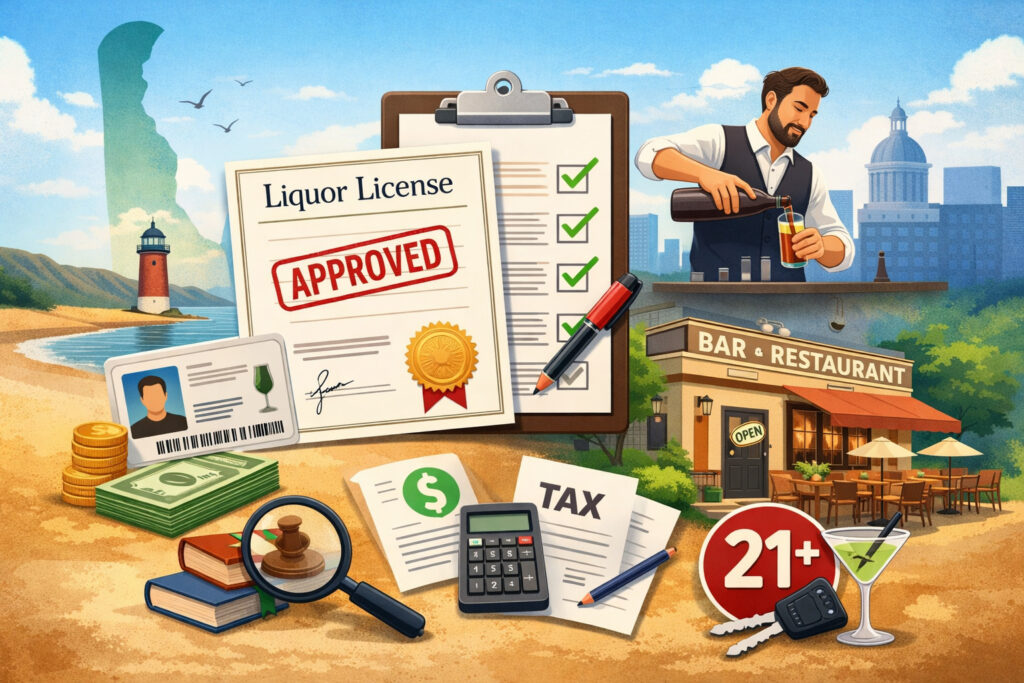
When people ask “What are the Delaware alcohol license requirements?” they usually mean two things: (1) who is eligible, and (2) what the business must prove about its location, ownership, finances, and operations.
While details vary by license type, Delaware applicants commonly need to be ready for the following categories.
Age requirements and serving expectations
At a minimum, alcohol service rules and operational expectations assume lawful service practices, including strict age verification at point of sale/service. Delaware’s OABCC materials also commonly require evidence of server training for those who will serve alcohol.
For example, the OABCC on-premises application checklist requires a server training certificate for all persons listed in the application who will serve alcohol.
Practical planning tips:
- Build ID-check procedures into your staff training.
- Keep training certificates and documentation organized for inspection readiness.
- Include a compliance “owner” (manager) responsible for refresher training and incident logs.
Business entity registration and ownership disclosures
Delaware expects applicants to apply as a properly formed business entity (corporation, partnership, LLC). The on-premises application is explicitly structured around an entity applicant and requests entity details (formation date, EIN, principal office) and a list of owners/officers/members/directors and ownership percentages.
Expect to provide documents such as:
- Certificate of incorporation/formation
- Good standing certificate (if applicable based on entity age)
- Governing documents (minutes listing directors/officers or LLC member agreement)
Ownership transparency matters. OABCC documentation frequently requires disclosures for significant owners (for example, those at or above certain ownership thresholds) and related financial/tax documentation.
Location control, lease terms, and floor plan approval
Most licenses are tied to specific premises. Applicants typically must show:
- A deed (if owned) or a lease that explicitly allows alcohol sale/service
- A detailed floor plan including dimensions, seating, bars, ingress/egress, and alcohol storage
Lease terms matter more than many first-time applicants realize. Some applications ask whether rent is tied to a percentage of receipts and whether there are undisclosed interests in the business or premises.
Zoning compliance and local approvals
Even though the license is issued at the state level, applicants typically need zoning approval from the relevant county or municipality. The on-premises checklist calls for zoning approval and commonly requires certificates of occupancy or building permits tied to your build-out timeline.
This means your “critical path” often includes local steps:
- Use approvals
- Occupancy approvals
- Sign permits (in some jurisdictions)
- Fire and health-related inspections (as applicable)
Public notice and protest-related requirements
Delaware licensing involves public notice in many cases, and a protest can trigger additional steps. The OABCC provides templates and instructions for notice and explains protest thresholds in its public notice materials.
For example, the mailed notice template indicates that for a hearing to be required, the Commissioner must receive one or more protest documents totaling at least 10 signatures of qualifying residents/property owners within a defined radius.
Additionally, the OABCC clarifies newspaper notice expectations, including that one notice may need to appear in a Delaware daily/weekly paper circulated within a five-mile radius of the premises and another circulated within the county.
Distance restrictions and proximity considerations
Delaware has distance requirements for certain license types, especially for taprooms, taverns, beer gardens, and package stores. OABCC’s distance certification form summarizes key minimum distances for certain categories:
- Taprooms/taverns/beer gardens: 1,200 feet in municipalities/incorporated areas; 0.9 miles (4,752 feet) in rural/unincorporated areas.
- Package stores: 0.5 miles (2,640 feet) in municipalities/incorporated areas; 3 miles in rural/unincorporated areas.
The distance certification materials also instruct applicants to list nearby churches and schools/colleges within a mile as part of the affidavit process.
Background checks and suitability review
Delaware’s application packet process commonly requires disclosures and vetting for owners and key stakeholders, and existing licensees may sometimes submit affidavits in lieu of additional documentation if there have been no disqualifying changes.
In practical terms, assume you’ll need:
- Consistent ownership disclosures across entity documents
- Clean and complete personal and business information for listed principals
- Sufficient financial transparency to answer questions about funding sources and interests (direct or indirect)
Step-by-step: How to get a liquor license in Delaware
If you’re looking for a clear “How to get a liquor license in Delaware” roadmap, this section breaks the process into manageable phases.
While the exact steps vary slightly by license type, most successful applicants follow the same core flow: entity → location → documentation → submission → notice/hearing (if applicable) → inspection → approval.
Step 1: Register your business and finalize ownership structure
Before you touch the Delaware liquor license application process, lock in:
- Your legal entity (LLC/corporation/partnership)
- Your ownership percentages
- Who will be listed as officers/members/directors
- Your EIN and business address information
Why this matters: the application asks for detailed ownership and may require disclosures and financial/tax documentation for both the entity and significant owners.
Best practice: keep an “OABCC binder” (digital folder) with signed operating agreements, minutes, capitalization records, and financing agreements.
Step 2: Secure a compliant location and confirm zoning early
Many applications stall because the location isn’t ready. Before applying:
- Confirm zoning supports your intended alcohol use (restaurant vs. bar vs. store)
- Ensure your lease permits alcohol sales/service (get it in writing)
- Start your floor plan and build-out planning (include bars, seating, storage, exits)
You’ll likely need:
- Zoning approval documentation
- Certificate of Occupancy or building permit plan (depending on timing)
Reality check: even if your concept is straightforward, permitting timelines can control your opening date more than the license review itself.
Step 3: Identify your license type and add-ons (Sunday, patio, entertainment)
Your application may ask whether you intend to:
- Sell alcohol on Sundays (often an explicit selection)
- Add a patio permit or outdoor service area
- Offer entertainment
For patios and outdoor service, Delaware rules can be strict, and some features may require variances (e.g., wet bars or certain entertainment).
Practical tip: decide these early. Adding a patio or entertainment after approval can require separate OABCC approval and public notice in some cases.
Step 4: Gather required documentation using the OABCC checklist
The OABCC provides checklists for common license categories. For on-premises licenses, the checklist commonly includes:
- Completed application form and required attachments
- Application processing fee
- Individual disclosure forms for owners/officers/members/directors/partners
- Server training certificates for those who will serve alcohol
- Financial statements (business and qualifying owners)
- Tax certification letters (where applicable)
- Lease/deed, floor plan, zoning approval
- Notice publication and mailed notice proofs (often not required for transfers)
- Distance affidavit for certain license types (taproom/tavern/beer garden)
Best practice: treat the checklist like a pass/fail pre-flight inspection. Missing “small” items is one of the fastest ways to add weeks to your timeline.
Step 5: Submit your application (online preferred)
The OABCC states that creating an online account in its Salesforce portal is the preferred method of submitting a liquor license application, though email submissions may be accepted.
After online submission, OABCC indicates a staff member will contact you by email to explain the process and required documents.
Step 6: Complete public notice steps (if required)
Many applications require public notice through:
- Newspaper publication (following instructions/templates)
- Mailed notice to nearby property owners (as required)
Delaware’s notice rules can be technical, so follow OABCC templates closely and keep proof (affidavits, mailing receipts, publication certificates).
Step 7: Prepare for a hearing (if protested or otherwise scheduled)
Not every application results in a hearing, but some do—especially if there’s sufficient public interest or a valid protest.
OABCC protest hearings are formal proceedings. The OABCC also explains:
- Who is eligible to testify (often those living/owning property within one mile, among others)
- Document deadlines (materials may be due at least 10 business days prior)
- Registration requirements and time limits for testimony
Planning tip: if your concept could draw attention (late hours, entertainment, patio, amplified sound), build your community outreach into your pre-opening plan.
Step 8: Inspection, final steps, and timeline expectations
Approval often involves aligning:
- Final build-out readiness
- Certificates of occupancy (or building permit milestones)
- Required decals at entrances (if applicable)
Timeline expectations vary widely based on:
- Completeness of your submission
- Whether public notice is required
- Whether a hearing is triggered
- Construction/occupancy status
- Local zoning and permitting complexity
The best way to avoid timeline shocks is to assume licensing and permitting move in parallel—not sequentially—and to submit with a clean, organized packet the first time.
Fees and costs: What a Delaware liquor license can cost
Understanding Delaware alcohol permit fees is essential for budgeting. Costs typically include (1) the OABCC processing/application fee, (2) the license fee itself, and (3) “soft costs” tied to compliance, build-out, and professional services.
Core OABCC fees you should expect
The OABCC fee schedule lists the most common fees and notes that fees are set in the Delaware Liquor Control Act. Key items include:
- Application processing fee: $1,000 (non-refundable) for applications that require OABCC vetting or are subject to a public hearing (with some exceptions).
- On-premises retail license fees (examples):
- Restaurant: $1,000
- Beer and wine only (Tavern): $500
- Hotel: $1,000
- Brew Pub: $2,000
- Beer Garden: $2,000
- Taproom: $1,000
- Caterer: $1,000
- Bottle Club: $300
- Temporary Large Event (promoter): $500 per event
- Off-premises retail license fees (examples):
- Store: $1,000
- In-store tasting: $150
- Growler filling: $150
Biennial vs. annual: how Delaware license terms work
A common point of confusion is renewal frequency. Delaware’s fee schedule states that in most cases, the fees listed are for a biennial license, renewable every two years. Delaware law similarly provides that licenses are generally valid for two years, unless otherwise stated.
Other cost categories to budget for
In addition to state fees, many operators incur meaningful additional costs:
- Build-out and design costs
- Floor plan preparation, bar layout, alcohol storage planning
- Patio build-out or alterations requiring separate approval
- Professional services
- Legal guidance for complex ownership structures, lease negotiations, or contested hearings
- Architectural drawings and permitting coordination (especially for restaurants and venues)
- Compliance and training
- Server training programs and ongoing onboarding
- POS controls for ID checks and audit logs
- Operational readiness
- Decals at public entrances (as required)
Transfers and changes can add fees and time
If you’re buying an existing business or acquiring a license, you may need to go through a transfer process. OABCC’s online licensing system supports license transfer applications.
Transfers may not require the same notice steps as a new application in some cases (checklists often note that notice is not required for transfers), but you should still budget for processing time and documentation.
Delaware liquor license application process: Where to apply, what you’ll need, and how to avoid delays
This section goes deeper on the Delaware liquor license application process so you can build a clean submission and reduce the risk of rejection or rework.
Where to apply
You typically apply through:
- OABCC Online Licensing (Salesforce portal) — preferred method
- Email submission (accepted in some circumstances)
For general guidance, Delaware’s “Business First Steps” portal also directs applicants to OABCC and provides contact details and links to relevant statutes and regulations.
Required documentation: what most applicants should prepare
While specifics vary, on-premises applicants commonly need:
- Core forms
- License application form (correct category)
- Individual disclosure forms for principals
- Ownership, entity, and governance
- Certificate of formation/incorporation
- Good standing certificate (if applicable)
- Operating agreement / corporate minutes listing officers/directors
- Financial and tax
- Business financial statement
- Owner financial statements (for qualifying ownership levels)
- Tax certification letters where applicable
- Premises and local compliance
- Lease with alcohol permission or deed
- Floor plan with seating/bars/storage/egress
- Zoning approval
- Certificate of occupancy or building permit status
- Notice and distance (where applicable)
- Newspaper publication affidavit(s)
- Proof of mailed notice to property owners (as required)
- Distance certification/affidavit for certain license types
Common delays and how to prevent them
Most delays trace back to a few repeat issues:
- Premises documents don’t match: Lease doesn’t clearly permit alcohol, or entity name differs from application.
- Floor plan isn’t detailed enough: Missing dimensions, bar locations, alcohol storage areas, or egress.
- Zoning approval is missing or unclear: “Pending” zoning often stalls licensing progression.
- Notice steps aren’t done exactly as required: Wrong newspapers, insufficient circulation, missing affidavits, or incomplete mailing proofs.
- Ownership disclosures are incomplete: Unlisted stakeholders, inconsistent percentages, or missing disclosure forms.
- Distance rules overlooked: Especially for taverns/taprooms/beer gardens and package stores.
Tips to avoid rejection (and reduce back-and-forth)
- Use the correct checklist for your license type and check off every line item before submission.
- Make your entity name consistent across your lease, tax documents, and application.
- Submit a “review-ready” floor plan (clean, labeled, with dimensions and seating counts).
- Plan notice early so you’re not waiting on publication schedules.
- Treat “optional” features as licensing decisions (Sunday sales, patio, entertainment). Each can create additional approvals or variances.
- Document your funding sources clearly—especially if you have investors, loans, or landlord participation.
Renewal and ongoing compliance in Delaware
Getting licensed is only the beginning. Delaware expects ongoing compliance with its statutes and administrative rules, and licensees can face sanctions if they violate state laws or regulations.
Liquor license renewal in Delaware
Delaware licenses are generally issued for two-year terms, and many common fees are listed as biennial in OABCC materials. That means your renewal planning should be on a two-year cadence unless your specific license is shorter by rule or approval.
Strong renewal habits:
- Set calendar reminders months ahead of expiration.
- Keep your ownership, tax, and financial documents continuously updated.
- Track changes that may require OABCC approval (premises changes, ownership changes).
Recordkeeping and operational controls
Even if your day-to-day operations are smooth, compliance problems often come from weak documentation. Build systems for:
- Training records: Keep server training certificates accessible for staff who serve alcohol.
- Hours and last-call procedures: Delaware’s OABCC FAQ includes rules like limits on serving close to posted closing time and required storage of alcohol by certain times.
- Sunday sales: On-premises operations may sell and serve during allowed hours provided the establishment holds a Sunday license.
- Premises integrity: Don’t “quietly” expand seating, add bars, or build patio features without approval when required—Delaware’s rules and OABCC processes treat the licensed premises as an approved plan.
Advertising and promotion compliance (including drink specials)
Delaware regulates alcohol advertising and promotions. OABCC’s advertising and promotion rule prohibits advertisements or promotions that would reasonably be expected to:
- Induce minors to purchase or consume alcohol
- Induce any person to consume alcohol to excess
- Violate applicable federal/state/local laws
- Make misleading claims
Practical implications:
- Be careful with “unlimited drinks,” “rapid consumption” messaging, or promotions that encourage overconsumption.
- Ensure your marketing stays professional and compliant, especially on social media.
Penalties for violations
Delaware’s Business First Steps portal explains that alleged violations investigated by DATE can be adjudicated by the ABC Commissioner through the administrative hearing process, with penalties ranging from reprimands to fines, suspension, or revocation.
The best defense is proactive compliance: train staff, document processes, and treat your licensed premises boundaries and operating hours as hard rules.
Special considerations Delaware business owners should know
Some Delaware alcohol rules surprise first-time operators because they feel like “policy choices” rather than legal requirements. The sections below cover frequent pressure points: BYOB/Bottle Clubs, happy hour realities, Sundays, municipal variations, and license transfers.
BYOB rules and Bottle Clubs
Delaware draws a clear line between:
- Nonprofit premises (which may allow alcohol brought and consumed without needing a Bottle Club license in some circumstances), and
- For-profit premises, which generally may not allow patrons to bring alcohol for consumption without first obtaining a Bottle Club license.
The OABCC also notes practical restrictions, such as that a Bottle Club may not keep alcohol left behind by customers after they leave and must dispose of it within specified time frames.
If your business model involves “BYOB,” plan for Bottle Club licensing early—especially if you’re an event venue, wedding venue, or a “bring your own bottle” dining concept.
Happy hour and drink specials
Delaware allows promotions, but the compliance focus is on avoiding advertising or practices that would reasonably be expected to encourage excessive consumption.
Instead of trying to push boundaries, build safe, compliant promotions:
- Time-limited discounts with clear terms
- Food pairings and prix fixe menus with controlled portions
- Transparent pricing that doesn’t suggest rapid or excessive consumption
If you’re unsure about a specific promotion concept, verify it with OABCC guidance before launching the campaign.
Sunday sales laws and legal hours
Sunday privileges matter for restaurants, bars, and stores.
OABCC’s FAQ explains:
- On-premises establishments may sell and serve alcohol between 8 a.m. and 1 a.m. every day, provided the establishment holds a Sunday license.
- Off-premises establishments may sell alcohol 9 a.m.–1 a.m. Monday–Saturday and 10 a.m.–8 p.m. Sunday (with seasonal variations noted for late-year Friday/Saturday mornings).
- Certain license types must remain closed on major holidays (example: package stores and craft distilleries on Thanksgiving, Christmas, and Easter).
Municipal and community variation (Wilmington, Dover, Rehoboth, and more)
Even with state-level licensing, your experience can differ significantly by location due to:
- Zoning categories and conditional-use requirements
- Noise and entertainment expectations (especially in residential-adjacent areas)
- Parking and occupancy constraints
- Community attention that can increase protest likelihood
If you’re in areas with higher density or stronger neighborhood involvement, invest more effort in:
- Early zoning conversations
- Clear operating policies (hours, security, crowd management)
- Proactive community outreach before notice publication
Transferring or selling a Delaware liquor license
License transfers can be an efficient path if you’re buying an existing business. Delaware’s online licensing system supports license transfer applications.
Also note: many requirements like newspaper notices or mailed notice proofs may not apply in the same way for transfers (checklists often indicate these are “not required for transfers”), but transfers still require careful documentation and OABCC approval.
Common mistakes to avoid
This section is intentionally blunt. Most liquor licensing problems aren’t caused by “bad luck”—they’re caused by predictable mistakes.
1) Submitting an incomplete application packet
Even a single missing checklist item can stop your review. The on-premises checklist is a good example of how comprehensive Delaware expects submissions to be: application form, processing fee, disclosures, training certificates, financials, tax letters, entity documents, lease/deed, floor plan, zoning approval, notice proofs, and more.
Fix: do a formal internal review before submission. Pretend you’re the reviewer and ask, “Could I approve this without emailing the applicant?”
2) Ignoring zoning and occupancy timing
Applicants often focus on the state license and forget that local approvals are the gating item. Delaware’s checklist explicitly calls out zoning approval and certificate of occupancy/building permit expectations.
Fix: parallel-track zoning, building permits, and the licensing application. Don’t wait.
3) Underestimating notice and protest risk
Public notice and protest mechanics can add real time and complexity. OABCC’s templates describe protest thresholds and how objections can trigger hearing-related steps.
Fix: plan notice weeks in advance, and build a community plan for higher-impact concepts (late hours, patio, entertainment).
4) Overlooking distance requirements
Distance requirements can be deal-breakers for certain license types, especially in dense markets. Delaware’s distance certification materials spell out specific minimum distances for certain on-premise and off-premise categories.
Fix: check distance feasibility before signing a lease, especially for taprooms/taverns/beer gardens and package stores.
5) Failing to plan for compliance after approval
Your license is not “set it and forget it.” Delaware regulates hours, last call behavior, storage timing, and other operational details.
Fix: create a compliance SOP manual and train managers before opening day.
Practical checklist: A Delaware liquor licensing action plan
Use this checklist as a working tool. It’s not a replacement for OABCC’s official checklist—but it will keep your project organized.
Business and ownership
- Form Delaware business entity (LLC/corp/partnership)
- Confirm ownership percentages and governance documents
- Create a master list of owners/officers/members/directors
- Gather entity formation and good-standing documents (if applicable)
Location and premises
- Secure a lease that explicitly permits alcohol sales/service (or deed)
- Obtain zoning approval from county/municipality
- Prepare floor plan with seating, bar placement, storage, ingress/egress
- Confirm certificate of occupancy/building permit plan
- Review distance requirements if applicable
License strategy
- Choose license type (on-premise vs. off-premise vs. bottle club vs. caterer)
- Decide on Sunday sales (if relevant)
- Decide on patio and entertainment features (and whether variances may be needed)
Application and documentation
- Download the correct OABCC checklist and forms
- Compile financial statements and tax certification letters (if applicable)
- Collect server training certificates for those who will serve alcohol
- Prepare public notice steps (newspaper + mailed notice) if required
- Pay the application processing fee if required
Submission and follow-through
- Submit via OABCC Online Licensing (preferred)
- Respond quickly to OABCC requests for clarification
- Prepare for hearing protocol if protested
- Plan final inspection readiness and required decals/entrance postings
FAQs
Q1) How long does it take to get a liquor license in Delaware?
Answer: Timelines vary based on license type, application completeness, local zoning/build-out status, and whether public notice or a hearing is triggered.
Applications that require public notice and face protests may take longer because protest hearings follow a formal process. A strong way to reduce delays is to submit a complete packet using the OABCC checklist and to align zoning/occupancy milestones early.
Q2) How much does a Delaware liquor license cost?
Answer: Many common Delaware liquor licenses have a $1,000 non-refundable application processing fee (when required), plus the license fee itself.
For example, the fee schedule lists restaurant licenses at $1,000, taprooms at $1,000, and package stores at $1,000, with other categories priced differently. Most of these fees are biennial (every two years).
Q3) Are Delaware liquor licenses annual or biennial?
Answer: In most cases, Delaware licenses are issued for two-year terms. Delaware law provides that licenses are valid for a period of 2 years unless stated otherwise. The OABCC fee schedule also notes most listed fees are for a biennial license, renewable every two years.
Q4) Can I transfer a liquor license in Delaware?
Answer: Yes. Delaware supports license transfers, and OABCC’s Online Licensing system specifically includes a pathway to apply to transfer a license for an existing premises. Transfer requirements and notice steps can differ from new applications, so use the transfer-specific checklist and documentation approach.
Q5) Do I need a separate permit for catering alcohol?
Answer: If you want to serve alcohol off-site, you generally need the appropriate catering privileges/license category. Delaware law recognizes off-site caterer licensing for transporting and selling alcohol for consumption on approved off-site premises, subject to rules. The on-premise application categories also include caterer options.
Q6) Can I serve alcohol at a private event in Delaware?
Answer: It depends on whether alcohol is sold/served under a license, whether the event is on a licensed premises, and whether the host is using a properly licensed caterer or gathering license where applicable.
Delaware also has nonprofit gathering licenses (eligibility applies), and promoters may use temporary large event permissions in certain circumstances. If your event is for-profit or open to the public, confirm the correct permit path with OABCC early.
Q7) What happens if my application is protested?
Answer: A protest can trigger a more formal process, including a protest hearing. OABCC publishes protocols for protest hearings, including who can testify, document submission deadlines, and registration requirements. The public notice template also outlines protest thresholds and submission methods.
Q8) Do I need to post my liquor license at my business?
Answer: Yes—OABCC’s FAQ states that a liquor license must be posted in a conspicuous place at the establishment. Posting is an easy compliance win: do it on day one and keep it visible.
Q9) Are there distance restrictions from churches or schools?
Answer: Delaware’s distance certification materials indicate applicants may need to list churches and schools/colleges within one mile (as part of the distance compliance process) and also summarize minimum distances between certain licensed premises depending on the license type and area. Because the rules can be location- and license-specific, validate your site before committing to a lease.
Q10) Can I run a mobile bar business with an OABCC license?
Answer: OABCC’s FAQ states that Delaware does not license mobile establishments that sell alcohol and that there is no provision for a mobile bar or bar trailer alcohol sales business under the Delaware Liquor Control Act.
Mobile bar operators may still offer bartending services in certain private-event contexts, but the alcohol itself must be procured separately by the host (per OABCC guidance).
Q11) Can my restaurant move alcohol between two locations I own?
Answer: OABCC’s FAQ indicates a retail licensee (such as a restaurant) may not transport product between commonly owned businesses unless the licensee is also a manufacturer of the product. Plan inventory and purchase accordingly.
Q12) Can I buy alcohol directly from a Delaware manufacturer?
Answer: OABCC’s FAQ notes that transporting beverages from one manufacturer to another without using a distributor is not permitted, and that retailers are generally not allowed to purchase alcohol directly from a licensed manufacturer (with limited exceptions described by OABCC). Work with the correct distribution channels to avoid compliance problems.
Q13) Do I need a Sunday license to sell alcohol on Sundays?
Answer: For on-premises establishments, OABCC’s FAQ explains that they may sell and serve alcohol during allowed hours every day provided the establishment holds a Sunday license. If Sunday sales matter to your business model, address this explicitly in planning and on your application.
Q14) What are the legal hours for selling alcohol in Delaware?
Answer: OABCC’s FAQ provides hours for on-premises and off-premises operations, including different Sunday hours for package stores and notes about holiday closures and seasonal variations. Always confirm your specific license privileges and local rules before setting public-facing “last call” policies.
Q15) Are liquor licenses limited by county in Delaware?
Answer: Some license types and availability can be affected by statutory frameworks, location constraints, and the local environment (zoning, protests, and distance restrictions).
Practically, availability can feel “limited” in certain markets because suitable locations are scarce under distance and zoning rules. For the most accurate answer for your exact address and license type, confirm directly with OABCC using the official application process and checklists.
Conclusion
Delaware liquor licensing is very doable—but it rewards preparation. The fastest, cleanest approvals typically come from applicants who (1) choose the right license type, (2) secure a compliant location with zoning approval, (3) build a complete documentation packet using OABCC checklists, and (4) execute public notice steps correctly when required.
Practical next steps you can take this week
- Pick your license path: on-premise, off-premise, Bottle Club, caterer, or temporary/event privileges.
- Validate your location: zoning first, distance requirements if applicable, and a lease that allows alcohol.
- Download the right OABCC checklist and forms and build a submission folder before you start filling anything out.
- Decide early on Sundays, patio, and entertainment, because these choices can affect approval steps and ongoing compliance.
- Use OABCC Online Licensing as your primary submission route and keep your supporting documents organized for quick follow-ups.
Finally, because liquor licensing rules can change and details can depend on your exact address and license category, verify any final interpretation with the OABCC’s official materials and guidance before you invest heavily in build-out or branding.