
How Much It Costs to Open a Restaurant in Delaware
Opening a restaurant in Delaware can cost anywhere from about $75,000 to $1,000,000+, depending on your concept (quick-service vs. full-service), location (New Castle County vs. beach towns), buildout needs, and whether you buy or lease. The real answer to the cost to open a restaurant in Delaware is not one number—it’s a set of cost buckets that move based on your choices.
A smart budget plan starts with two truths:
- Your biggest costs are usually space + buildout + equipment + payroll, not paperwork.
- Delaware has unique operating realities—especially gross receipts tax (instead of sales tax) and specific state licensing flows that affect timing and cash needs. Delaware’s business license guidance notes that Delaware does not impose a state sales tax but does impose gross receipts tax across business types.
This guide breaks down the cost to open a restaurant in Delaware into clear categories, gives realistic price ranges, explains which numbers are “must pay” vs. “depends,” and includes future-looking budget predictions you can plan around in 2026 and beyond.
What “Cost to Open a Restaurant in Delaware” Really Includes (Startup vs. Pre-Opening vs. Working Capital)
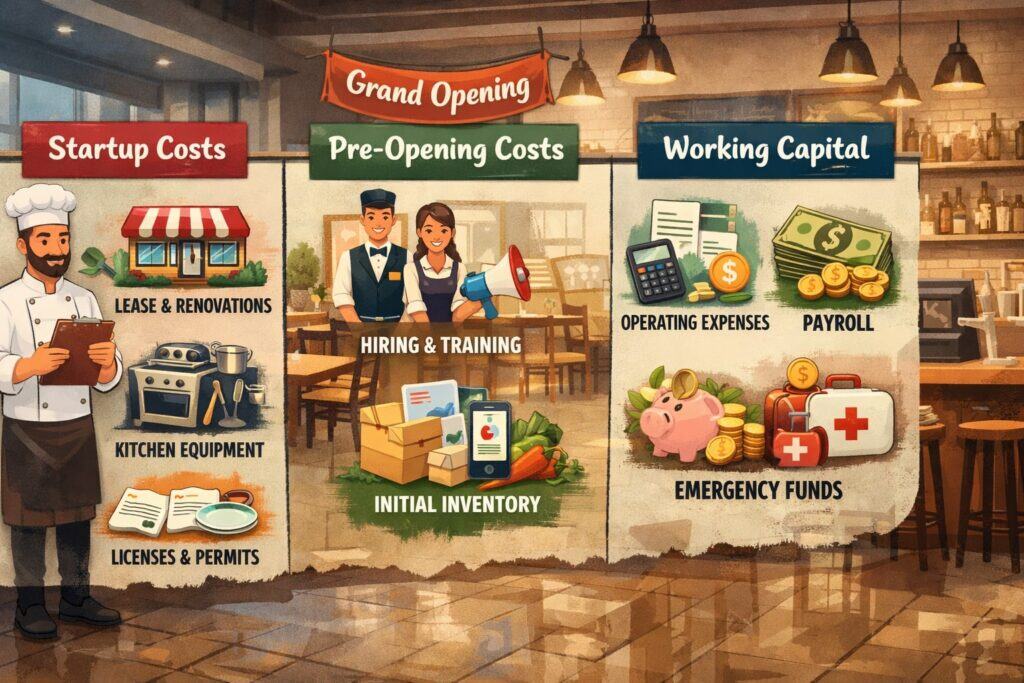
When people ask about the cost to open a restaurant in Delaware, they often mean the visible startup purchases—equipment, furniture, signs. But a successful opening budget in Delaware includes three layers:
Startup costs are one-time investments: deposits, permits, construction, equipment, POS, initial smallwares, and initial inventory. These are the big-ticket items that can swing your total dramatically.
If you’re converting an existing restaurant space, your buildout may be manageable. If you’re taking a “vanilla shell,” expect a heavier construction bill.
Pre-opening costs are what you pay before the first guest walks in: staff recruiting and training payroll, menu testing, soft opening food waste, marketing launch spend, professional fees, and insurance paid upfront. Many first-time owners underestimate how much cash it takes to open the doors and keep them open until revenue stabilizes.
Working capital is survival cash. It’s the money that covers payroll, rent, utilities, and vendors while you ramp up. A restaurant in Delaware can look “busy” and still run tight due to labor and food costs.
Delaware’s wage rules matter here: the state minimum wage is $15.00 as of January 1, 2025, and tipped employees have a $2.23/hour minimum cash wage under Delaware rules. That impacts your staffing model and the amount of working capital you need.
If you want a practical definition: the cost to open a restaurant in Delaware is the amount needed to sign the lease, pass inspections, buy everything, hire the team, open the doors, and operate for long enough to reach consistent weekly profitability.
Typical Total Cost Ranges to Open a Restaurant in Delaware (By Concept Type)
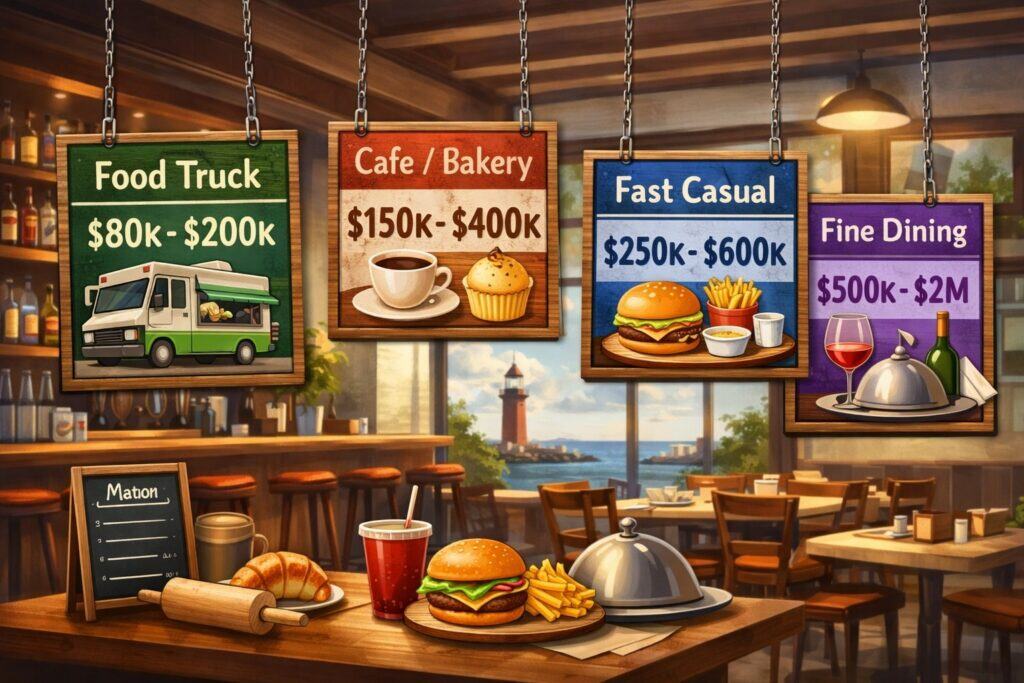
A helpful way to estimate the cost to open a restaurant in Delaware is to start with concept ranges. These are broad on purpose because equipment needs and buildout requirements vary widely across Delaware properties.
Small takeaway / quick-service (QSR) restaurant in Delaware
You may land in the $75,000–$250,000 range if you choose a modest footprint, minimal dining, and a space with an existing grease trap/hood. Costs climb when you need major plumbing or ventilation. QSR models can also reduce labor needs, which lowers working capital requirements.
Fast casual restaurant in Delaware
Expect $150,000–$450,000 depending on buildout and seating. Fast casual often requires strong kitchen production plus customer-facing finishes that look modern. The cost to open a restaurant in Delaware in this category often spikes because you pay for both: functional kitchen + brand-forward design.
Full-service restaurant in Delaware (table service)
A common band is $300,000–$900,000+. Full-service usually includes a larger dining room, bar buildout, more refrigeration, more smallwares, more staff, and higher pre-opening payroll. If you pursue alcohol sales, your licensing path can add more steps and money.
Chef-driven or high-end restaurant in Delaware
Often $750,000–$1,500,000+, especially if your design, custom millwork, and premium equipment are part of the value proposition. These concepts also require higher working capital because labor and food costs are higher at the start.
Your best estimate comes from combining concept range + property reality. Two Delaware restaurants with the same menu can have totally different startup totals because one space already has the kitchen infrastructure and the other doesn’t.
Delaware Business Formation Costs (LLC/Corporation Fees + Registered Agent + Compliance)

Before you open a restaurant in Delaware, you usually form a legal entity (often an LLC). Your formation choices affect upfront cost, ongoing annual fees, and how you structure ownership.
For an LLC, Delaware’s Division of Corporations provides a Certificate of Formation form that states the fee to file the Certificate is $110. If you want certified copies, expedited processing, or additional certificates, those add cost.
You’ll also need a registered agent in Delaware. Many operators pay a registered agent service annually. This is a recurring compliance cost, not a one-time filing.
If you’re forming a corporation instead of an LLC, Delaware’s corporate fee schedule and filing requirements differ, and you may also have franchise tax obligations depending on structure. The point for restaurant budgeting is simple: entity formation is usually a small slice of the cost to open a restaurant in Delaware, but it is foundational and time-sensitive.
A strong Delaware setup includes:
- Entity filing costs (LLC or corporation)
- Registered agent service
- Operating agreement / bylaws drafted properly
- Separate business bank account
- Accounting system and chart of accounts set up before you spend heavily
Done early, this prevents legal and tax issues that can become expensive once you’re already operating.
Delaware Business License Costs (State License + Restaurant Retailer Classification)

Every business operating in Delaware generally must obtain a Delaware business license through the Division of Revenue’s One Stop system. For restaurants, the restaurant retailer category matters because it ties to licensing and gross receipts tax rules.
Delaware’s Division of Revenue guidance on requirements notes the annual fee for a Delaware business license varies, but the rate is generally $75.00 for a first location.
Additionally, a Delaware revenue document for restaurant retailers states a restaurant retailer is required to obtain a business license—$75 for the first location and $25 for each additional location—and that it must be renewed annually.
That means the licensing portion of the cost to open a restaurant in Delaware is not huge compared to construction—but it’s required, it affects compliance, and it’s tied to ongoing renewals. Also, Delaware business licenses typically expire on December 31 and require renewal.
If you plan to expand to multiple locations in Delaware, budget for additional location license fees and increased compliance workload from day one.
Food Establishment Permits and Health Requirements in Delaware (Inspections, Plan Review, and Timing Costs)
To operate legally, a restaurant in Delaware must follow the state’s food establishment permitting and inspection process.
Delaware’s “First Steps” guidance for food establishments notes the Division of Public Health issues permits and recommends contacting the Office of Food Protection early to understand the licensing procedure—especially before purchasing or construction.
The cost impact here isn’t only the permit fee itself (which can vary by establishment type). The bigger cost driver is timing and buildout compliance.
If your plans are incomplete or your equipment layout doesn’t meet requirements, you can face redesign, delays, and repeat contractor mobilization—each of which increases the cost to open a restaurant in Delaware.
Delaware’s plan review documentation describes that plans and specifications must be submitted for review and approval before construction, conversion, or major remodeling, and that any required fees apply.
Practical budgeting tips:
- Allocate money for professional kitchen drawings (even for small concepts).
- Build extra time into your schedule so delays don’t burn payroll and rent.
- Expect at least one round of corrections unless you use experienced restaurant architects and GC teams.
If you treat permitting as a “paperwork step” instead of a buildout requirement, it can become one of the most expensive hidden parts of opening a restaurant in Delaware.
Liquor License Costs in Delaware (Beer/Wine vs. Full Liquor + Compliance Rules)
If alcohol is part of your revenue plan, liquor licensing can materially change the cost to open a restaurant in Delaware.
Delaware’s Office of the Alcoholic Beverage Control Commissioner (OABCC) publishes a license and fee schedule and notes that many fees are for a biennial license (renewed every two years). For example, Delaware code references common fee levels such as:
- Restaurant license (alcoholic liquor in a restaurant): $1,000 biennial license fee
- Beer and/or wine only in a restaurant: $500 biennial license fee
Those license fees are only part of the alcohol budget. You should also plan for:
- Bar buildout (plumbing, sinks, refrigeration, ice, glassware)
- Added insurance coverage
- ID compliance systems and staff training
- Inventory and cash tied up behind the bar
A Delaware restaurant with alcohol often needs higher working capital because alcohol inventory is purchased upfront and recovers over time. If your concept depends on beverage margins, prioritize licensing early, because timeline delays can crush projected cash flow.
Real Estate Costs in Delaware (Lease Deposits, Rent, and Site Selection Economics)
In most openings, real estate is the most influential variable in the cost to open a restaurant in Delaware. You’re not just paying rent—you’re paying for the building’s readiness for restaurant operations.
Your upfront real estate cash usually includes:
- Security deposit (often 1–3 months)
- First month rent
- Sometimes last month rent
- Legal fees for lease review and negotiation
- Utility deposits
The less obvious cost is how “restaurant-ready” the site is. A former restaurant space can save you significantly if it already has:
- Hood and fire suppression
- Grease interceptor and correct plumbing
- Sufficient electrical capacity
- Existing walk-in cooler/freezer areas
- ADA-compliant restrooms
A non-restaurant shell in Delaware can be far more expensive because bringing utilities and ventilation up to code is not optional. Site selection is a cost strategy. Sometimes paying a higher rent for a restaurant-ready location is cheaper than paying a lower rent for a shell that needs heavy mechanical work.
To manage the cost to open a restaurant in Delaware, evaluate sites using a “buildout risk lens,” not just a rent-per-square-foot lens. The right location can reduce buildout cost, shorten timeline, and cut working capital needs.
Buildout and Construction Costs (The Biggest Driver of the Cost to Open a Restaurant in Delaware)
Construction is often the largest line item in the cost to open a restaurant in Delaware. It includes demolition, framing, HVAC upgrades, plumbing, electrical, flooring, walls, ceiling, restrooms, kitchen buildout, fire systems, and finishes.
Your buildout spend generally falls into three categories:
- Light renovation: If the site was already a restaurant and infrastructure is usable, you may focus on cosmetic upgrades, repairs, minor layout changes, and equipment replacement.
- Moderate conversion: If the site was not exactly your concept, you may need meaningful plumbing, electrical, and layout changes, plus new kitchen ventilation or grease management upgrades.
- Full build / heavy conversion: If the space is a vanilla shell or a non-restaurant conversion, expect major MEP costs (mechanical/electrical/plumbing) and longer timelines.
The construction budget also needs a contingency. Restaurant renovations uncover surprises—old lines, code changes, hidden water damage. A realistic Delaware opening budget includes a contingency buffer so you don’t stall halfway through.
If your aim is to control the cost to open a restaurant in Delaware, your construction strategy matters as much as your menu strategy. Choosing the right property and using experienced restaurant contractors usually saves more money than trying to “value engineer” the last 5% of finishes.
Kitchen Equipment Costs (New vs. Used, Leasing, and Where Budgets Blow Up)
Kitchen equipment is a major part of the cost to open a restaurant in Delaware, especially because it’s easy to underestimate the “complete system” required to run service.
You’re not buying one oven. You’re building an operating ecosystem:
- Cooking line equipment (ranges, fryers, grills, ovens)
- Ventilation system compatibility
- Refrigeration (reach-ins, undercounters, prep coolers)
- Dishwashing and sanitation systems
- Ice machines and beverage equipment
- Storage and shelving
- Smallwares (knives, pans, sheet trays, cambros)
Buying used equipment can cut upfront cost, but it can raise risk if warranties are limited or if the equipment doesn’t match your power and ventilation requirements. Leasing can preserve cash but may increase total paid over time.
A hidden cost to open a restaurant in Delaware is the “last 10%” equipment: thermometers, labels, racks, mop sinks, chemical dispensers, replacement parts, spare fryer baskets, and so on. These are small individually, but together they can become thousands.
If you want a stable equipment budget, build it in layers:
- Must-have to pass inspection and operate
- Must-have to hit menu throughput
- Nice-to-have upgrades after you stabilize revenue
That structure helps you open on budget without sacrificing service quality.
Furniture, Fixtures, and Dining Room Costs (Brand Experience Without Overspending)
Dining room spending can either be a smart brand investment or a budget sink. The cost to open a restaurant in Delaware often rises when owners buy “Instagram-worthy” items before they’ve finalized operational needs.
Your dining room typically includes:
- Tables, chairs, booths
- Host stand, service stations
- Lighting fixtures
- Décor and wall finishes
- Music system
- Menu boards or printed menu design
- Signage (interior and exterior)
The best approach is to connect dining room cost to your business model. A quick-service restaurant in Delaware may need durable seating and strong signage more than premium finishes. A full-service restaurant in Delaware may justify higher spend if ambiance supports higher check averages.
Also, don’t forget that fixtures tie into permits and buildout. Lighting upgrades might require electrical work. Custom booths might require lead time that delays opening—adding more pre-opening rent and payroll.
If you’re optimizing the cost to open a restaurant in Delaware for long-term success, prioritize:
- Comfort and durability (replacement is expensive)
- Easy cleaning materials
- Traffic flow for servers and bussers
- A cohesive, not extravagant, design
A good dining room earns its cost back through repeat visits and higher ticket size.
Staffing and Payroll Costs in Delaware (Minimum Wage Reality + Pre-Opening Payroll)
Labor is one of the most important parts of the cost to open a restaurant in Delaware because you pay it before you earn it.
Delaware’s wage and hour guidance shows the current minimum wage is $15.00 as of January 1, 2025, and tipped employees have a minimum cash wage of $2.23/hour (with rules ensuring total earnings meet minimum wage). This influences how you staff and how much working capital you keep.
Pre-opening payroll costs often include:
- Hiring time (manager hours spent recruiting)
- Training wages for FOH and BOH
- Mock services and soft opening runs
- Payroll taxes and workers’ compensation setup costs
A common mistake is assuming pre-opening training can be done “in a few days.” If you want consistency, plan a training runway that includes:
- Menu knowledge and allergy procedures
- POS training
- Sanitation and opening/closing checklists
- Speed drills for kitchen execution
Even if you run a smaller restaurant in Delaware, you will spend meaningful money before launch. It’s better to plan for that cost than to open and lose customers because service breaks early.
Delaware Taxes That Affect Restaurant Budgets (Gross Receipts Tax + No State Sales Tax)
Delaware’s tax structure changes how you think about pricing and margins. Delaware’s Division of Revenue explains that Delaware does not impose a state sales tax, but it does impose gross receipts tax, which is a tax on total gross revenues and is levied on the seller rather than the consumer.
For restaurants, this matters because gross receipts tax applies based on revenue, not profit. Delaware’s gross receipts tax FAQs note that rates vary by business activity and can range up to 0.7468% depending on classification.
From a budgeting perspective, this affects:
- Menu pricing (you need margin room)
- Forecasting (tax exists even in tight months)
- Expansion planning (more locations = more compliance complexity)
Delaware’s One Stop FAQ also highlights that businesses with employees must register for withholding and other employer requirements.
So when you calculate the cost to open a restaurant in Delaware, don’t stop at rent + equipment. Include tax compliance, bookkeeping support, and monthly reporting time. These aren’t glamorous, but they’re part of running stable cash flow.
Insurance Costs for a Restaurant in Delaware (Coverage You’ll Likely Need)
Insurance is often paid upfront (monthly deposits or annual premiums), so it directly impacts the cost to open a restaurant in Delaware.
Most restaurants in Delaware typically evaluate:
- General liability
- Property coverage (especially if you own equipment)
- Workers’ compensation (required when you have employees)
- Liquor liability (if serving alcohol)
- Commercial auto (if you deliver with company vehicles)
- Cyber or data coverage (if you store customer data via POS/online ordering)
Insurance cost depends on sales volume, alcohol, occupancy load, cooking methods, claims history, and your safety programs. The key budgeting point is not the exact premium—it’s the fact that insurance is rarely optional if you want a lease, a liquor license, and vendor relationships.
A smart strategy is to align insurance with operations:
- Train staff and document training
- Maintain clear incident reporting
- Keep equipment maintenance logs
- Use cameras where appropriate
That reduces risk and can help stabilize premiums over time. For your Delaware restaurant budget, insurance belongs in both startup and ongoing cost projections.
Technology Costs (POS, Online Ordering, Payroll, Inventory, and Security)
Technology is now a core part of the cost to open a restaurant in Delaware, not an optional add-on. Even small restaurants need systems that reduce mistakes and speed up service.
Common tools include:
- POS system hardware and software subscription
- Payment processing setup (terminals, fees, gateways)
- Online ordering / delivery integrations
- Kitchen display system (KDS) or printers
- Payroll software and scheduling
- Inventory and recipe costing tools
- Accounting integrations
- Guest Wi-Fi and network security
These costs show up as both startup hardware spend and monthly recurring subscriptions. If you ignore the subscription layer, you underestimate long-term operating costs.
Technology selection is also tied to compliance and reporting. You want clean sales tracking for gross receipts tax filing, accurate payroll records for wage rules, and secure payment handling. Delaware operators benefit when their POS reporting matches their tax and accounting needs, because it reduces administrative labor.
If your goal is to control the cost to open a restaurant in Delaware, choose technology that you will actually implement, train on, and use daily. Half-used systems are pure waste.
Inventory, Vendor Setup, and Opening Week Costs (The “Hidden” Cash Requirements)
Even after permits, buildout, and equipment, you still need to buy what makes a restaurant a restaurant: food, beverage, packaging, cleaning supplies, and paper goods.
Opening inventory costs include:
- Initial food stock (proteins, produce, dry goods, frozen)
- Beverage inventory (NA + alcohol if applicable)
- Disposables (to-go containers, bags, utensils)
- Chemicals (sanitizer, degreaser)
- Linens (if not disposable)
- Smallwares you forgot (you will forget some)
The cost to open a restaurant in Delaware also includes “opening week inefficiency.” In the first two weeks you’ll likely have:
- More spoilage than normal
- More comps and mistakes
- More overtime during training
- Vendor minimum orders that don’t match your exact usage yet
Planning for this is not pessimistic—it’s professional. A restaurant in Delaware becomes profitable faster when you budget realistically for the messy ramp-up period instead of expecting day-one perfection.
Marketing and Grand Opening Costs (Local Visibility in Delaware Without Wasting Spend)
Marketing is part of the cost to open a restaurant in Delaware because awareness is what turns your buildout into revenue.
Your launch plan may include:
- Brand identity (logo, fonts, menu design)
- Website and Google Business Profile setup
- Photography (food + interior)
- Social media content and ads
- Local partnerships and community events
- Soft opening invites and influencer tastings (if relevant)
- Signage and street visibility
The key is balancing “buzz” with “repeatable traffic.” A Delaware restaurant can get a big weekend pop and still struggle if it doesn’t capture repeat customers.
A strong plan emphasizes:
- Clear concept positioning (“what are we known for?”)
- Easy-to-find hours, location, and ordering links
- A loyalty or email capture flow
- Reviews strategy (ask happy guests, respond consistently)
Marketing spend should match concept economics. A quick-service restaurant in Delaware may prioritize local search and convenience messaging. A full-service restaurant in Delaware may prioritize ambience and reservations.
A Sample Budget Framework for the Cost to Open a Restaurant in Delaware (Use This to Build Your Plan)
A budget framework helps you translate the cost to open a restaurant in Delaware into a working model. Instead of guessing a total number, build your plan as categories and percentages:
- Category A: Site + Buildout (often the largest share): Lease deposits, architectural plans, construction, electrical/plumbing upgrades, fire systems.
- Category B: Equipment + Smallwares: Cooking equipment, refrigeration, dish, storage, utensils, pans.
- Category C: Licensing + Professional Fees: Delaware entity filing (LLC Certificate of Formation fee listed as $110), business license (generally $75 first location), permitting workflows, accountant/legal support.
- Category D: Pre-Opening Payroll + Training: Manager time, staff onboarding, training meals.
- Category E: Inventory + Launch Marketing: Opening stock, photography, signage, promo spend.
- Category F: Working Capital: The cash that keeps you alive until sales stabilize.
This framework works because it scales. Whether your Delaware restaurant budget is $120,000 or $1.2 million, the same categories apply. Your job is to size each category to your concept and your site reality.
Future Predictions: Where Delaware Restaurant Opening Costs Are Headed (2026–2028 Outlook)
The cost to open a restaurant in Delaware is shaped by broader cost trends. While exact pricing varies, several pressures are predictable:
- Labor costs are likely to remain a primary driver: Delaware’s minimum wage is $15.00 (effective January 1, 2025), and wage compliance affects staffing models, scheduling, and training budgets. Even small increases in labor costs can require menu price adjustments to protect margins.
- Buildout costs tend to stay elevated when contractor availability is tight: If demand for commercial renovations increases in certain Delaware corridors, timelines and bids can rise. The best defense is picking restaurant-ready spaces and doing detailed planning early, because delays cost money.
- Technology will become more essential, not less: Online ordering, payroll automation, and inventory controls reduce waste and labor inefficiency. Restaurants that open without solid systems often pay more later to “fix the foundation.”
- Consumers will keep valuing convenience + consistency: That pushes more Delaware restaurants toward operational efficiency: streamlined menus, better prep systems, and faster service. Those choices can reduce the cost to open a restaurant in Delaware by limiting equipment needs and labor complexity.
The most resilient strategy is building a restaurant in Delaware that can operate profitably under conservative sales assumptions. If revenue beats your plan, you win. If it doesn’t, you still survive.
FAQs
Q 1: What is the cheapest way to open a restaurant in Delaware legally?
Answer: The cheapest legal path is usually a small, limited-menu concept in a previously licensed restaurant space. That lowers buildout risk and speeds permitting.
You still need a Delaware business license (generally $75 for the first location) and must follow Delaware food establishment permitting processes. The cost to open a restaurant in Delaware drops dramatically when you avoid major ventilation and plumbing work.
Q 2: How much does a Delaware business license cost for a restaurant?
Answer: Delaware’s Division of Revenue guidance notes the annual fee for a Delaware business license varies, but it is generally $75.00 for a first location. A Delaware restaurant retailer document also states $75 for the first location and $25 for each additional location with annual renewal.
Q 3: Does Delaware have sales tax on restaurant meals?
Answer: Delaware does not impose a state sales tax, but it does impose gross receipts tax on the seller, based on total revenue (not profit). This is important when calculating the real cost to open a restaurant in Delaware and when pricing your menu for sustainable margins.
Q 4: How much is a liquor license for a restaurant in Delaware?
Answer: Delaware’s OABCC publishes a license and fee schedule and notes many fees are biennial. Delaware code references common biennial fee levels such as $1,000 for a restaurant license to sell alcoholic liquor and $500 for beer and/or wine only in a restaurant. Your total alcohol launch budget should also include bar buildout, added insurance, and initial inventory.
Q 5: What minimum wage should I budget for a restaurant in Delaware?
Answer: Delaware’s wage guidance states the current minimum wage is $15.00 as of January 1, 2025, and tipped employees have a $2.23/hour minimum cash wage, with rules ensuring total earnings meet minimum wage. Labor is one of the biggest drivers of the cost to open a restaurant in Delaware because you pay it before sales stabilize.
Conclusion
The cost to open a restaurant in Delaware is best understood as a full business launch budget—not just equipment and décor. Your total cost depends on concept, location, and buildout complexity, and it must include working capital for the ramp-up phase.
At a minimum, most Delaware restaurants must handle:
- Legal entity setup (Delaware LLC Certificate of Formation fee listed as $110)
- Delaware business licensing (generally $75 for first location; restaurant retailer guidance also notes $75 + $25 additional locations)
- Food establishment permitting and health compliance through Delaware’s Office of Food Protection
- Operating realities like Delaware gross receipts tax (instead of sales tax)
- Labor budgeting under Delaware’s wage rules ($15 minimum wage; $2.23 tipped cash wage)
If you want the simplest success rule: choose the right space, build a conservative budget, and protect working capital. That approach reduces risk more than any single cost-cutting tactic—and it gives your restaurant in Delaware the runway it needs to become consistently profitable.