
Compliance Checklist for Delaware Restaurant Owners
Opening a restaurant involves much more than creating a menu, purchasing equipment, and hiring employees. Restaurant owners must coordinate business registration, licensing, food safety, property approvals, employment procedures, taxes, insurance, payment security, and ongoing recordkeeping.
A compliance checklist for Delaware restaurant owners helps organize these responsibilities into a practical system. It allows owners to identify what must be completed before opening, what must be checked during daily operations, and what must be renewed or reviewed later.
This guide is relevant to full-service restaurants, cafés, bakeries, takeout businesses, food trucks, ghost kitchens, caterers, commissary kitchens, commercial kitchens, and other food-service operations.
However, the exact requirements may differ according to the business model, menu, location, building, equipment, ownership structure, and services offered.
A restaurant serving alcohol, operating a patio, offering catering, or using a mobile food unit may have different responsibilities from a small counter-service café. Requirements may also vary among cities, towns, counties, landlords, and properties.
Restaurant owners should verify current requirements through official Delaware and local resources before making financial or operational commitments.
Qualified professionals should be consulted for questions involving law, taxes, accounting, employment, food safety, insurance, construction, real estate, cybersecurity, payment compliance, or financial planning.
What Is Restaurant Compliance?
Restaurant compliance is the process of understanding and following the rules, permits, licenses, inspections, safety practices, employment responsibilities, financial obligations, and operating standards that apply to a food business.
It begins while the restaurant is still being planned. Owners may need to review the proposed business structure, property use, kitchen layout, equipment, food-preparation methods, staffing plan, and service model before submitting applications or beginning construction.
Compliance continues after the restaurant opens. Managers must maintain food-safety practices, keep permits active, monitor staff procedures, protect payment information, organize financial records, and respond to operational changes.
Restaurant legal requirements in Delaware may involve several different authorities. One agency may oversee business licensing, another may regulate food establishments, and local offices may manage zoning, construction, signage, and occupancy.
Receiving one approval does not necessarily mean the restaurant is fully authorized to operate. A business license, food establishment permit, zoning confirmation, certificate of occupancy, and alcohol license serve different purposes.
Compliance Is an Ongoing Responsibility
Restaurant compliance is not a one-time opening task. Licenses may require renewal, food establishments may be inspected, employees need continued training, and business records must be updated when information changes.
Daily compliance may include checking food temperatures, maintaining handwashing supplies, sanitizing food-contact surfaces, protecting food from contamination, monitoring employee hygiene, and keeping exits unobstructed.
Weekly or monthly responsibilities may include reviewing pest-control records, examining temperature logs, confirming payroll accuracy, checking payment-system permissions, reviewing insurance changes, and tracking upcoming renewal dates.
Operational changes should also trigger a compliance review. Adding alcohol service, outdoor dining, delivery, catering, entertainment, new equipment, or another location may affect existing approvals.
The restaurant should identify who is responsible for each area. An owner may oversee licenses and insurance, while a general manager handles employee records and a kitchen manager manages food-safety procedures.
Why Restaurant Owners Should Use a Checklist
A Delaware restaurant owner checklist reduces dependence on memory and informal conversations. It gives owners and managers one place to track requirements, deadlines, responsibilities, documents, and unresolved questions.
A useful checklist can help prevent missed renewals, incomplete applications, inconsistent business information, inspection problems, and confusion among managers.
Each checklist item should identify:
- The requirement or approval
- The issuing authority
- The responsible person
- The application or review status
- The target completion date
- The renewal date
- The location of supporting documents
- Any corrective action still required
Owners should distinguish between an application that has been submitted and an approval that has been granted. “In progress,” “pending inspection,” and “approved” represent different stages.
A checklist should be reviewed before opening, before an inspection, during monthly management meetings, and whenever the restaurant changes its location, ownership, menu, equipment, services, or operating model.
Delaware Restaurant Compliance at a Glance
The following Delaware restaurant compliance checklist provides an overview of the major areas restaurant owners should investigate. It is a starting point rather than a complete list for every business.
| Compliance area | What to review | Why it matters | Priority |
| Business setup | Entity, trade name, ownership and business license | Establishes the operating business | High |
| Food establishment permit | Application, plans, menu and facility review | Supports authorized food service | High |
| Health inspection | Food safety, sanitation and facility readiness | Helps protect customers | High |
| Zoning | Permitted use, parking and location restrictions | Confirms the concept fits the property | High |
| Building and fire | Construction, occupancy, exits and cooking systems | Supports safe operation | High |
| Employment | Hiring, payroll, wages, training and records | Supports workplace compliance | High |
| Taxes | Registration, gross receipts, payroll and bookkeeping | Supports accurate reporting | High |
| Insurance | Liability, property and employment-related coverage | Helps manage business risks | High |
| Payment security | Terminals, passwords, permissions and customer data | Protects payment information | Medium/High |
| Recordkeeping | Permits, logs, reports and renewals | Supports inspections and reviews | High |
Owners can use this table to identify which areas have not yet been reviewed. Each broad category should then be divided into smaller, trackable tasks.
For example, “food establishment permit” may involve contacting the appropriate office, submitting plans, describing the menu, providing equipment information, responding to review comments, preparing for inspection, correcting deficiencies, and receiving final authorization.
Why Compliance Requirements Can Vary
Restaurant compliance requirements in Delaware are affected by the operation’s specific characteristics. A bakery that sells packaged products may have a different approval path from a restaurant that cooks raw animal foods, cools prepared meals, and serves alcohol.
The building also matters. Converting a retail space into a restaurant may require more review than taking over an existing food-service location. However, a former restaurant space should not automatically be treated as fully approved for a new owner or concept.
Requirements may be influenced by:
- The city, town, or county
- Building use and previous occupancy
- Menu and food-preparation processes
- Seating capacity
- Cooking and ventilation equipment
- Alcohol service
- Outdoor dining
- Drive-through service
- Delivery and catering
- Mobile food operations
- Entertainment or extended hours
Restaurant owners should describe the intended operation accurately when contacting agencies. A vague description may result in incomplete guidance or additional review later.
Business Registration and Basic Setup

The first part of a Delaware restaurant compliance checklist is establishing the business correctly. This may involve selecting a business structure, registering the entity where required, choosing a trade name, obtaining identification numbers, and applying for the appropriate business license.
Restaurant owners can use the official business registration and licensing portal to review state registration steps. Businesses with a location, employees, or sales activity in Delaware generally need to evaluate Division of Revenue registration and licensing requirements.
A state business license is an important foundation, but it does not replace food establishment approval, zoning, building permits, occupancy authorization, fire review, signage approval, or alcohol licensing.
Owners who need a step-by-step overview can review this guide on applying for a Delaware business license for restaurants.
The business setup process may include:
- Selecting a legal structure
- Registering the business entity
- Registering a trade name when applicable
- Obtaining employer identification
- Applying for a business license
- Establishing tax accounts
- Opening a business bank account
- Documenting ownership
- Preparing payroll registrations
- Confirming local business requirements
Professional advice may be appropriate when selecting a business structure or creating ownership agreements.
Keep Business Information Consistent
The same legal name, trade name, physical address, mailing address, ownership information, and tax details should appear consistently across applications and commercial records.
Inconsistent information can delay licensing, insurance underwriting, banking, payroll setup, payment processing, and agency reviews. For example, the lease may name one entity while the food permit application identifies another.
Create a verified business-information sheet containing:
- Full legal entity name
- Approved trade name
- Business address
- Mailing address
- Ownership names and percentages
- Employer identification details
- Primary contact information
- Bank-account ownership
- Lease or property information
Use this sheet when completing government forms, insurance applications, vendor contracts, banking documents, payroll records, and payment-processing applications.
Store copies of the formation documents, license applications, tax registrations, ownership agreements, and lease in an organized location accessible to authorized managers.
Update Records When Things Change
Business records should be updated after changes in ownership, business name, address, bank account, mailing address, contact person, operating hours, or restaurant concept.
A single change may affect several systems. Changing the legal entity or bank account could require updates to tax records, insurance policies, payroll accounts, vendor payments, licenses, and payment settlement information.
Ownership changes may require more than an administrative update. Certain permits or agreements may not automatically transfer to a new owner.
Create a change-management checklist that identifies every agency, professional, vendor, and technology provider that may require notification.
Keep written confirmation of submitted changes. Telephone conversations may be helpful, but owners should retain updated documents, confirmation emails, application copies, and approval notices.
Delaware Restaurant Licensing Requirements

Delaware restaurant licensing requirements are generally divided among business licensing, food establishment permitting, local approvals, and specialized permissions.
The state’s food-establishment guidance recommends contacting the Office of Food Protection early, particularly before purchasing, constructing, expanding, or altering a proposed food-service location. The Division of Public Health permits and inspects restaurants, mobile units, and other regulated food establishments.
The exact requirements depend on the operation. A full-service restaurant may need different approvals from a bakery, food truck, temporary vendor, caterer, or ghost kitchen.
A detailed overview of food service permits required in Delaware can help owners understand how public health, business licensing, local approvals, and specialized permits may interact.
Licensing Depends on the Food Business Type
Owners should identify the business type before submitting applications. The description should accurately explain what food will be prepared, how it will be stored, and where it will be served.
Possible business types include:
- Full-service restaurant
- Quick-service restaurant
- Café
- Bakery
- Takeout restaurant
- Food truck
- Mobile food unit
- Catering operation
- Commissary kitchen
- Ghost kitchen
- Temporary food vendor
- Shared commercial kitchen
A restaurant preparing food in advance for catering may have different operational needs from a café preparing food for immediate service. Mobile operations may need to document water, wastewater, storage, and servicing arrangements.
Owners should also disclose planned activities such as online ordering, delivery, outdoor service, alcohol sales, special events, or multiple brands operating from one kitchen.
An inaccurate or incomplete description can lead to delays when the actual operation does not match the approved plan.
Begin Permit Planning Early
Permit planning should begin before signing an unconditional lease, purchasing nonrefundable equipment, or starting construction.
Food establishment review may consider:
- Proposed menu
- Kitchen floor plan
- Equipment specifications
- Refrigeration capacity
- Dry storage
- Handwashing sinks
- Warewashing facilities
- Plumbing
- Ventilation
- Food-preparation flow
- Cleaning and sanitizing
- Waste handling
- Employee facilities
Owners should confirm what plans and supporting documents are required. Changes requested during review may affect equipment placement, plumbing, ventilation, construction costs, or opening timelines.
Food Establishment Permit and Facility Requirements
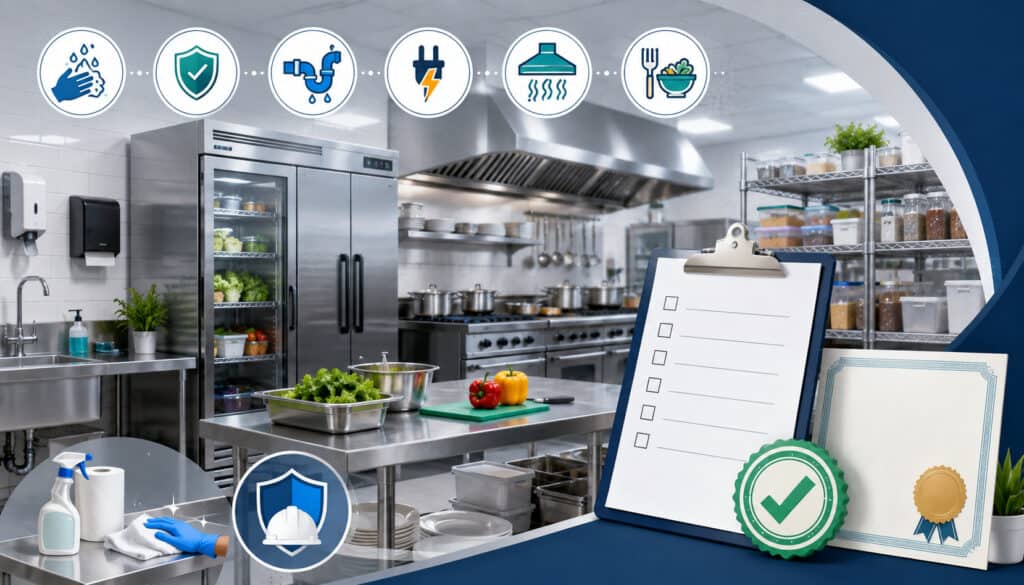
A food establishment permit addresses the restaurant’s ability to store, prepare, package, serve, or otherwise provide food safely.
The official food establishment guidance explains the general permitting role of the Division of Public Health and encourages prospective operators to contact the Office of Food Protection before construction or facility changes.
Permit review may examine both the facility and the proposed food processes. A restaurant that cooks, cools, reheats, and hot-holds food may require more detailed procedures than an operation offering a limited menu.
Owners should be prepared to provide accurate information about:
- Menu items
- Food sources
- Preparation steps
- Cooking methods
- Cooling and reheating
- Refrigeration
- Food storage
- Warewashing
- Employee handwashing
- Cleaning chemicals
- Pest prevention
- Waste and grease handling
The facility must support the actual operation. A menu that is more complex than the kitchen’s equipment or storage capacity can create operational and compliance problems.
Coordinate the Menu and Facility Plan
The menu is a compliance document because it helps determine what equipment, storage, procedures, and food-safety controls the restaurant may need.
A restaurant serving only beverages and commercially prepared products may have different facility needs from an operation handling raw seafood, poultry, or large batches of cooked food.
Before finalizing the kitchen layout, map how food will move through the operation:
- Receiving
- Storage
- Preparation
- Cooking
- Cooling or holding
- Service or packaging
- Cleaning and waste removal
Look for points where raw and ready-to-eat foods could cross, employees may block handwashing sinks, or clean utensils may be exposed to dirty equipment.
The facility should support safe work during busy periods, not only when the kitchen is empty.
Keep Permit Records Accessible
Permit applications, approved plans, inspection reports, renewal notices, approval letters, and correspondence should be organized in a compliance binder or secure digital folder.
Managers should know:
- Which permits must be displayed
- Where original approvals are stored
- Which operating conditions must be maintained
- When renewals are due
- Who communicates with inspectors
- How corrective actions are documented
Do not store important permit information only in an owner’s personal email account. Authorized managers should be able to retrieve records during an inspection, emergency, or management transition.
Delaware Restaurant Health Requirements
Food safety compliance in Delaware includes the practices used to protect food from contamination and control conditions that could contribute to foodborne illness.
The Delaware Food Code covers areas such as food sources, employee health, hygiene, temperature control, storage, equipment, cleaning, sanitizing, facilities, and inspections. Food preparation areas may be subject to health inspection without advance notice.
Delaware restaurant health requirements should be integrated into daily management rather than treated as an inspection-day project.
Important areas include:
- Approved food sources
- Receiving procedures
- Cold and hot holding
- Cooking temperatures
- Cooling and reheating
- Date marking
- Employee illness reporting
- Handwashing
- Glove use
- Cross-contamination prevention
- Allergen awareness
- Cleaning and sanitizing
- Pest control
- Waste handling
Daily Food-Safety Habits Matter
Many compliance problems develop during routine operations. A refrigerator may gradually warm, a sanitizer container may be prepared incorrectly, or an employee may store raw food above ready-to-eat products during a busy shift.
Managers should conduct opening, mid-shift, and closing checks.
An opening check may include:
- Refrigerator temperatures
- Handwashing supplies
- Sanitizer setup
- Food labels
- Pest evidence
- Equipment condition
A mid-shift review can identify problems caused by busy service, while the closing review can address cooling, labeling, cleaning, waste removal, and overnight storage.
Logs should reflect real observations and measurements. Employees should not complete forms automatically without checking the actual conditions.
Train Staff on Health Requirements
Food-safety training should be appropriate for each employee’s role. Cooks, servers, dishwashers, managers, food-truck workers, delivery coordinators, and catering staff can all affect food safety.
Training topics may include:
- Handwashing
- Illness reporting
- Proper glove use
- Food-temperature checks
- Raw-food separation
- Allergen communication
- Cleaning procedures
- Sanitizer testing
- Chemical storage
- Pest reporting
- Waste handling
- Corrective actions
Employees should understand what to do when something goes wrong. For example, a temperature problem may require manager review, equipment evaluation, product relocation, or disposal.
Document training dates, subjects, trainers, attendees, and follow-up actions. Retraining should occur after repeated errors, procedural changes, inspection findings, or management observations.
Delaware Restaurant Inspection Checklist
Restaurant inspection readiness should be part of normal operations. Managers should not wait for an inspection notice before reviewing food storage, employee practices, sanitation, equipment, and records.
| Inspection area | What to check | Why it matters | Priority |
| Food temperatures | Cooking, cooling, reheating and holding | Controls food-safety risks | High |
| Handwashing | Accessible sinks, soap, towels and correct use | Helps prevent contamination | High |
| Food storage | Separation, labeling and date marking | Protects food during storage | High |
| Cleaning | Equipment, utensils and food-contact surfaces | Controls residue and contamination | High |
| Sanitizer | Correct preparation and testing | Supports effective sanitation | High |
| Employee hygiene | Illness reporting, restraints and clean practices | Protects food and customers | High |
| Pest prevention | Evidence, monitoring and service records | Protects the facility | High |
| Equipment | Condition, cleanliness and maintenance | Supports safe food preparation | High |
| Waste | Trash, grease and wastewater handling | Reduces sanitation problems | High |
| Records | Permits, logs and corrective actions | Demonstrates operational control | Medium/High |
Managers can adapt this Delaware restaurant inspection checklist to the menu, equipment, and service model.
A food truck may need additional checks for potable water, wastewater, generator operation, and mobile refrigeration. A catering business may need transportation and off-site service controls.
Document Corrective Actions
Identifying a problem is only the beginning. Managers should record what happened, what was corrected, who completed the correction, and how the restaurant will prevent recurrence.
A corrective-action record may include:
- Date and time
- Location or equipment
- Description of the issue
- Food or process affected
- Immediate response
- Responsible manager
- Maintenance required
- Training required
- Follow-up verification
For example, recording an unsafe holding temperature without explaining the response does not show that the risk was addressed.
Managers should review repeated corrective actions. Frequent refrigerator problems may indicate overloading, poor airflow, door damage, maintenance issues, or inadequate staff procedures.
Zoning Requirements for Delaware Restaurants
Zoning determines whether a particular restaurant activity is permitted at a specific address. It can affect site selection, lease negotiations, parking, drive-throughs, outdoor dining, signs, delivery traffic, entertainment, and operating hours.
Delaware restaurant zoning requirements are generally administered at the local level. Requirements may differ between cities, towns, counties, and special districts.
A commercial property is not automatically approved for every type of restaurant. A small café, bar, food truck lot, ghost kitchen, and drive-through restaurant may be classified differently.
Check Zoning Before Signing a Lease
Restaurant owners should confirm the intended use before committing substantial money to a location.
The zoning inquiry should describe:
- Type of restaurant
- Number of seats
- Operating hours
- Takeout and delivery
- Cooking equipment
- Alcohol service
- Outdoor seating
- Drive-through activity
- Catering
- Entertainment
- Signs
- Mobile vending
Do not rely solely on a landlord’s statement that restaurant use is allowed. Request written information from the appropriate authority and have lease terms reviewed by qualified professionals.
A previous restaurant tenant does not guarantee that the new operation will be approved. The former use may have been different, subject to conditions, or based on an earlier layout.
Zoning Is Separate From Health Approval
Zoning approval and health approval address different issues. A restaurant may be acceptable from a food-safety perspective but not permitted at the proposed address.
Similarly, zoning approval does not confirm that the kitchen, building, fire systems, plumbing, or equipment meet other requirements.
Restaurant owners should track each approval separately:
- Business licensing
- Food establishment permitting
- Zoning
- Building permits
- Fire review
- Occupancy
- Signage
- Alcohol licensing
Building, Fire, and Occupancy Compliance
Restaurant buildings have demanding plumbing, electrical, ventilation, sanitation, accessibility, and fire-safety needs.
Building compliance may include construction permits, certificate of occupancy, restroom requirements, exit capacity, occupancy limits, electrical work, plumbing, ventilation, grease systems, accessibility, and structural changes.
The official restaurant plan review and fire inspection resources identify restaurant-related review areas that may include building plans, fire alarms, suppression systems, hood ducts, and kitchen hood fire-suppression systems.
A certificate of occupancy is not the same as a food permit or business license. This guide to the certificate of occupancy for Delaware restaurants explains how occupancy approval fits into the larger restaurant-opening process.
Buildout Can Trigger Additional Review
Construction and equipment changes can trigger building, fire, plumbing, electrical, mechanical, accessibility, or health review.
Examples include:
- Installing cooking equipment
- Adding a hood system
- Changing the seating count
- Moving walls
- Adding a bar
- Installing a grease interceptor
- Modifying restrooms
- Changing exits
- Adding outdoor seating
- Converting retail space into food service
Owners should not assume a contractor will manage every approval. The restaurant owner remains responsible for tracking the overall project and retaining final documents.
Approved plans should be compared with the completed buildout. Unapproved changes made during construction can delay final inspections.
Coordinate Professionals Early
Restaurant owners should coordinate the landlord, architect, engineer, contractor, equipment supplier, fire-protection company, and reviewing authorities before construction begins.
Each participant may focus on only one part of the project. The landlord may focus on the lease, the contractor on construction, and the kitchen supplier on equipment.
Someone must maintain the complete approval schedule.
Keep records of:
- Submitted plans
- Review comments
- Revised drawings
- Permit numbers
- Inspection results
- Contractor certifications
- Equipment approvals
- Final signoffs
- Occupancy documents
Signage, Outdoor Dining, and Public Space Rules
Restaurant signage can include wall signs, projecting signs, window graphics, temporary banners, sidewalk signs, menu boards, and illuminated displays.
Local rules may control sign size, placement, lighting, attachment, and visibility. Landlord approval does not necessarily replace a local sign permit.
Owners should confirm requirements before ordering custom signs. A sign that cannot be approved may be expensive to redesign or replace.
Outdoor dining can create additional requirements involving zoning, accessibility, barriers, public rights-of-way, fire access, lighting, noise, alcohol service, insurance, and operating hours.
Outdoor Dining May Need Separate Approval
Patio or sidewalk seating should be reviewed as a separate operational area.
Owners may need to confirm:
- Approved seating boundaries
- Maximum number of tables
- Accessible travel paths
- Fire and emergency access
- Barrier requirements
- Furniture-storage rules
- Lighting limitations
- Noise restrictions
- Permitted hours
- Alcohol-service boundaries
- Insurance requirements
Managers should receive a copy of the approved layout. Tables, planters, signs, heaters, and service stations should not gradually move beyond the permitted area.
Outdoor food service also requires procedures for cleaning, pests, weather, food protection, waste, and employee access to handwashing.
Alcohol Service Compliance Considerations
Alcohol service requires a separate licensing and compliance process. Permission to prepare or serve food does not automatically authorize alcohol sales.
The official alcohol licensing authority reviews liquor-license applications, modifications, and renewals. On-premises applicants may need to submit an application and supporting documents relevant to the ownership, property, finances, and proposed operation.
Alcohol service may affect:
- Restaurant layout
- Licensed service areas
- Outdoor seating
- Storage
- Employee training
- Age verification
- Operating procedures
- Insurance
- Incident records
- Hours of service
Plan Alcohol Service Carefully
Restaurant owners should begin alcohol planning early when beverage sales are important to the concept.
The premises layout, ownership, lease, and local approvals may be relevant to the application. Changes after approval may also require review.
Managers should establish procedures for:
- Age verification
- Refusing service
- Monitoring guest behavior
- Preventing unauthorized access
- Controlling alcohol storage
- Managing outdoor service
- Recording incidents
- Training employees
- Maintaining license records
Liquor liability and other insurance considerations should be reviewed with an appropriate professional.
Employment and Labor Requirements
Restaurant employment requirements in Delaware can involve hiring records, payroll, wage practices, tip procedures, scheduling, meal breaks, child-labor restrictions, unemployment insurance, workers’ compensation, workplace safety, and anti-discrimination policies.
The Delaware Department of Labor provides employer resources covering labor laws, workers’ compensation, workplace safety, unemployment insurance, and discrimination.
Because employment requirements depend on the restaurant’s staffing model and circumstances, owners should obtain qualified guidance when establishing policies or responding to employee issues.
Hiring Compliance Starts Before the First Shift
Employment systems should be prepared before employees begin work.
The restaurant should establish:
- Job descriptions
- Pay rates
- Payroll accounts
- Timekeeping procedures
- Tip-reporting procedures
- Scheduling rules
- Attendance policies
- Onboarding forms
- Food-safety training
- Workplace-safety training
- Anti-harassment procedures
- Complaint-reporting channels
Managers should understand who may hire employees, approve overtime, change pay, edit time records, distribute tips, issue discipline, and terminate employment.
Shared or informal practices can lead to inconsistent records. Written procedures provide managers and employees with clearer expectations.
Keep Employee Records Organized
Employee files may contain hiring forms, policy acknowledgments, payroll information, training records, schedules, incident notes, and required employment documentation.
Access should be restricted to authorized individuals. Sensitive employee information should not be stored in open folders, personal messaging applications, or unsecured devices.
Managers should document:
- Training completion
- Schedule changes
- Time-record corrections
- Workplace incidents
- Safety discussions
- Policy acknowledgments
- Performance-related actions
Records should be retained according to applicable requirements and professional guidance.
Workplace Safety and Restaurant Operations
Restaurant employees face practical daily hazards, including hot surfaces, sharp tools, wet floors, cleaning chemicals, heavy supplies, crowded kitchens, electrical equipment, and repetitive movement.
Safety should be integrated into operating procedures rather than limited to posters or occasional training.
Managers should examine how employees actually perform tasks during busy periods.
Safety Training Should Be Ongoing
Safety training may include:
- Knife handling
- Fryer operation
- Burn prevention
- Spill cleanup
- Chemical dilution
- Ladder use
- Lifting techniques
- Electrical safety
- Equipment shutdown
- Fire-extinguisher awareness
- Emergency exits
- Incident reporting
New employees should receive training before using hazardous equipment. Existing employees should receive refresher training when procedures change or incidents occur.
Managers should investigate accidents and near misses. The review should identify whether equipment, maintenance, staffing, training, or workflow contributed to the event.
Tax and Financial Compliance Considerations
Restaurant tax compliance can include business licensing, gross receipts reporting, payroll withholding, income records, employer responsibilities, tip records, and financial documentation.
Delaware does not impose a state or local sales tax. However, businesses may have gross receipts tax and other reporting obligations based on their activities. Gross receipts tax is imposed on the seller or service provider rather than added to the customer’s bill as a traditional sales tax.
Restaurant owners should work with qualified tax and accounting professionals to determine which registrations, forms, filing schedules, and records apply.
Clean Records Support Tax Compliance
Restaurant financial records should connect sales activity with deposits, refunds, tips, payroll, vendor purchases, and bank transactions.
Useful records may include:
- Point-of-sale reports
- Payment-processor statements
- Bank statements
- Cash-count records
- Refund and void reports
- Gift-card activity
- Payroll records
- Tip reports
- Vendor invoices
- Inventory records
- Expense receipts
- Filing confirmations
The amount recorded in the point-of-sale system may not equal the amount deposited because of processing fees, refunds, chargebacks, adjustments, or settlement timing.
These differences should be reconciled and documented.
Owners should keep personal and business transactions separate. Clear separation supports bookkeeping, tax preparation, banking, and ownership records.
Insurance and Risk Management
Restaurant insurance needs depend on the property, concept, employees, vehicles, alcohol service, delivery, catering, equipment, and contractual requirements.
Coverage discussions may include:
- General liability
- Property insurance
- Workers’ compensation
- Business interruption
- Equipment breakdown
- Food spoilage
- Liquor liability
- Commercial auto
- Cyber coverage
- Employment-related risks
Insurance does not replace compliance, training, maintenance, or safe operations. It is one part of a larger risk-management system.
Review Policies Before Opening
Before opening, owners should verify that policies are active and that the business name, address, operations, and coverage limits are accurate.
Review:
- Policy limits
- Deductibles
- Exclusions
- Landlord requirements
- Lender requirements
- Additional insureds
- Vehicle restrictions
- Security conditions
- Claim-reporting procedures
- Renewal dates
A full-service restaurant, food truck, caterer, bar, delivery-heavy operation, and ghost kitchen may have different exposures.
Contact the insurance professional before adding a new activity. An existing policy may not automatically cover catering, alcohol, delivery, outdoor dining, entertainment, or another location.
Payment Processing and Data Security Compliance
Restaurants accept payments through countertop terminals, handheld devices, online ordering pages, mobile wallets, delivery platforms, and other systems.
Payment security involves protecting card information, account credentials, customer data, terminals, reports, and administrative functions.
Restaurant owners should understand their PCI-related responsibilities and confirm the appropriate requirements with their payment provider and qualified security professionals.
Protect Customer Payment Data
Employees should not write complete card numbers or bank details in unsecured notes, emails, messages, photographs, paper files, or spreadsheets.
Restaurants should:
- Use approved payment devices
- Change default passwords
- Install authorized updates
- Protect administrative accounts
- Secure remote access
- Inspect terminals for tampering
- Limit stored payment information
- Remove access promptly after employee departure
Employees should know who is authorized to repair, replace, move, or inspect payment terminals.
Online ordering systems should also be reviewed. Owners need to understand which provider handles the payment page and which security responsibilities remain with the restaurant.
Limit POS and Payment Access
Employees should receive only the permissions required for their jobs.
Access may need to be restricted for:
- Refunds
- Voids
- Discounts
- Tip adjustments
- Reports
- Price changes
- User creation
- Administrative settings
Each employee should use an individual account where available. Shared manager passwords reduce accountability.
Managers should regularly review unusual refunds, repeated voids, excessive discounts, manual entries, after-hours transactions, changed tips, and newly created users.
Recordkeeping Requirements for Restaurant Owners
Organized records help restaurant owners prepare for inspections, renew permits, resolve disputes, respond to agency questions, and manage staff responsibilities.
Restaurant records may include:
- Business registrations
- Licenses and permits
- Inspection reports
- Approved plans
- Zoning confirmations
- Occupancy documents
- Fire records
- Food-safety logs
- Employment files
- Payroll records
- Tax documents
- Insurance policies
- Vendor invoices
- Maintenance reports
- Pest-control records
- Training records
- Incident reports
Sensitive information should be protected with appropriate physical and digital access controls.
Build a Compliance Binder or Digital Folder
Organize records by category rather than storing every document in one folder.
A practical structure may include:
- Business and ownership
- Licenses and permits
- Food safety and inspections
- Zoning, building and fire
- Employment and payroll
- Taxes and accounting
- Insurance
- Payments and cybersecurity
- Vendors and maintenance
- Incidents and corrective actions
Record the effective date, renewal date, responsible person, and issuing authority for each important document.
Authorized managers should know where records are stored and how to retrieve them.
Build a Restaurant Compliance Calendar
A compliance calendar should track:
- Business license renewal
- Food permit renewal
- Alcohol license renewal
- Insurance renewal
- Tax deadlines
- Payroll dates
- Training refreshers
- Equipment maintenance
- Pest-control service
- Fire-system service
- Internal inspections
- Document reviews
Set reminders early enough to gather documents and resolve problems before the deadline.
This guide on renewing restaurant permits in Delaware provides additional context for organizing recurring permit responsibilities.
Compliance for Food Trucks, Ghost Kitchens, and Takeout Operations
Food trucks, mobile units, ghost kitchens, takeout restaurants, and catering businesses still need strong compliance systems. Their responsibilities may be different from traditional dining rooms, but they are not necessarily simpler.
Food Trucks and Mobile Food Units
Food truck compliance may involve:
- Mobile food permitting
- Commissary or servicing arrangements
- Potable water
- Wastewater disposal
- Handwashing
- Refrigeration
- Hot holding
- Food storage
- Generator safety
- Fire safety
- Vending locations
- Event approvals
- Parking rules
- Inspection records
Operators should verify requirements for every city, event, public location, or private property where the unit will operate.
Permission from a property owner may not replace local authorization.
Mobile employees should carry or have access to permits, commissary records, temperature logs, location approvals, and emergency contact information.
Takeout Restaurants and Ghost Kitchens
Delivery-heavy operations need procedures for food holding, packaging, labeling, pickup, driver handoff, customer communication, and online payment security.
Pickup areas should protect food from contamination and unauthorized access. Delivery drivers should not enter preparation areas unnecessarily.
Ghost kitchens should confirm that the location and operating model are approved for the intended food use. Operating several online brands from one kitchen does not remove the underlying permit and food-safety responsibilities.
Managers should also control access to:
- Online ordering platforms
- Delivery accounts
- Refund tools
- Customer information
- Payment reports
- Brand-specific menus
- Administrative email accounts
Master Delaware Restaurant Compliance Checklist
The following master checklist can be used before opening, during monthly reviews, before inspections, and when expanding services.
| Checklist area | Question to ask | Evidence to maintain | Priority |
| Business setup | Is the correct business registered and licensed? | Registration and license records | High |
| Ownership | Are names and ownership details consistent? | Formation and ownership documents | High |
| Food permit | Is food establishment approval complete? | Permit and approval correspondence | High |
| Zoning | Is the intended use allowed at the address? | Written zoning confirmation | High |
| Building and fire | Are construction and safety approvals complete? | Permits and inspection records | High |
| Occupancy | Is the property approved for restaurant use? | Occupancy documentation | High |
| Health inspection | Are food-safety systems ready? | Reports, logs and corrective actions | High |
| Employment | Are hiring and payroll systems operational? | Employee and payroll records | High |
| Taxes | Are registrations and records organized? | Account and filing records | High |
| Insurance | Are appropriate policies active? | Policies and certificates | High |
| Payments | Are terminals and accounts secured? | Access lists and provider records | Medium/High |
| Records | Are permits and renewal dates tracked? | Compliance calendar and files | High |
| Operational changes | Have new services been reviewed? | Updated approvals and procedures | High |
Assign Responsibility for Each Compliance Area
Every checklist item should have:
- A named owner
- A target date
- A current status
- A renewal date
- A document location
- A backup responsible person
Avoid assigning responsibilities only to “management.” A named person is more likely to complete and document the task.
The responsible person should understand what completion means. Submitting an application is not the same as receiving approval, and creating a policy is not the same as training employees.
Unfinished items should be reviewed during regular meetings. Record the next action, responsible person, and completion date.
Common Compliance Mistakes to Avoid
Restaurant owners often experience problems because ordinary tasks are completed in the wrong order or not documented properly.
Common mistakes include:
- Signing a lease before confirming zoning
- Starting construction before plan review
- Treating a business license as the only required approval
- Assuming a former restaurant space is fully approved
- Purchasing equipment before confirming requirements
- Opening before final inspections
- Missing renewal deadlines
- Keeping incomplete food-safety logs
- Failing to document corrective actions
- Hiring before payroll systems are ready
- Sharing manager passwords
- Storing payment information insecurely
- Relying on verbal statements
- Failing to update records after changes
Treating Compliance as a Last-Minute Task
Waiting until opening week creates unnecessary pressure. Permit questions, construction corrections, insurance issues, payroll setup, and employee training may require more time than expected.
Owners should include compliance tasks in the main restaurant project plan.
The opening schedule should identify:
- Application dates
- Review periods
- Construction milestones
- Inspection readiness
- Staff-training dates
- Equipment testing
- Document completion
- Corrective-action time
Avoid announcing a firm opening date until the major approvals are complete or reasonably predictable.
Relying on Verbal Assumptions
Verbal guidance can help owners understand a process, but important decisions should be supported by written confirmation, official documents, or qualified professional advice.
Keep copies of:
- Emails
- Approved plans
- Permit records
- Inspection reports
- Professional opinions
- Lease documents
- Insurance confirmations
- Agency correspondence
Written records help prevent misunderstandings and provide continuity when staff, contractors, or officials change.
Best Practices for Restaurant Compliance Management
A strong restaurant compliance program combines official verification, practical procedures, trained employees, organized records, and regular management review.
Recommended practices include:
- Verify requirements through official resources
- Confirm zoning before signing a lease
- Begin food permit review early
- Keep business information consistent
- Organize permits and inspection reports
- Train employees on food safety
- Maintain temperature and cleaning logs
- Document corrective actions
- Track renewals
- Prepare payroll systems before hiring
- Review financial records regularly
- Maintain appropriate insurance
- Protect customer payment data
- Limit system access by employee role
- Review compliance after operational changes
Create a Monthly Compliance Review Routine
A monthly review can cover:
- Expiring permits
- Food-safety logs
- Corrective actions
- Employee training
- Payroll records
- Tax notices
- Insurance changes
- Equipment maintenance
- Pest-control reports
- Payment-system access
- Refund and void activity
- Incidents
- Planned operational changes
The meeting should produce documented actions. Each action needs a responsible person and completion date.
Managers should review unfinished items at the next meeting rather than allowing them to disappear from the checklist.
Prepare for Inspections Throughout the Year
Inspection readiness should reflect daily operating quality.
Managers can walk through the restaurant and examine:
- Receiving areas
- Food storage
- Coolers and freezers
- Preparation areas
- Handwashing sinks
- Cooking equipment
- Dishwashing areas
- Chemical storage
- Restrooms
- Trash areas
- Employee records
- Payment terminals
- Required permits
Employees should know where documents are stored and who should respond to inspector questions.
How Compliance Supports Long-Term Restaurant Growth
Strong compliance systems can make expansion easier. Owners considering catering, outdoor dining, alcohol service, delivery, food trucks, or new locations need reliable records and repeatable procedures.
Organized permits, financial reports, training records, inspection results, and operating procedures make it easier to understand what worked at the first location.
Compliance also supports trust. Customers expect safe food and secure payments. Employees expect accurate pay and safe working conditions. Landlords, insurers, vendors, lenders, and agencies expect reliable documentation.
Good Records Make Growth Easier
Growth creates more complexity. Additional locations mean more permits, employees, insurance policies, payment users, equipment, and renewal dates.
A central compliance system helps owners compare locations and identify missing documents.
Standard operating procedures can be adapted for new locations, but local requirements should still be verified. A procedure that works in one municipality may need changes in another.
Frequently Asked Questions
What should a compliance checklist for Delaware restaurant owners include?
It should include business registration, licensing, food establishment approval, health inspections, zoning, building and fire review, occupancy, employment, taxes, insurance, signage, alcohol service, payment security, and recordkeeping. Each item should identify the responsible person, deadline, status, renewal date, and supporting documents.
What are the main Delaware restaurant requirements before opening?
Restaurant owners commonly need to establish the business, obtain the appropriate business license, complete food establishment permitting, confirm zoning, address building and fire requirements, prepare for inspection, arrange insurance, and establish employment and financial systems. The exact requirements depend on the concept, location, building, menu, and services.
What permits and licenses may a Delaware restaurant need?
A restaurant may need a business license, food establishment permit, local business approval, zoning confirmation, building permits, occupancy authorization, fire review, sign approval, outdoor-dining permission, and an alcohol license where applicable. Food trucks, caterers, and temporary vendors may have additional requirements.
What food-safety requirements should restaurant owners review?
Owners should review sourcing, receiving, storage, cooking, cooling, reheating, holding, employee hygiene, handwashing, cleaning, sanitizing, cross-contamination, allergen procedures, pest control, and waste handling. The restaurant should also maintain logs and corrective-action records.
How often should restaurant owners review compliance records?
Critical food-safety records should be reviewed during daily operations. Broader records such as licenses, training, insurance, payroll, tax documents, and payment access should be reviewed monthly.
The complete checklist should also be reviewed before inspections, renewals, renovations, ownership changes, and service expansions.
Do food trucks have restaurant compliance requirements?
Yes. Food trucks may need business licensing, food establishment approval, food-safety systems, water and wastewater controls, temperature monitoring, location permission, fire safety, insurance, and records. Requirements may vary by operating location and event.
Do ghost kitchens need restaurant permits?
Ghost kitchens generally need approval for the food operation and the physical location. The absence of a dining room does not remove food-safety, business, zoning, employment, tax, or payment responsibilities. Operators should verify whether multiple brands or service models affect existing approvals.
Why is zoning part of restaurant compliance?
Zoning determines whether the proposed restaurant activity is allowed at the address. It may also affect parking, drive-through service, outdoor dining, signs, entertainment, delivery traffic, and hours. Zoning approval is separate from health, building, fire, and business licensing.
Where should restaurant owners verify current requirements?
Restaurant owners should use official Delaware resources and contact the city, town, or county responsible for the proposed location. Qualified professionals should be consulted for legal, tax, employment, insurance, food-safety, construction, real-estate, cybersecurity, payment, investment, or financial questions.
Conclusion
A compliance checklist for Delaware restaurant owners helps transform a complicated group of responsibilities into a manageable operating system.
Restaurant compliance may include business registration, licensing, food establishment permits, health inspections, zoning, building approval, fire safety, occupancy, employment, taxes, insurance, signage, alcohol service, payment security, staff training, and recordkeeping.
The checklist should not be used only during the opening process. It should support daily food-safety procedures, monthly management reviews, permit renewals, employee training, inspection preparation, and operational changes.
Owners should verify requirements through official state and local resources, keep written records, assign responsibilities, track deadlines, and document corrective actions.
A well-organized compliance system cannot remove every restaurant risk. However, it can help owners identify responsibilities earlier, prepare more effectively, and maintain safer and more consistent restaurant operations.