
Choosing the Best Restaurant Concept for Delaware Markets
Choosing the best restaurant concept for Delaware markets begins with a practical question: what dining experience can serve a specific customer group consistently, at an acceptable price, in a location with enough demand?
A restaurant concept is more than a cuisine. It connects food, service, atmosphere, pricing, location, staffing, technology, and customer expectations.
Delaware contains distinct restaurant environments. A coastal concept may depend on seasonal visitors, a neighborhood restaurant on repeat residents, an office-area café on weekday breakfast and lunch, and a college-area operation on value, convenience, and online ordering.
The strongest Delaware restaurant business ideas fit local demand, budget, facility, labor conditions, operator experience, and long-term goals. This guide explains how to compare restaurant concepts for Delaware, test assumptions, plan operations, and choose a direction that can work under real conditions.
What Does Choosing a Restaurant Concept Mean?
Choosing a restaurant concept means defining the restaurant’s central promise and building every major business decision around it. The concept should identify who the restaurant serves, what it serves, how customers order, how much they pay, what kind of experience they receive, and why they should choose the business instead of another option.
A useful concept statement can often be expressed in one sentence. For example: “A neighborhood café serving quick breakfasts, coffee, and light lunches to commuters and remote workers,” or “A family-friendly coastal restaurant offering approachable seafood, efficient service, and takeout for visitors and local residents.”
That sentence gives direction to menu development, equipment purchases, staffing, décor, marketing, and pricing.
A Restaurant Concept Is More Than a Menu
A menu is one part of restaurant concept development, but it cannot carry the entire idea. Customers experience the concept through the speed of service, the ordering process, the layout, the music, the packaging, the cleanliness, the employee interactions, the visual identity, and the reliability of each visit.
The concept also shapes the back of the house. It determines how much storage is needed, what equipment must be installed, how many employees work each shift, how ingredients move through the kitchen, and how orders are checked before reaching customers.
A quick-service restaurant concept may prioritize counter flow, short ticket times, durable packaging, and highly repeatable recipes. A casual dining restaurant concept may require hosts, servers, table management, broader training, and a kitchen that can handle several courses at once.
The best concept aligns the customer-facing promise with a realistic daily workflow. When the promise and the operation conflict, service becomes inconsistent and costs become harder to control.
Why Concept Fit Matters
A creative food idea can still struggle when it does not fit its market. Customers may like the food but reject the price, location, wait time, portion size, service style, or operating hours. The kitchen may be unable to produce the menu consistently, or the staffing plan may depend on skills that are difficult to hire and retain.
Concept fit means matching customer demand, location, competition, budget, labor, menu complexity, seasonality, and owner capability. A promising idea may become impractical when the lease, facility, or working-capital needs exceed the plan.
Owners should therefore evaluate the concept as an operating system, not only as a creative idea. The goal is to find a format that the market wants and the team can execute repeatedly.
Delaware Restaurant Concept Planning at a Glance
A concept comparison should begin before a lease is signed, major equipment is purchased, or branding work is finalized. The following table organizes the most important planning areas and shows why each one affects concept selection.
| Planning Area | What to Evaluate | Why It Matters | Priority |
| Target customer | Residents, workers, tourists, students, families, retirees | Shapes menu, hours, service, and pricing | High |
| Location type | Downtown, beach town, suburb, highway, college area, neighborhood | Affects traffic patterns and demand | High |
| Service model | Full-service, quick-service, fast casual, café, takeout, food truck | Determines staffing and cost structure | High |
| Menu complexity | Ingredients, preparation, equipment, skill requirements | Affects speed, consistency, and waste | High |
| Competition | Nearby restaurants, pricing, reviews, and market gaps | Helps define positioning | High |
| Seasonality | Visitor traffic, local events, school schedules, weather | Influences cash flow and staffing | Medium/High |
| Pricing | Customer expectations, food costs, labor, rent, packaging | Supports sustainable margins | High |
| Staffing | Roles, wages, training, scheduling, availability | Directly affects service quality | High |
| Technology | POS, online ordering, reservations, payments, reporting | Supports efficiency and control | Medium/High |
| Marketing | Local visibility, online listings, reviews, social media | Helps customers discover the concept | High |
Compare two or three concepts across the table and mark where each idea is strong, weak, or dependent on untested assumptions.
Why Delaware Markets Are Not All the Same
Delaware’s restaurant demand varies by community, traffic source, and time of year. Coastal areas can attract visitors seeking seafood, breakfast, desserts, family dining, and convenient grab-and-go meals.
Downtown districts may support lunch, happy-hour, business dining, delivery, and event traffic. Suburban communities may favor dependable takeout, family meals, pizza, sandwiches, cafés, and casual dining that serves repeat customers.
College-adjacent areas can create demand for affordable meals, flexible hours, online ordering, and social gathering spaces. Highway corridors may reward visibility, parking, speed, and familiar formats. Small towns and residential neighborhoods may respond well to concepts that build trust, participate in community life, and provide consistent value.
Owners should avoid treating statewide dining interest as a single market. The relevant market is usually the practical trade area around the proposed site: the people who live, work, study, shop, visit, or travel nearby.
Step One: Understand Customers and Study Market Demand
Local restaurant concept planning should begin with target customers, not décor, logo ideas, or a long menu. Define the groups most likely to visit and the reasons they would choose the restaurant.
Residents may value convenience and consistency. Office employees may prioritize speed at lunch. Families may need accessible pricing, comfortable seating, and menu flexibility. Tourists may look for local identity, visible locations, and memorable experiences.
Restaurant market research combines customer research and competitive analysis. The market research and competitive analysis guidance explains that market research helps identify customers while competitive analysis helps a business find a distinct market position.
Useful research includes traffic observations, competitor menus, reviews, delivery listings, community feedback, and conversations with potential customers. Local restaurant guides for Delaware communities can also show the range of concepts already attracting attention.
Match the Concept to Customer Habits
Customer habits determine when and how revenue is likely to occur. Breakfast concepts need reliable morning traffic and fast routines. Lunch concepts near offices may face concentrated demand during a short period.
Dinner-focused restaurants may require reservations, table management, alcohol service planning, and more labor per transaction. Takeout concepts must consider packaging, pickup flow, order accuracy, and foods that remain appealing after travel.
Ask practical questions: How often will the target customer visit? Are purchases planned or spontaneous? Will customers dine alone, as couples, with children, or in groups? Do they expect counter service, table service, delivery, catering, or a drive-up option? What price range feels reasonable for the occasion?
A concept is stronger when it fits an existing behavior rather than requiring customers to adopt an unfamiliar routine. It can still be distinctive, but the ordering process, value, and use case should be easy to understand.
Look for Gaps, Not Just Trends
Trends can reveal changing preferences, but copying a popular format without local evidence can create direct competition in an already crowded category. A better approach is to identify unmet needs.
Review what customers repeatedly praise and criticize in competitor reviews. Look for limited operating hours, weak takeout experiences, missing dietary options, inconsistent service, poor parking, or neighborhoods with few convenient dining choices.
A gap may involve service, price, daypart, atmosphere, or ordering rather than cuisine. An area with many dinner restaurants may still lack dependable breakfast, efficient pickup, or a focused neighborhood option.
Validate the gap with more than one source. Repeated evidence is more useful than a few enthusiastic comments.
Step Two: Choose the Service Model and Match It to the Location
The service model determines how customers interact with the restaurant and how the operation earns revenue. Common models include full-service, casual dining, fast casual, quick-service, café, bakery, food truck, catering-focused kitchen, bar-and-grill, takeout-focused restaurant, and hybrid formats.
Each model creates different labor, equipment, space, and workflow requirements. Full-service emphasizes table management and coordination; quick-service emphasizes speed and repeatability; cafés depend on daytime routines; and food trucks trade a dining room for mobility, limited storage, and schedule uncertainty.
Location selection should follow concept logic. A strong site for one model may be weak for another. High pedestrian traffic can support a café or specialty dessert shop, while a family restaurant may need convenient parking and easy road access. A catering-focused operation may prioritize kitchen capacity and delivery routes over storefront visibility.
Full-Service Versus Quick-Service
A full-service concept can create higher average checks and a more complete dining experience, but it generally requires more labor, training, space, and operating coordination.
Seating capacity, table turns, reservations, server sections, beverage service, and guest recovery procedures all become important. The menu may also require more preparation and broader kitchen capabilities.
A quick-service restaurant concept is built around speed, repeatability, and transaction volume. The menu must be easy to understand, order, produce, package, and hand off. Because individual checks may be lower, the concept often depends on efficient throughput and frequent visits. A slow ordering interface or complicated customization process can weaken the model.
Neither format is automatically better. The right choice depends on customer expectations, rent, staffing availability, kitchen design, price point, traffic patterns, and the operator’s ability to manage the service standard consistently.
Foot Traffic, Visibility, and Facility Fit
Visibility helps, but it should not be evaluated alone. A restaurant also needs access, parking or walkability, safe entry, delivery access, nearby demand generators, and traffic at the hours the concept operates.
A busy road may produce little value if customers cannot enter easily. A walkable location may be attractive but unsuitable if the concept depends on large family groups or frequent takeout pickups without convenient stopping space.
The facility must support ventilation, utilities, refrigeration, storage, accessibility, waste handling, and customer flow. A former restaurant space may still require costly changes for a different menu or service model.
Before committing to a site, compare the facility with the equipment list, production volume, staffing plan, and menu. Lease and real estate questions should be reviewed with qualified professionals who understand the property and intended use.
Step Three: Evaluate Competition and Seasonal Demand
Competitive research helps owners understand what customers can already buy, how much they pay, and what experiences are available nearby. Start by mapping direct competitors, such as restaurants with a similar cuisine, service model, or price range.
Then include indirect competitors that solve the same customer need, such as grocery prepared foods, convenience stores, cafés, delivery-only kitchens, or fast-food options.
Compare menus, prices, service speed, atmosphere, hours, access, delivery, reviews, and complaints. The goal is to identify customer expectations and areas where a new concept can offer a clearer benefit.
Seasonality should be studied at the same time. Coastal restaurant concepts may experience strong visitor demand during peak travel periods and slower traffic outside them. College areas may change when classes are not in session.
Business districts may have stronger weekdays than weekends. Event-driven locations may produce irregular surges rather than dependable daily demand.
Learn From Competitor Reviews Without Copying
Online reviews can reveal patterns that are difficult to see during a single visit. Repeated praise may identify the features customers value most, such as friendly service, generous portions, local ingredients, quick pickup, or a distinctive atmosphere.
Repeated complaints may reveal opportunities involving wait times, order accuracy, cleanliness, limited hours, inconsistent pricing, or poor communication.
Reviews should be interpreted carefully. One negative comment may reflect an unusual situation, while a repeated issue across many customers is more meaningful. Compare comments across several restaurants and platforms, then verify observations in person when possible.
Use competitor research to define a reason to choose the new restaurant. That reason may be a more focused menu, faster lunch service, better family convenience, stronger local identity, improved takeout, or a price-to-value balance that fits the area.
Plan for Peak and Slow Periods
Seasonal demand affects hiring, inventory, supplier schedules, marketing, operating hours, and working capital. A coastal concept may need temporary staffing and higher peak inventory, followed by reduced schedules, local promotions, catering, or adjusted operating days during slower periods.
Year-round concepts often depend on residents, workers, families, and repeat customers. They may have steadier demand but still experience weather, holiday, school, or weekday fluctuations. Owners should estimate sales by month and daypart rather than assuming an even annual average.
A concept should be able to handle its busiest realistic periods without damaging quality and survive weaker periods without relying on constant emergency decisions. This balance is essential when choosing the best restaurant concept for Delaware markets.
Step Four: Build the Menu Around Operations
Menu development should translate the concept into a repeatable production system. Begin with a focused set of items that serve the target customer and fit the service model. Then evaluate each item for preparation time, ingredient availability, equipment requirements, skill level, food cost, waste risk, allergen handling, packaging, and travel quality.
A large menu increases inventory, prep, training, equipment demands, and inconsistency. A smaller menu can improve speed when items share ingredients and preparation steps.
Every menu item should have a role. Some items attract attention, some produce dependable margin, some meet common dietary needs, and some increase average checks through sides, beverages, or add-ons. Items that do not support demand, brand identity, or operational efficiency should be questioned before they become permanent.
Simple Menus Can Be Strong Menus
A focused menu gives the kitchen fewer processes to master. Recipes can be standardized, employees can be trained more quickly, and purchasing can be concentrated among a manageable group of ingredients. This can improve consistency and reduce the amount of slow-moving inventory that becomes waste.
Simplicity does not mean a concept must feel limited. Variety can come from seasonal specials, sauces, sides, preparation choices, or carefully controlled customization. The key is to avoid adding items that require unique ingredients, specialized equipment, or lengthy preparation without producing enough demand.
Owners should test ticket times and station capacity before finalizing the menu. A dish may taste excellent but still be unsuitable if it slows the line during a lunch rush or requires attention that the staffing model cannot provide.
Menu Items Should Support Pricing and Brand
The menu should express the restaurant theme and make the value proposition easy to understand. A coastal restaurant concept may emphasize seafood, regional flavors, family-friendly choices, or quick visitor service.
A café concept in Delaware may focus on coffee, baked goods, breakfast, and light lunch. A neighborhood grill may prioritize familiar meals, repeat visits, and dependable takeout.
Pricing must reflect the full cost of delivering each item, not only the ingredients. Labor, packaging, utilities, rent, waste, payment costs, delivery commissions, and overhead all affect the amount the business must earn. Menu design should guide customers toward items that fit both their expectations and the restaurant’s economic needs.
Every item should reinforce the concept, work within the kitchen, and provide value customers can recognize.
Step Five: Review Startup Costs, Staffing, and Pricing Together
A restaurant concept must fit the available capital and the amount of ongoing risk the owner can manage. Startup costs may include lease deposits, renovations, kitchen equipment, furniture, signage, licenses, professional services, insurance, opening inventory, technology, marketing, training, and working capital.
The startup cost planning guide recommends estimating costs before launch so owners can evaluate funding needs and the path toward profitability.
Concept complexity drives cost. Full-service seafood may need extensive refrigeration and skilled labor; a bakery may need specialized ovens; and a food truck still requires a vehicle, equipment, storage, maintenance, and event planning.
Owners can use a detailed guide to costs involved in opening a restaurant in Delaware as a starting point, but every location and concept needs its own estimates. Quotes, lease terms, equipment condition, utility capacity, and construction requirements should be verified directly.
Labor Availability Should Shape the Concept
Staffing needs should be calculated by role, shift, daypart, and sales volume. A concept may require cooks, prep employees, servers, bartenders, hosts, cashiers, dishwashers, managers, delivery support, or catering staff. The number of people is only part of the question; required skill, training time, schedule flexibility, and supervision also matter.
A concept that depends on highly specialized labor can become vulnerable if qualified employees are difficult to recruit or retain. Simplified recipes, cross-training, clear station design, and documented procedures can reduce that risk. However, owners should not cut labor so aggressively that service quality, cleanliness, safety, or employee sustainability suffers.
The concept should reflect realistic staffing conditions. If the plan only works when every shift is fully staffed by highly experienced employees at an unrealistic labor cost, the model needs revision.
Pricing Should Match Value and Real Costs
Restaurant pricing should connect customer expectations with the cost of operating the concept. Ingredient cost matters, but so do wages, occupancy, utilities, packaging, technology, promotions, maintenance, and administrative expenses. Full-service pricing also supports the added labor and experience provided at the table.
Low-price competition creates pressure when the concept lacks enough volume. Define value through convenience, quality, portions, local identity, atmosphere, speed, or consistency.
Build price assumptions into realistic sales projections. The guide to financial projections for restaurants in Delaware can help owners organize assumptions for sales, labor, food costs, and operating expenses. Specific financial, tax, or investment decisions should be reviewed with qualified professionals.
Step Six: Plan Takeout, Delivery, Technology, and Payments
Takeout, delivery, catering, and online ordering can expand access to the restaurant, but they must be designed into the concept rather than added without operational planning. Some foods travel well, while others lose texture, temperature, or presentation quickly. Packaging, order staging, pickup space, delivery timing, and item availability should be tested before launch.
Online and dine-in orders can peak together. Define who monitors orders, how tickets enter production, where completed orders wait, and how customers receive updates.
Technology should support the service model. A point of sale system may connect ordering, kitchen routing, inventory, employee permissions, reservations, customer records, online ordering, and reporting. The correct setup depends on whether the concept is table-service, counter-service, mobile, delivery-focused, or hybrid.
Not Every Concept Works Well for Delivery
Delivery suitability should be evaluated item by item. Fried foods may soften, delicate dishes may shift during transport, and temperature-sensitive items may require specialized packaging. Long preparation times can also make promised delivery windows difficult to meet.
A delivery menu can be smaller than the dine-in menu. Removing fragile or slow items may protect quality and reduce mistakes. Pricing should account for packaging and channel costs while remaining understandable to customers. Portions and containers should be tested under realistic travel times rather than judged immediately after preparation.
Third-party delivery can provide visibility and convenience, but it also affects customer communication, data access, fees, and responsibility for the final handoff. Owners should compare direct and third-party approaches based on demand, operational capacity, and customer expectations.
Payment Convenience Affects the Experience
Payment processing is part of customer experience and operational control. Restaurants may need card payments, mobile wallets, online payments, tips, split checks, deposits for catering, gift cards, refunds, and detailed reporting. Slow checkout or unclear receipts can weaken an otherwise positive visit.
The workflow should match the concept: tableside payment for full service, fast terminals for counter service, and deposits or invoicing for catering. Online ordering also needs clear cancellation and refund policies.
Owners should review processing costs, user permissions, reconciliation, chargeback handling, equipment, data security, and integration with the POS. Payment, legal, and compliance questions should be discussed with qualified providers and advisers rather than decided only by advertised rates.
Step Seven: Build a Clear Brand and Community Connection
Brand identity turns the operational concept into something customers can recognize and remember. It includes the name, visual design, décor, menu language, photography, uniforms, website, social profiles, online listings, and the tone employees use with guests. These elements should communicate the same promise.
A family concept should feel welcoming and convenient, fast casual should communicate speed, and a coastal concept should support local character through its menu and service rather than décor alone.
The concept should be easy to explain in a few seconds. Customers need to understand what the restaurant offers, who it is for, what kind of experience to expect, and why it is worth choosing.
Local Connection Can Build Relevance
Community connection can make a restaurant more useful and memorable through relationships with nearby suppliers, schools, charities, offices, events, or neighborhood groups. Local catering and thoughtful responses to feedback can encourage repeat business.
Local sourcing can support the brand when it is reliable and accurately represented. However, it also requires vendor planning, seasonal availability, pricing review, quality standards, and backup suppliers. A menu that depends on one difficult-to-source ingredient may create inconsistency.
Community involvement should be authentic and operationally sustainable. It works best when it fits the concept and the team’s capacity rather than becoming a collection of disconnected promotions.
Review Permits and Requirements Early
Operational requirements can influence concept choice. A restaurant, bakery, caterer, food truck, bar, or seafood operation may involve different facilities, health, licensing, fire, zoning, employment, and insurance considerations.
Delaware’s Food Establishments guidance notes that food businesses should review permit needs and that businesses operating in Delaware generally need a state business license even when a specific food establishment permit may not apply.
The Division of Small Business provides assistance for businesses that are starting or growing. Contact appropriate agencies and qualified professionals before major commitments.
This article provides general educational information, not legal, tax, accounting, employment, food safety, insurance, real estate, investment, or financial advice.
Step Eight: Test the Concept and Build a Working Business Plan
Concept testing reduces guesswork before the owner invests heavily in a permanent location or full team. Testing methods can include pop-ups, catered events, farmers market stands, limited-menu service, tasting events, delivery trials, surveys, or a soft opening.
The goal is not only to confirm that people enjoy the food. It is to test demand, price acceptance, preparation time, packaging, staffing, service flow, and repeat interest.
Track purchases, average transaction size, errors, bottlenecks, waste, and repeat interest. Patterns across several tests are more useful than isolated praise.
A restaurant business plan should then organize the validated concept. It should describe the target market, service model, menu, location strategy, competition, staffing, marketing, technology, startup budget, operating assumptions, risks, and milestones.
Test Food and Operations Together
A tasting that serves a few carefully prepared dishes does not prove the concept can operate during a rush. Tests should recreate realistic order volume and staffing limits. Time each item, observe where employees wait or collide, measure holding quality, and review how orders are communicated.
Test realistic prices, packaging, and portions because promotional pricing may not reveal true purchase behavior.
Use small tests to remove weak items, simplify preparation, improve instructions, and identify equipment needs. The purpose is to learn before expensive decisions become difficult to reverse.
Use the Business Plan as a Working Tool
The business plan should change as research improves. Vendor quotes may alter food cost assumptions. A location may require different equipment. Customer testing may show stronger demand for breakfast than dinner. Staffing research may reveal that a complicated service model is unrealistic.
Key sections include the concept summary, customer profile, competitive analysis, menu strategy, operating plan, staffing plan, marketing plan, startup costs, sales assumptions, and risk plan.
Operators considering a specialized coastal concept can review this example of a business plan for a seafood restaurant in Delaware to see how menu, sourcing, location, and operations connect.
The plan should expose assumptions and support decisions rather than merely describe an ideal future.
Restaurant Concept Comparison and Ideas to Consider
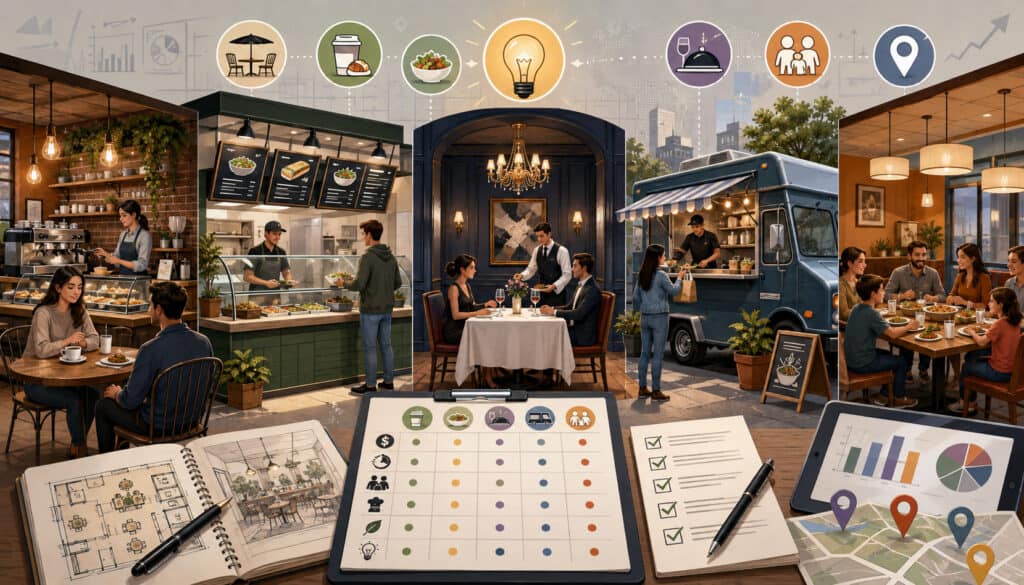
No concept type is guaranteed to succeed, but comparison can show where each model may fit and what it demands operationally. The following table summarizes several restaurant startup ideas in Delaware.
| Concept Type | Best-Fit Location | Main Strength | Main Challenge | Operational Complexity |
| Fast casual | Suburbs, office areas, college areas | Speed and repeat traffic | Requires strong systems | Medium |
| Café | Downtowns, neighborhoods, commuter areas | Morning and daytime demand | Labor and margin control | Medium |
| Food truck | Events, visitor areas, business districts | Flexibility and lower fixed footprint | Weather, storage, schedules, permits | Medium |
| Family restaurant | Residential areas and suburbs | Broad appeal and repeat visits | Staffing and menu breadth | Medium/High |
| Coastal seafood | Beach towns and visitor areas | Strong local identity | Seasonality, sourcing, food cost | High |
| Quick-service | High-traffic locations | Volume potential | Competition and speed pressure | Medium/High |
| Catering-focused kitchen | Business and event markets | Larger planned orders | Logistics and scheduling | High |
| Specialty dessert | Walkable areas and visitor zones | Impulse and occasion purchases | Demand consistency | Medium |
| Takeout-focused neighborhood restaurant | Residential and commuter areas | Convenience and smaller dining room | Packaging and pickup flow | Medium |
| Bakery café | Downtown, suburban, and community centers | Multiple dayparts and repeat traffic | Early production and waste control | Medium/High |
Coastal and visitor-oriented areas may support seafood, breakfast, desserts, family dining, quick-service, and grab-and-go formats, provided the plan addresses seasonality and peak staffing. Suburban, office, college, and neighborhood markets may reward cafés, pizza, sandwiches, bowls, bakeries, lunch speed, catering, and dependable takeout.
Choose Fit Over Popularity
A popular concept can still be wrong for a particular operator or site. Full service may require too much capital and labor, a food truck may depend on uncertain event access, and a café may fail without reliable morning traffic.
Score each idea on demand, location fit, startup cost, staffing, menu complexity, seasonality, distinction, pricing flexibility, and owner experience. One weakness may be manageable, but several connected weaknesses usually require revision.
The best restaurant concept for Delaware markets serves a real need and can be executed reliably with available resources. Owners should also consider whether the model fits their own management experience, schedule, and willingness to oversee complex service, staffing, and purchasing systems over time without losing consistency.
Common Mistakes When Choosing a Restaurant Concept

A common mistake is committing before studying the market. Passion should be tested against demand, competition, pricing, location, and operating cost. Owners may love a cuisine or theme before confirming that target customers will visit often enough.
Excessive complexity is another risk. Large menus, several service styles, extended hours, delivery, catering, and events add training, inventory, technology, and management needs. New restaurants usually benefit from mastering fewer promises.
Other frequent mistakes include:
- Choosing a site because the rent looks attractive without confirming facility fit.
- Underestimating labor requirements and management coverage.
- Ignoring seasonal changes in traffic and staffing.
- Copying competitors instead of developing a clear position.
- Pricing from competitor menus without calculating actual costs.
- Adding online ordering without kitchen capacity and pickup planning.
- Treating branding as decoration rather than a customer promise.
- Buying equipment before finalizing the menu and workflow.
- Assuming opening demand will continue without repeat customers.
- Failing to plan cash for slow periods and surprises.
A disciplined concept process does not eliminate uncertainty, but it makes assumptions visible and gives owners time to adjust before the most expensive commitments are made.
Best Practices and a Step-by-Step Selection Framework

Start with customer and location fit, then test operations and financial reality. Branding should follow the business model.
Use this sequence:
- Define the owner’s goals, experience, available time, and risk limits.
- Identify target customers and the occasions the restaurant will serve.
- Study nearby competition, reviews, traffic patterns, and market gaps.
- Compare service models and choose a realistic operating format.
- Build a focused draft menu and test production requirements.
- Estimate startup costs, staffing, prices, and working capital.
- Evaluate locations for demand, access, visibility, and facility fit.
- Test the concept through small-scale sales or a soft launch.
- Build the business plan, operating procedures, and launch schedule.
- Review assumptions with experienced operators and qualified advisers.
Build a Concept Scorecard
Use a scorecard to compare ideas consistently. Rate each concept from one to five on demand, distinction, location fit, startup cost, staffing, menu complexity, seasonal stability, pricing flexibility, operational risk, and growth potential. Note the evidence behind every score.
Do not let one exciting strength hide several weaknesses. Strong interest may be offset by poor facility fit and high labor needs, while a simpler concept with moderate demand and dependable repeat customers may be more sustainable.
Update the scorecard after research, menu tests, site visits, and vendor quotes. Scores should change when evidence changes rather than remain tied to first impressions. Keep brief notes beside each rating so advisers can challenge the assumptions and help identify missing information before commitment.
Restaurant Concept Selection Checklist
| Checklist Area | Question to Ask | Why It Matters | Priority |
| Customer demand | Who will visit, when, and why? | Confirms market fit | High |
| Location | Does the area and building support the concept? | Affects traffic and cost | High |
| Competition | What options already serve the same need? | Shapes positioning | High |
| Menu | Can the kitchen execute it consistently? | Protects quality and speed | High |
| Pricing | Do prices cover real operating costs? | Supports margin | High |
| Staffing | Can the required team be hired and trained? | Affects service | High |
| Seasonality | How will demand change during the year? | Affects cash flow | Medium/High |
| Startup budget | Can the budget support buildout and opening? | Reduces financial pressure | High |
| Technology | What ordering, POS, reservation, and payment tools are needed? | Supports workflow | Medium/High |
| Testing | Has the concept been validated through real purchases? | Reduces guesswork | High |
| Compliance | Have applicable requirements been reviewed? | Prevents avoidable delays | High |
| Launch plan | Are training, suppliers, marketing, and soft opening scheduled? | Supports execution | High |
Keep research, quotes, lease information, menus, test results, staffing assumptions, and plan updates organized.
The launch plan should cover suppliers, training, POS setup, payments, listings, signage, outreach, and a soft opening. Record errors, questions, and bottlenecks before expanding demand.
Frequently Asked Questions
How do I choose the best restaurant concept for Delaware markets?
Define a customer group and location type, then research what those customers buy, when they dine, what they pay, and which needs are underserved. Compare service models, menu complexity, costs, staffing, seasonality, and facility needs. Test the idea through real sales before making major commitments.
What are some strong restaurant concepts for Delaware?
Possible concepts include cafés, fast casual, seafood, breakfast, food trucks, bakeries, neighborhood grills, family dining, takeout, catering kitchens, pizza, healthy bowls, and specialty desserts. Suitability depends on the local trade area, customer habits, competition, budget, and staffing rather than the category alone.
How does location affect restaurant concept selection?
Location determines who can reach the restaurant, when they visit, how they arrive, and what service they expect. The building must also support the kitchen, ventilation, storage, utilities, seating, delivery access, and customer flow required by the concept.
Are food trucks a good restaurant business idea in Delaware?
A food truck may suit a focused menu, event sales, mobility, and concept testing. It still requires planning for permits, sales locations, storage, weather, vehicle maintenance, limited production space, staffing, and schedule uncertainty. Evaluate the model against specific places to sell.
How can seasonality affect Delaware restaurant concepts?
Seasonality changes customer volume, hours, staffing, purchasing, marketing, and cash flow. Forecast sales by month and daypart. Coastal, college, business, and event-oriented concepts may need flexible hours, local promotions, catering, or additional operating cash during slower periods.
How do I test a restaurant concept before opening?
Use pop-ups, catering trials, markets, tasting events, preorders, delivery tests, or limited service. Charge realistic prices and track purchases, preparation time, waste, accuracy, packaging, and feedback. Simulate rush periods and use repeated patterns rather than one opinion.
Conclusion
Choosing the best restaurant concept for Delaware markets requires more than selecting a cuisine or following a dining trend. The concept must fit local customers, the location, available capital, staffing realities, menu capabilities, competitive conditions, seasonality, pricing, and the owner’s long-term goals.
A strong process begins with market research and a focused customer promise. It continues through service-model selection, site evaluation, menu testing, cost planning, technology design, compliance review, and realistic projections. Small-scale testing and a working business plan help owners replace assumptions with evidence before committing heavily.
The best concept is not necessarily the largest, newest, or most fashionable. It is the one the market understands, the team can execute consistently, and the business can support through both strong and slow periods.
Owners should be prepared to simplify the menu, adjust hours, refine pricing, change the service flow, or reconsider a location when evidence shows that the original idea is not a strong fit.
Concept selection is therefore an ongoing management process rather than a single creative decision. Careful planning, disciplined testing, organized records, professional guidance where needed, and continued attention to customer feedback can help a restaurant serve its community well while building a more sustainable foundation for long-term growth.