Restaurant Permit Renewal Process in Delaware
Running a restaurant in Delaware is as much about consistent compliance as it is about great food and service. A smooth Restaurant Permit Renewal Process in Delaware helps you avoid surprise closures, late fees, and interruptions that can ripple through staffing, supply ordering, catering contracts, and customer trust.
Renewals are not “one permit, one office.” Most restaurants juggle renewals across (1) the state business license through Delaware’s One Stop/Division of Revenue, (2) the food establishment permit through the Division of Public Health (Office of Food Protection), and—if you serve alcohol—(3) the liquor license renewal through the Office of the Alcoholic Beverage Control Commissioner (OABCC). Each has its own timing, documentation expectations, and compliance triggers.
This guide breaks down the full Restaurant Permit Renewal Process in Delaware in a practical, operator-friendly way: what to renew, when to renew, how to prepare, what inspectors typically focus on, and how to prevent delays.
It also covers common “hidden” events—like ownership changes, concept changes, remodels, menu shifts toward higher-risk foods, adding catering, or adding a bar program—that can turn a routine renewal into a more involved review.
Delaware’s health authority may renew a food establishment permit after a proper application, fees, and an inspection showing compliance, so your operational readiness matters just as much as your paperwork.
Throughout the article, you’ll see the keyword Restaurant Permit Renewal Process in Delaware used intentionally for clarity and search intent, along with related terms restaurant license renewal Delaware, food establishment permit renewal, Delaware One Stop business license renewal, and OABCC liquor license renewal—so the article stays both user-friendly and search-engine friendly.
What “Restaurant Permit Renewal” Usually Means in Delaware
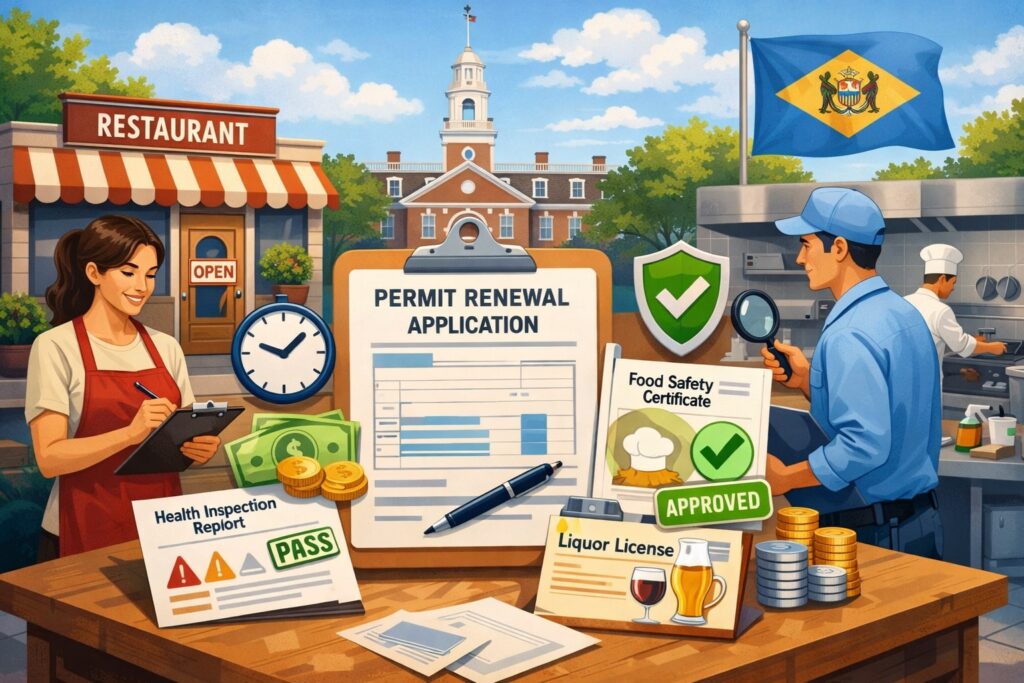
In everyday conversation, owners say “I need to renew my restaurant permit,” but in Delaware that phrase usually bundles multiple renewals and compliance checks. Understanding what you actually renew is the first step in a reliable Restaurant Permit Renewal Process in Delaware.
At minimum, most restaurants must keep (1) a current Delaware business license (often renewed through Delaware One Stop), and (2) a current food establishment permit issued by the Division of Public Health (Office of Food Protection). If alcohol is served, you add (3) an OABCC liquor license renewal track.
A key point: renewals are not just fee payments. Business license renewal is largely an administrative/tax-registration step, while food establishment permit renewal is closely tied to food safety compliance and may depend on inspection outcomes.
Delaware’s regulations and agency guidance emphasize that permits can be renewed after the proper application, fees, and an inspection showing compliance.
That means your “renewal plan” should include a readiness plan: cleaning schedules, temperature logs, sanitizer verification, employee hygiene controls, pest prevention, and documented managerial control—because those are the things that most often slow the Restaurant Permit Renewal Process in Delaware.
It’s also important to distinguish state-level licensing from other approvals that may be local or situation-specific (like fire inspections, building permits for renovations, signage rules, or local zoning). Those are not always branded as “restaurant permits,” but they can still stop operations if lapsed.
So, the practical definition of the Restaurant Permit Renewal Process in Delaware is: maintain every authorization that allows you to (a) legally operate as a business, (b) prepare and sell food, and (c) sell alcohol (if applicable), while staying inspection-ready year-round.
Agencies Involved in the Restaurant Permit Renewal Process in Delaware
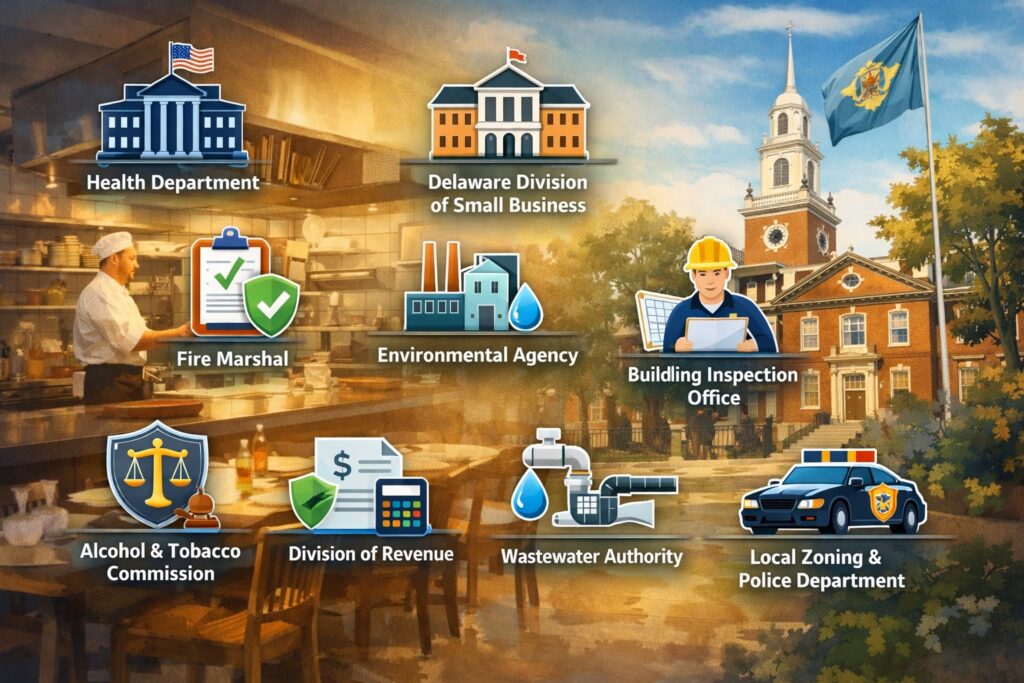
A successful Restaurant Permit Renewal Process in Delaware starts with knowing which office controls which piece. For business licensing, Delaware funnels many licensing tasks through Delaware One Stop, which is positioned as a portal to add, renew, change, or close licenses for your registered business.
This is typically connected to the Division of Revenue’s business licensing functions and the state’s licensing calendar approach.
For food safety and restaurant operating permits, the key authority is the Delaware Division of Public Health (DPH), specifically its Office of Food Protection. DPH issues permits for food establishments and provides the licensing and compliance pathway restaurants follow.
Delaware’s own “first steps” guidance also points operators toward early engagement with the Office of Food Protection for licensing procedures and compliance expectations—showing how central this office is for restaurants.
If you serve alcohol, the relevant regulator is the Delaware Office of the Alcoholic Beverage Control Commissioner (OABCC). The OABCC handles liquor license applications, modifications, inspections, and renewals, and it maintains an online licensing approach where creating an online account and submitting through the portal is described as the preferred method.
In practice, restaurants also interact with additional authorities during renewals or ongoing compliance: fire/occupancy officials, building inspection offices for remodel work, and sometimes other DPH environmental health programs (depending on your operation).
While this guide focuses on the main statewide permits and renewals, the most resilient Restaurant Permit Renewal Process in Delaware treats these agencies as a coordinated compliance ecosystem—not separate tasks you scramble to do at the last minute.
Renewal Timing and Planning: Building a 12-Month Compliance Calendar

The easiest way to make the Restaurant Permit Renewal Process in Delaware painless is to stop treating renewal as a once-a-year emergency. A smarter approach is a rolling 12-month compliance calendar.
Delaware One Stop guidance notes business licenses are issued by calendar year and offers renewal choices (such as renewing for one year or selecting a multi-year option where available), which makes it especially important to check your renewal window early and keep proof of payment and status accessible.
For food establishment permits, the timing can feel less “calendar simple” because inspections and compliance conditions can affect how fast a renewal clears.
Delaware’s administrative language highlights that renewal can require the proper application, fees, and an inspection showing compliance with the food code. That means your planning must include (a) time to correct violations, (b) time to schedule follow-ups if needed, and (c) time to gather required documents.
Here’s how a high-performing calendar-based plan supports the Restaurant Permit Renewal Process in Delaware:
- Quarterly internal audits (temperature controls, cleaning, pest prevention, allergen controls, handwashing access).
- Monthly documentation checks (manager certifications if applicable, service vendor contracts, grease trap service, hood cleaning logs).
- Pre-renewal “inspection readiness week” (deep clean, calibrate thermometers, verify sanitizer concentration, refresh employee training).
- Renewal lead time (start paperwork 45–60 days before typical due dates, even if your permit often renews smoothly).
This approach reduces late fees, reduces inspection surprises, and makes your renewal more predictable. More importantly, it protects revenue: a single interruption during peak season costs more than the time it takes to run a disciplined Restaurant Permit Renewal Process in Delaware.
Delaware Business License Renewal for Restaurants (Delaware One Stop)

For most restaurants, the business license is the “base layer” of the Restaurant Permit Renewal Process in Delaware.
Delaware One Stop’s renewal guidance emphasizes that business licenses are issued by calendar year and that businesses may renew each year or select a longer renewal option (where offered). It also describes payment methods and practical renewal prompts that help businesses stay in good standing as operations change.
Step-by-step approach for a clean renewal
- Log into Delaware One Stop and navigate to the licensing renewal area for operating and renewing. The portal is designed to support license maintenance.
- Confirm business details (legal name, DBA, address, responsible parties). These details matter for matching records across agencies.
- Select renewal length (for example, annual or multi-year if applicable). The portal describes one- or three-year renewal options for Division of Revenue licenses issued by calendar year.
- Update “change events”. Delaware’s renewal flow flags business growth events like becoming an employer; if you’ve added staff, you may need additional registrations tied to payroll withholding and other employer-related programs.
- Pay and save confirmation. Capture payment receipts and confirmation pages in a compliance folder that managers can access.
What commonly delays business license renewal
Delays often come from mismatched records (address differences between agencies), unresolved tax matters, or selecting the wrong license type/category.
The best way to keep this portion of the Restaurant Permit Renewal Process in Delaware smooth is to standardize your business identity across documents and to store a “renewal packet” with prior confirmations, your entity information, and login credentials under controlled access.
Food Establishment Permit Renewal: Delaware DPH Office of Food Protection
For restaurants, the food establishment permit is the heart of the Restaurant Permit Renewal Process in Delaware because it ties directly to public health compliance. Delaware’s Division of Public Health (DPH) Office of Food Protection is the key authority, and Delaware’s own guidance stresses early engagement to understand licensing procedures.
The most important renewal concept is this: Delaware’s regulatory framework indicates the authority may renew a permit after a properly completed application is submitted, reviewed, and approved; fees are paid; and an inspection shows the establishment is in compliance with the food establishment regulations.
This language means your renewal isn’t purely administrative. Food safety readiness is part of the renewal pathway.
How to prepare for permit renewal in real operational terms
A renewal-ready restaurant typically maintains:
- Active managerial control (clear, enforced rules for hygiene, temperature control, cross-contamination prevention).
- Documented food safety practices (cooling logs, hot-hold logs, receiving logs, sanitizer checks).
- Facilities readiness (handwashing sinks stocked and accessible, proper warewashing setup, equipment in good repair).
- Employee practices (glove use where appropriate, illness reporting culture, allergen awareness, no bare-hand contact with ready-to-eat foods unless allowed under a controlled alternative procedure).
Even if your restaurant has passed inspections for years, small drift—like a broken thermometer, unlabeled sanitizer buckets, missing date marks, or blocked hand sinks—can create a renewal headache.
The cleanest Restaurant Permit Renewal Process in Delaware is the one where inspection readiness is continuous, not seasonal.
Inspections and Compliance: What Inspectors Usually Focus On During Renewal Cycles
Because inspection outcomes can influence the Restaurant Permit Renewal Process in Delaware, it helps to understand the practical inspection mindset. Inspectors are not there to “trap” operators; they verify that your systems prevent the most common foodborne illness risks. Delaware’s permit renewal framework points to compliance confirmation through inspection.
Core risk areas that commonly appear in renewal-related inspections
Temperature control tends to be top-tier: cold holding, hot holding, cooling, and reheating. Restaurants that cool large batches (soups, rice, proteins) without shallow pans, ice baths, or blast chilling often get flagged. The solution is to treat cooling like a written recipe step, not a vague “let it sit.”
Cross-contamination and separation is another frequent focus. Raw proteins stored over ready-to-eat foods, shared cutting boards without sanitizing, and unclear allergen controls are common issues. A strong Restaurant Permit Renewal Process in Delaware includes color-coded tools, clear shelf labeling, and training refreshers.
Handwashing and hygiene is a constant. Blocked sinks, empty soap dispensers, missing paper towels, or employees skipping handwashing are easy violations and hard to defend. Make handwashing compliance visible: signage, accountability, and manager modeling.
Sanitizer concentration and warewashing also matter. Buckets need correct concentration, test strips must be present, and dish machines must hit target parameters. If you can’t prove sanitizer strength, you’ll struggle to demonstrate control.
The theme is “evidence of control.” When you build that evidence into daily routines, the Restaurant Permit Renewal Process in Delaware becomes a predictable administrative step rather than a stressful operational event.
Change of Ownership, Concept Changes, and When “Renewal” Becomes Re-Licensing
One of the biggest pitfalls in the Restaurant Permit Renewal Process in Delaware is assuming a change event is “minor” when regulators treat it as material.
Delaware’s guidance on ownership changes states that the Division of Public Health may renew a permit for an existing food establishment or issue a permit to a new owner after a properly completed application is submitted, fees are paid, and an inspection shows compliance.
That is a major point: a sale, partnership restructuring, or transfer can trigger a process that looks more like a new permit issuance than a simple renewal.
Common change events that affect renewals
- Ownership transfer (asset sale, equity changes, new controlling partner).
- Moving locations or changing the physical layout.
- Major remodels (kitchen reconfiguration, new hoods, equipment additions).
- Concept changes (adding raw bar, sushi, sous-vide, reduced oxygen packaging).
- Operational expansion (adding catering, commissary production, multiple units under one license structure).
When a change event is on the horizon, your best move is proactive communication with the relevant agency instead of waiting until renewal season.
Delaware’s food establishment guidance encourages early contact with the Office of Food Protection to understand the process before purchasing, constructing, or amending premises. That same “call early” mindset applies to renewal-impacting changes.
A future-proof Restaurant Permit Renewal Process in Delaware includes a rule: if the change affects your food safety risk profile or facility design, treat it as a permit-impacting event and plan for added documentation and inspection time.
Plan Review, Renovations, and Equipment Changes That Affect Renewals
Many restaurant owners get blindsided when renovations slow down the Restaurant Permit Renewal Process in Delaware. The reason is simple: facility design and equipment choices affect food safety.
Delaware’s plan review document emphasizes that a permit applicant or permit holder must submit properly prepared plans and specifications for review and approval—along with required fees—before construction, conversion, remodeling/renovation, or changes in operation type.
Why plan review matters to renewal
Even if your renewal date is months away, a poorly timed remodel can trigger plan review requirements and follow-up inspections that overlap with renewal windows.
If you add a new cookline, refrigeration, dish machine, hood system, or make structural changes (floors, drains, walls), you may need to show that the facility still supports safe flow: receiving → storage → prep → cook → hold → service → warewash → waste.
Practical advice for restaurants planning work
- Schedule construction away from renewal deadlines when possible.
- Keep plans and spec sheets for new equipment (model numbers, NSF/ANSI certifications if relevant).
- Document temporary operations if you remain open during work (handwash access, warewashing continuity).
- Expect post-renovation inspection and build time for corrections.
Restaurants that treat renovations as both a business project and a compliance project experience fewer surprises. In other words, the best Restaurant Permit Renewal Process in Delaware is the one that stays aligned with your construction calendar, not just your accounting calendar.
Liquor License Renewal for Restaurants: OABCC Process and Practical Tips
If your restaurant serves alcohol, your Restaurant Permit Renewal Process in Delaware includes OABCC renewal. The OABCC describes its role as considering applications, performing inspections, and granting renewals of liquor licenses.
It also highlights online licensing, noting that creating an online account and submitting through the portal is the preferred method to expedite processing (even though email may be accepted).
What restaurants should prepare for alcohol license renewal
Liquor renewals tend to hinge on two categories:
- Administrative completeness: correct license type, current entity information, correct premises information, and required attachments.
- Compliance history and premises integrity: the OABCC performs inspections and oversees modifications; if you changed your bar layout, expanded seating, or altered service areas, you may need to ensure the licensed premise description remains accurate.
Operational best practices that protect renewal
- Keep employee alcohol service practices consistent (ID checks, no service to minors, cut-off procedures).
- Document training and management oversight for responsible service.
- If you plan changes (patio service, new bar, event service), treat them as “license-impacting” and communicate early.
From a risk perspective, alcohol licensing is a visibility issue: complaints, neighborhood concerns, and enforcement patterns can all increase scrutiny. A disciplined alcohol compliance program strengthens your overall Restaurant Permit Renewal Process in Delaware by reducing the chance that renewals stall due to avoidable violations.
Fees, Payments, and Recordkeeping: What to Save and How Long to Keep It
A surprisingly common failure point in the Restaurant Permit Renewal Process in Delaware is not the renewal itself—it’s losing proof of renewal.
When you can’t quickly produce evidence of a current business license, current food establishment permit, or current liquor license status, small issues can turn into major disruptions: delayed vendor onboarding, banking underwriting questions, platform verification delays, and inspection disputes.
Delaware One Stop explicitly discusses renewal selection and payment methods within the portal flow, which implies you should treat payment confirmation as part of compliance documentation.
For food establishment permitting, Delaware’s process language connects renewal to fees and an inspection showing compliance, so your proof set should include both administrative records (invoices, receipts) and operational records (inspection reports, corrective action notes).
What to store in your “renewal packet”
- Business license renewal confirmation(s).
- Food establishment permit renewal invoice/receipt and latest inspection report.
- Alcohol license renewal confirmation and any premise diagrams/modification approvals.
- A “change log” describing major changes since last renewal (equipment additions, menu risk changes, ownership changes).
- Key vendor service records (hood cleaning, grease trap service, pest control) because inspectors often ask for evidence of ongoing control.
A strong rule for the Restaurant Permit Renewal Process in Delaware: if a document would help you prove you’re compliant in under 60 seconds, store it in your renewal packet. Keep a digital copy with controlled access, and keep a printed “inspection binder” onsite for day-to-day operations.
Common Mistakes That Delay the Restaurant Permit Renewal Process in Delaware
Even well-run restaurants can trip up on small details. Knowing the common pitfalls lets you build a smoother Restaurant Permit Renewal Process in Delaware year after year.
Many delays come from “fragmentation”—owners renew the business license but forget the health permit timing, or renew the liquor license but forget a premise modification that must be documented. Others come from operational drift: the restaurant was compliant, then the system weakened, and renewal season reveals the gaps.
Mistake 1: Waiting until the last minute
Business license renewal may be straightforward, but food establishment permit renewal can depend on inspection readiness and corrective actions. Delaware’s renewal language ties compliance inspection to permit renewal decisions, so you need time buffers.
Mistake 2: Treating violations as “paperwork issues”
If you correct a problem but don’t document the fix, you can’t prove control. The best Restaurant Permit Renewal Process in Delaware includes both correction and documentation.
Mistake 3: Underestimating change events
Ownership changes, remodels, menu shifts toward specialized processes, and adding alcohol service areas can all increase scrutiny. Delaware’s plan review expectations for remodels and operational changes show how upgrades can trigger review requirements.
Mistake 4: Poor internal communication
Many renewals fail because the owner knows the due date, but the GM doesn’t; or the chef knows the standards, but frontline staff doesn’t. Build redundancy: two people should understand the renewal calendar, and compliance should be part of onboarding.
When you fix these four categories, you reduce the friction that makes the Restaurant Permit Renewal Process in Delaware stressful.
Best-Practice Renewal Workflow: A Repeatable System for Multi-Location Restaurants
If you operate more than one unit, the Restaurant Permit Renewal Process in Delaware becomes a systems challenge. Multi-location operators should build a standardized workflow that produces consistent outcomes across restaurants, regardless of manager turnover or seasonal staffing changes.
Step 1: Centralize your compliance data
Keep a single dashboard (even a simple spreadsheet) with each location’s:
- business license status,
- food establishment permit status,
- last inspection date and score/outcome,
- alcohol license status (if applicable),
- key contacts and login credentials stored securely.
Delaware One Stop is built for licensing management and renewal workflows, so it helps to align your internal tracker with the portal’s structure.
Step 2: Standardize “inspection readiness” routines
A central checklist reduces variability:
- daily line checks,
- weekly deep clean priorities,
- monthly maintenance review,
- quarterly mock inspections.
Because renewal may rely on compliance inspection outcomes, this step directly reduces renewal risk.
Step 3: Create a corrective action playbook
When a violation occurs, your team should know:
- who owns the fix,
- what “proof” is required (photo, invoice, retraining roster),
- where it gets stored,
- how it gets communicated to leadership.
This is how mature operators turn the Restaurant Permit Renewal Process in Delaware into a predictable, low-drama routine.
Future Outlook: How the Restaurant Permit Renewal Process in Delaware May Evolve
While the fundamentals of health protection and licensing will remain, the Restaurant Permit Renewal Process in Delaware is likely to become more digital, more data-driven, and more risk-tiered over time.
Delaware already emphasizes online workflows in key areas: Delaware One Stop for licensing actions and OABCC’s online licensing system (Salesforce-based) as the preferred submission pathway.
Likely future trends that restaurant owners should plan for
- More online-first renewals and document uploads: Agencies increasingly prefer digital submission because it reduces processing time, improves recordkeeping, and supports automated completeness checks.
- Higher expectations for documented managerial control: Renewals that rely on inspection compliance will likely continue to reward restaurants that can show logs, training, and corrective actions. The operational side of the Restaurant Permit Renewal Process in Delaware will matter even more as staffing turnover rises in the industry.
- More attention to specialized processes and higher-risk foods: Trends like raw preparations, fermented foods, vacuum packaging, and sous-vide are popular. As these practices spread, regulators may increase emphasis on documented controls and approved procedures.
- Improved integration across agencies: Over time, it’s reasonable to expect better coordination between licensing portals and compliance systems, reducing duplicate data entry—though restaurants should still plan as if they must manage each renewal track.
The best strategy is to build a renewal system that would still work if requirements become stricter: stronger training, better records, and proactive communication. That’s how you stay ahead of the Restaurant Permit Renewal Process in Delaware rather than reacting to it.
FAQs
Q.1: What is the difference between a Delaware business license renewal and a food establishment permit renewal?
Answer: The difference matters because it shapes how you prepare for the Restaurant Permit Renewal Process in Delaware. A Delaware business license renewal is primarily about maintaining your authorization to operate as a business under the state’s licensing framework and keeping your registration details current.
Delaware One Stop’s renewal flow reflects a structured licensing process with calendar-year orientation and renewal length choices.
A food establishment permit renewal, on the other hand, is fundamentally a public health authorization. Delaware’s regulatory language makes it clear that renewal may involve a properly completed application, payment of fees, and an inspection showing the restaurant is in compliance with the food establishment regulations.
Operationally, this means you can often complete the business license renewal with correct information and payment, while the food establishment permit renewal requires “real-world readiness”: safe temperatures, effective sanitizing, employee hygiene, and a facility that supports safe food flow.
Many restaurant owners underestimate this difference and assume all renewals are “just pay and print.” A strong Restaurant Permit Renewal Process in Delaware treats business licensing as administrative compliance and food permitting as both administrative and operational compliance.
Q.2: Can I renew my restaurant permits online in Delaware?
Answer: In many cases, yes—significant parts of the Restaurant Permit Renewal Process in Delaware can be handled online, but “online” doesn’t eliminate the need for inspection readiness.
Delaware One Stop is positioned to help businesses add, renew, change, or close licenses through a single portal-style experience, which supports online renewal workflows for business licensing.
For alcohol licensing, the OABCC states that creating an online account and submitting applications through its online licensing system (Salesforce-powered) is the preferred method, even if email submissions may be accepted. This strongly suggests renewals and related filings are increasingly online-first for alcohol licenses.
For food establishment permits, restaurants often interact with DPH Office of Food Protection processes and inspections.
While forms and communications may be digital in many situations, the key “gate” is not just submission—it’s demonstrating compliance at inspection if required by the renewal pathway. Delaware’s language linking renewal to inspection compliance shows why “online renewal” doesn’t mean “no operational checks.”
So the best answer is: you can handle much of the paperwork online, but the Restaurant Permit Renewal Process in Delaware still depends on meeting the substantive requirements behind the permits.
Q.3: What happens if I change ownership or sell my restaurant—does the permit just renew?
Answer: Ownership change is one of the most misunderstood areas of the Restaurant Permit Renewal Process in Delaware. Many operators assume the permit “stays with the location.”
In reality, Delaware’s ownership-change guidance indicates that the Division of Public Health may renew a permit for an existing food establishment or may issue a permit to a new owner after a properly completed application is submitted, fees are paid, and an inspection shows compliance with the food establishment regulations.
That means an ownership change can move you into a process that resembles a new issuance rather than a casual annual renewal. Practically, you should plan for:
- an updated application under the new ownership/entity,
- fee processing,
- an inspection to verify compliance,
- updates to contact details and responsible parties.
If you’re selling a restaurant, the smoothest outcomes happen when the buyer and seller jointly plan the compliance timeline: inspect readiness, maintenance fixes, and documentation handoff. If you wait until after closing to “figure out renewal,” you risk an operational interruption at the exact moment the new owner needs stability.
For alcohol licensing, premise and ownership changes often have additional requirements and scrutiny, so you should coordinate with OABCC as early as possible. A mature Restaurant Permit Renewal Process in Delaware treats ownership change as a major compliance project, not routine paperwork.
Q.4: Does a renovation or kitchen upgrade affect my renewal requirements?
Answer: Yes, renovations can affect the Restaurant Permit Renewal Process in Delaware, especially when they change your kitchen layout, equipment, or operational risk profile.
Delaware’s plan review guidance states that permit holders must submit plans and specifications for review and approval, including fees, before remodeling/renovation or when there is a change in type of food establishment or operation.
This matters because renewal is not isolated from your facility’s current condition. A remodel that introduces new equipment (refrigeration, dish machines, cookline, ventilation) can create new compliance considerations: adequate handwashing access, correct warewashing capacity, proper storage, and safe workflow.
If renovations are incomplete, poorly documented, or create temporary non-compliant setups, they can cause inspection issues that complicate renewal timing.
The practical best practice is to treat any renovation as a dual-track plan:
- Construction plan (budget, timeline, contractor milestones)
- Compliance plan (plan review, inspection scheduling, temporary operating procedures)
When you manage both, the Restaurant Permit Renewal Process in Delaware becomes smoother because you’re not trying to “retrofit compliance” at the end. If you ignore the compliance side, you can end up with delays, rework costs, and renewal complications.
Q.5: What are the most common inspection issues that can delay renewal?
Answer: Inspection delays are usually caused by repeatable patterns, not rare surprises. Since Delaware’s permit renewal pathway can depend on an inspection showing compliance, these issues can directly disrupt the Restaurant Permit Renewal Process in Delaware.
The most common delay drivers tend to include:
- Handwashing violations: sinks blocked, no soap/towels, or staff behavior that doesn’t match policy.
- Temperature control gaps: cold holding above safe ranges, improper cooling methods, or hot holding failures.
- Sanitizer issues: lack of test strips, incorrect sanitizer concentration, or unclear sanitizing procedures.
- Cross-contamination risks: raw over ready-to-eat storage, shared tools, poor separation.
- Facility maintenance: broken gaskets, damaged floors/walls, pest entry points, grease accumulation.
The fix is not “panic cleaning.” The fix is systems: a daily manager walk-through, a weekly deep-clean schedule, and a monthly maintenance review with documented actions. If your restaurant builds those habits, renewal inspections become confirmation rather than confrontation.
A strong Restaurant Permit Renewal Process in Delaware treats inspection readiness as a year-round operational standard and uses internal audits to find issues before regulators do.
Q.6: How can I make the Restaurant Permit Renewal Process in Delaware faster and less stressful?
Answer: To make the Restaurant Permit Renewal Process in Delaware faster, you need to reduce two kinds of friction: paperwork friction and compliance friction.
Paperwork friction comes from missing documents, mismatched business details, and late submissions. Compliance friction comes from inspection findings that require corrections, follow-ups, and additional time.
Start with a renewal packet: store your Delaware One Stop renewal confirmations, food permit invoices/inspection reports, and OABCC renewal proofs (if applicable) in one organized system. Delaware One Stop and OABCC both emphasize structured renewal and online workflows, so aligning your internal records to those systems reduces rework.
Then implement an inspection-readiness rhythm:
- daily temperature checks,
- sanitizer verification,
- handwashing checks,
- labeling and date marking checks,
- weekly facility walk-throughs.
Finally, treat change events (ownership changes, remodels, menu risk increases) as compliance projects with lead time. Delaware’s plan review and ownership-change guidance show that changes can trigger review, fees, and inspections that influence your renewal timeline.
When you do these three things, the Restaurant Permit Renewal Process in Delaware becomes a repeatable system—not a yearly crisis.
Conclusion
The Restaurant Permit Renewal Process in Delaware is easiest when you treat it as an operating system instead of a once-a-year task.
At the core, most restaurants manage three renewal tracks: the Delaware business license (often handled through Delaware One Stop), the food establishment permit through the Division of Public Health Office of Food Protection, and—if you serve alcohol—the OABCC liquor license renewal process.
Delaware’s guidance shows strong momentum toward online licensing workflows (Delaware One Stop and OABCC online licensing), but also makes clear that food permitting renewal can hinge on inspection-based compliance.
The most effective operators build buffers: start renewal preparation early, keep a complete renewal packet, and maintain year-round inspection readiness.
They also treat ownership changes, renovations, and operational expansions as compliance projects that can reshape the renewal pathway—because Delaware’s documents and regulatory language connect renewals to correct applications, fees, plan review in certain circumstances, and compliance inspection outcomes.
If you want your restaurant to stay stable through staffing changes, seasonal rushes, and growth phases, design your compliance the same way you design your menu: with consistency, clear standards, and repeatable execution.