How to Renew Restaurant Permits in Delaware
Keeping permits active is one of the least glamorous parts of running a restaurant, but it is one of the most important. A missed renewal can create problems that ripple through daily service, payroll, vendor relationships, inspections, and even your ability to keep the doors open.
For owners, operators, and managers, the goal is not just to renew restaurant permits in Delaware on time. It is to build a repeatable process that keeps the business compliant without turning every renewal into a last-minute scramble.
The challenge is that restaurant compliance is rarely tied to one single document. A typical operation may need to track a business license, a food establishment permit, tax accounts, local approvals, and possibly an alcohol license.
Each item may have its own agency, timeline, payment method, and supporting paperwork. Delaware also routes different parts of restaurant regulation through different state and local channels, which means the right next step depends on what you are renewing and where your restaurant is located.
Official state guidance confirms that Delaware business licenses are renewed through Delaware One Stop, food establishment permits are handled through the Office of Food Protection, and alcohol renewals are handled through the Office of the Alcoholic Beverage Control Commissioner.
This guide breaks the process down in a practical way. You will learn what usually needs renewal, how the Delaware restaurant permit renewal process works, what documents to gather, what mistakes cause delays, and how to stay ahead of deadlines.
You will also see how the process can look different for a small café, a full-service restaurant, or a multi-location group. The goal is simple: help you renew restaurant permits in Delaware with less stress, fewer surprises, and stronger day-to-day compliance.
Why restaurants need multiple renewals, not just one
Many owners assume “restaurant licensing” is a single annual event. In practice, that is rarely true. A restaurant often operates under several active approvals at once, and each one serves a different purpose.
One permit confirms the business is registered to operate. Another focuses on food safety and public health. Others may cover sales activity, signage, alcohol service, fire review, occupancy, or local use approvals.
This is why Delaware restaurant permit renewal is best understood as a system rather than a form. If one part of that system expires, you can still end up facing service disruptions even when the rest of your paperwork looks current.
For example, a restaurant might have a valid business license but still run into problems if its health-related permit, local inspection approval, or alcohol license is not currently required.
Permits expire for practical reasons. Renewal gives agencies a chance to verify that a business is still operating under the right structure, at the correct location, with current contact information, updated ownership details if needed, and continued compliance with health and safety standards.
Renewal also allows regulators to collect fees, confirm account status, and ensure that changes in operations are disclosed.
Delaware’s official business renewal process specifically prompts businesses to review operational changes such as employment status and licensing term selection, while the state’s health and alcohol authorities each maintain their own permit and renewal tracks.
For restaurant operators, the takeaway is simple: do not wait until one email reminder arrives and assume that covers everything. Build your renewal process around categories of permits.
The permits that most often affect restaurant operations
Most restaurants in Delaware should expect to review these categories regularly:
- Business license
- Food service or food establishment permit
- Tax accounts and filing obligations connected to sales activity
- Local permits or approvals
- Alcohol license, if alcohol is served
- Other operation-specific approvals, such as signage, occupancy, fire, mobile vending, or seasonal use approvals
Not every restaurant needs every item. A coffee kiosk inside another business may have a different compliance profile than a freestanding full-service restaurant. A catering company may face different renewal needs than a dine-in concept.
A food truck may have a separate permitting path from a brick-and-mortar operation. Delaware’s food establishment guidance also recognizes multiple establishment types and encourages operators to confirm requirements early with the Office of Food Protection.
That is why the smartest approach is to ask two questions for each permit: first, does this approval still apply to our current operation; second, when and how is it renewed? Those two questions prevent a surprising number of compliance issues.
Why renewal problems usually start long before the deadline
Restaurants rarely miss renewals because someone does not care. More often, the trouble starts when compliance lives in too many places. The owner has one notice in an email. The general manager has another document in a desk drawer. Bookkeeping has the tax login. A district manager knows the alcohol file. No one person sees the full picture.
The operational pace of restaurants makes this worse. When staffing, food costs, repairs, and guest service are competing for attention, renewal paperwork drops down the list until it becomes urgent. Then a missing certificate, unpaid fee, inspection issue, or outdated account detail stalls the process.
Renewal friction also increases when the restaurant has changed in ways that feel routine internally but matter to regulators. Common examples include:
- A change in legal entity or trade name
- A new manager or compliance contact
- A menu expansion that changes food handling risk
- A remodel or equipment change
- A shift in employee count
- A new alcohol service area
- A location move or partial relocation
- A change in mailing address or billing contact
State agencies expect businesses to keep this information current. Delaware One Stop’s renewal process, for example, specifically directs businesses to assess operational changes as part of license renewal.
That is why a strong restaurant license renewal Delaware strategy starts weeks before anything is due. Renewal goes faster when your records already match how the restaurant actually operates.
Which restaurant permits usually need renewal in Delaware
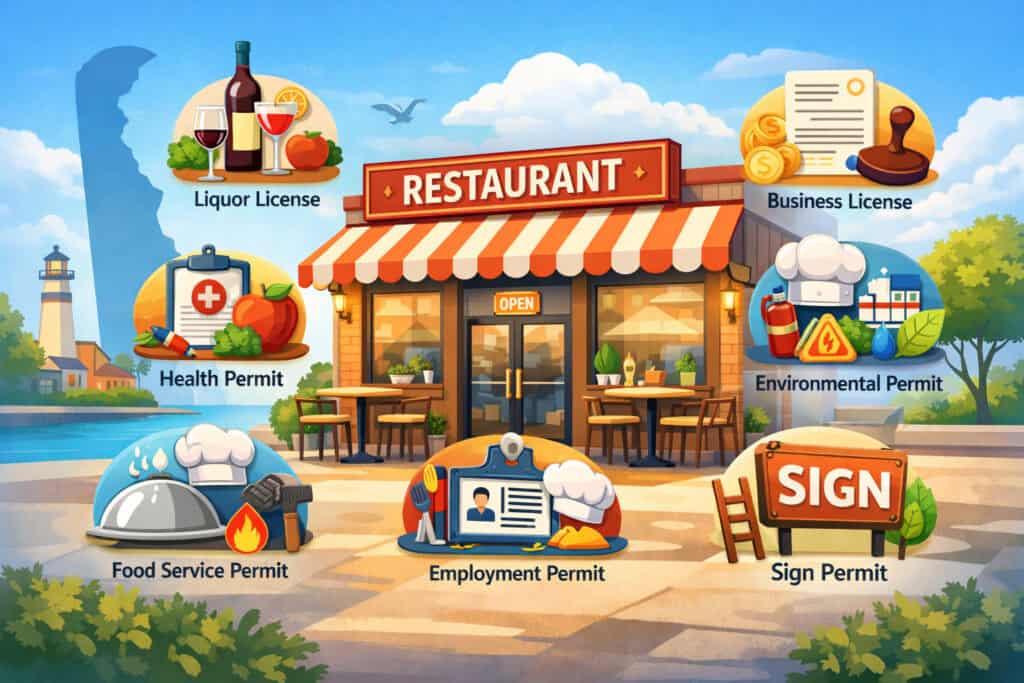
To renew restaurant permits in Delaware successfully, you need to know which permits are typically in play and which agency handles each one.
The exact list can vary based on concept, county, municipality, and whether your business serves alcohol, runs multiple locations, or uses mobile units. But for many restaurants, the permits below are the core compliance items to track.
The table gives a practical snapshot. Always verify your exact renewal cycle and requirements directly with the issuing authority, because some timelines and rules can differ by permit type, business activity, and local jurisdiction.
| Permit or approval | What it covers | Common renewal focus | Where to confirm |
| Business license | Legal authority to conduct business activity | License term, business details, fees, account updates | Delaware One Stop / Division of Revenue |
| Food establishment permit | Public health and food safety authorization | Permit payment, inspections, compliance history, operational changes | Office of Food Protection |
| Sales tax-related account compliance | Tax collection and filing obligations | Filing status, account accuracy, payments due | Division of Revenue |
| Local permits or approvals | Zoning, occupancy, fire, signage, local use | Local forms, inspections, fees, approvals tied to location | City, town, or county offices |
| Alcohol license | Authorization to sell alcoholic beverages | Renewal fee, supporting records, location/service compliance | OABCC |
| Specialized permits | Seasonal, mobile, outdoor seating, event-related, other operation-specific items | Use-specific renewals and supporting documents | Issuing state or local office |
Business license renewal for restaurant operators
For many operators, the business license is the starting point of Delaware permit renewal requirements for restaurants. Delaware One Stop states that Division of Revenue licenses are issued by calendar year, and businesses may renew for one year or choose a three-year option where available.
The state’s renewal page also notes available electronic payment methods and prompts users to confirm whether there have been changes such as becoming an employer.
For restaurant owners, that means the business license renewal is not just a fee payment. It is a review point. If your concept has expanded, if you added staff, changed address details, or updated the operating entity, your renewal workflow may need more than a quick click-through.
Incomplete or outdated information can slow approvals or create downstream issues with tax and compliance records.
This is also where many operators confuse “business license” with “everything else.” A renewed business license does not automatically renew your food establishment permit, local approvals, or alcohol-related licensing. Treat it as one important layer, not the complete stack.
Food service and health permit renewal
Food permit renewal is the category that operators often refer to as Delaware food license renewal, even though the exact permit terminology can vary.
The Delaware Department of Health and Social Services directs food establishments to the Office of Food Protection and specifically provides an online path to make the annual Division of Public Health Food Establishment Permit payment.
The state also notes that the office permits thousands of food establishments and oversees inspection and enforcement activity tied to food safety.
In practical terms, food service permit renewal process issues usually connect to the condition and operation of the business, not just the payment itself. If your records are incomplete, your facility has unresolved sanitation issues, or prior inspection findings were not fully corrected, renewal can become more complicated.
Restaurants that have made major layout, equipment, or menu handling changes may also need to confirm whether updated review or additional communication with the agency is required.
That is why owners should not treat the health permit as a last-minute invoice. It is better to run a pre-renewal food safety review internally before you submit anything.
Sales tax registration and tax account status
Restaurants also need to think carefully about tax compliance when reviewing renewals. A business may not “renew” a sales tax registration in the same way it renews a health permit, but tax accounts still need to remain active, accurate, and in good standing. Late filings, unpaid balances, or outdated account details can complicate the broader compliance picture.
The Division of Revenue’s business taxpayer resources connect licensing and tax responsibilities in a way that matters for restaurants. Because food service businesses handle recurring taxable transactions and reporting obligations, owners should review tax account status as part of every permit cycle, not as a separate afterthought.
A useful way to handle this is to add tax account review to your restaurant compliance renewal checklist. Confirm that:
- Filing frequency is correct
- Authorized users still have access
- Notices are going to the right email and address
- Prior balances are resolved
- The entity name and business location information are current
Local permits and alcohol-related renewals
State-level approvals are only part of the picture. Depending on the city, town, or county where the restaurant operates, you may also need to track local permits tied to zoning, signage, building occupancy, fire review, outdoor seating, or use of the space. These can be especially important after remodels, patio expansions, seating changes, or operational shifts.
If the restaurant serves alcohol, the alcohol license renewal process should be handled as its own compliance track. Delaware’s Office of the Alcoholic Beverage Control Commissioner states that it grants renewals of liquor licenses, and its online licensing page notes that existing licensees can pay for renewals, purchase decals, and pay fines through the online system.
Alcohol renewals deserve extra attention because they often involve stricter scrutiny, supporting records, or conditions tied to the licensed premises. A restaurant that expanded bar service, altered seating areas, or changed how alcohol is stored or served should review whether those changes affect renewal or require separate approval.
Step by step: how to renew business license in Delaware restaurant operations require

For many operators, the question “how do I renew business licenses in Delaware restaurant operations required?” really means “what is the cleanest way to get through renewal without missing something important?” The answer is to separate the state filing itself from the internal prep work that makes the filing accurate.
Delaware’s official renewal guidance points businesses to Delaware One Stop and states that business licenses are issued by calendar year, with one-year and three-year renewal options available in the renewal flow. But before you log in, gather the information that tends to slow restaurants down.
Step 1: Review the restaurant’s current operating details
Before starting the filing, confirm the basics:
- Legal business name
- Trade name, if used
- Business address and mailing address
- Contact person and email
- Ownership or entity changes
- Employer status
- Location count
- Operational status of each restaurant unit
This step matters because the renewal system is only as accurate as the information you provide. If your restaurant changed payroll providers, opened another location, moved mailing addresses, or restructured the business entity, you want those details sorted before submission.
Step 2: Gather login access and payment readiness
A surprising number of renewals get delayed because the right person cannot access the account. Restaurants should confirm in advance who has Delaware One Stop access, whether multi-factor authentication is working, and whether the payment method on file is still valid.
Delaware One Stop states that card payments and ACH debit transactions are accepted through its renewal process. That is helpful operationally, but payment readiness also means internal approval readiness. If ownership approval is needed for renewal fees, get it early rather than after the filing is already started.
Step 3: Confirm the correct license term and business activity
The renewal flow may ask you to choose the renewal period and verify business details. Restaurants should read these prompts carefully instead of rushing through them. If your concept now includes added business activities, multiple operating lines, or changes in employment, those updates can affect what needs to be reflected in your renewal record.
This is also the right time to confirm whether each location is correctly represented. Multi-unit operators should avoid assuming that one renewal takes care of all restaurant addresses or activities unless the system and account records clearly show that structure.
Step 4: Submit the renewal and save proof immediately
Once the renewal is submitted, save every confirmation screen, receipt, email, and payment proof in a central compliance file. Do not rely on one person’s inbox. Save the confirmation using a file name that includes the permit type, location, and date.
A good naming format looks like this:
- Main-Street-Cafe_Business-License_Renewal-Confirmation
- Riverfront-Grill_Delaware-One-Stop_Receipt
- North-Location_Business-License_Payment-Proof
This takes less than a minute but prevents hours of confusion later if a notice, audit question, lender request, or permit inspection comes up.
Step 5: Update the restaurant’s internal compliance tracker
The filing is not done until your internal records are updated. Record:
- Date submitted
- Date paid
- Proof stored location
- Next expected renewal cycle
- Any open follow-up items
- Responsible staff member
That last part matters. Every active permit should have a named internal owner, even if ownership or accounting handles payment.
Delaware food license renewal: what restaurant owners should expect

When people talk about Delaware food license renewal, they are usually referring to the ongoing renewal or annual payment obligations tied to the restaurant’s food establishment permit and related food safety compliance.
The Delaware Department of Health and Social Services makes clear that the Office of Food Protection oversees food establishments and provides an online path for annual food establishment permit payment.
It also emphasizes that the office regulates thousands of food establishments and supports inspection, enforcement, and food safety oversight.
For restaurant owners, that means food permit renewal is both administrative and operational. You are not just renewing a piece of paper. You are maintaining the public health approval that supports your restaurant’s ability to prepare, handle, and serve food.
What the food service permit renewal process usually involves
Although exact requirements can vary by operation and situation, many restaurants should expect the food service permit renewal process to include some combination of:
- Confirming permit status and renewal timing
- Paying the required annual fee or permit charge
- Verifying current establishment information
- Addressing unresolved compliance items
- Preparing for inspections or follow-up review
- Confirming whether operational changes need to be reported
If your restaurant has had a stable year with clean records and no major changes, renewal may be straightforward. If you changed the kitchen layout, expanded menu processes, added high-risk food handling, or had prior sanitation issues, you may need more preparation.
This is where internal self-audits pay off. Before the renewal window opens, review temperature logs, sanitation routines, pest control records, hood and grease maintenance records, employee hygiene procedures, and any recent inspection findings. Make sure corrective actions are documented, not just discussed.
Food safety issues that can complicate renewal
A delayed food permit renewal is often not caused by a single dramatic violation. More often, it comes from a pattern of smaller issues that suggest weak control systems. Examples include:
- Incomplete temperature monitoring
- Poor handwashing station readiness
- Missing sanitizer testing records
- Inconsistent cleaning schedules
- Unclear allergen handling
- Evidence of pest activity
- Unrepaired facility problems
- Missing documentation for required food safety management practices
Even if your location is busy and financially healthy, weak documentation can make compliance harder to demonstrate. A restaurant that “usually does things right” still needs records that show it.
How to prepare before the renewal window
A practical Delaware food license renewal prep routine should happen at least several weeks before your expected due date. Focus on these tasks:
- Walk the facility as if an inspector were visiting today
- Review the last inspection report line by line
- Verify all corrective actions are complete
- Confirm manager and key contact information is current
- Gather payment information and account access
- Check that food safety logs are current and stored consistently
- Review any recent operational changes that may affect permit status
Renewal timelines, cycles, and why early preparation matters
One of the biggest mistakes operators make is assuming all permits renew on the same cycle. In reality, different approvals may follow different calendars, and some renewal timelines are more predictable than others.
Delaware business license renewals are tied to a calendar-year structure through Delaware One Stop, while food establishment permit payments are described by the state as annual. Alcohol renewals and local approvals may follow their own separate schedules and administrative workflows.
That is why good renewal management is less about memorizing one deadline and more about building a layered calendar.
A practical way to think about renewal timing
Instead of asking “when does everything expire?” ask these better questions:
- Which permits are annual?
- Which permits are tied to the calendar year?
- Which permits depend on separate local approval cycles?
- Which permits become more difficult to renew if there are open violations or unpaid balances?
- Which permits require extra lead time because they involve inspections or supporting documents?
This approach gives you a much more realistic operating picture. A restaurant with alcohol service and local patio approvals may need a much longer planning runway than a small carryout operation with fewer active permits.
Why earlier is better for restaurant operators
Restaurants should start renewal prep early because the real delay is usually not the form itself. The real delay is the missing backup material. It might be a tax issue bookkeeping needs to fix, an outdated mailing address, an unpaid fee, a portal login problem, or a facility issue that should have been repaired earlier.
Early preparation also gives you time to confirm requirements directly with the issuing office if something is unclear. That matters because permit type, municipality, and operating model can all influence the correct process.
A useful planning rhythm for most restaurants looks like this:
- 90 days before expected due date: review permit file and confirm requirements
- 60 days before: gather documents, confirm account access, fix open issues
- 30 days before: submit renewals or finalize any remaining items
- 7 days before: verify payment confirmation and proof of submission
Documents and information commonly required for renewal
The fastest way to reduce renewal stress is to maintain a standard document package for each location. Even when the exact renewal requirements differ by permit, the same core information tends to come up again and again. When these items are already organized, restaurant license renewal Delaware tasks go much faster.
At a minimum, every location should keep a current permit file with the following:
- Legal entity name and trade name
- Business address and mailing address
- Federal tax ID or state account identifiers where applicable
- Owner and manager contact details
- Copies of current licenses and permits
- Prior renewal confirmations and payment receipts
- Inspection reports and corrective action records
- Food safety logs and sanitation documentation
- Payroll or employer status information if relevant
- Alcohol-license-related records, if applicable
- Local permit approvals, inspection sign-offs, or occupancy documents
How to organize renewal records so they are actually usable
Many restaurants technically “have the paperwork,” but it is stored in a way that makes it hard to use under deadline pressure. The best structure is simple and location-based.
Create one main folder per location, then use subfolders such as:
- Business license
- Food permit
- Tax and revenue
- Local permits
- Alcohol
- Inspections
- Renewals and receipts
- Vendor compliance and safety logs
Inside each folder, store the newest documents first and use consistent file names. Keep a matching physical binder only for the most important active documents and confirmations.
This system is especially valuable for multi-unit groups. Without location-specific organization, it becomes easy to mix up records, submit the wrong proof, or miss a location-specific renewal requirement.
Information that should be reviewed before every submission
Even if you already have the documents, you should still review them for accuracy. Check:
- Is the address current?
- Is the contact email monitored?
- Has ownership changed?
- Has the restaurant changed its trade name?
- Are all payments current?
- Have prior compliance issues been resolved?
- Has the menu or service model changed?
- Are there any local approvals that need parallel renewal?
This simple review prevents the common mistake of submitting a technically complete renewal that contains outdated information.
Common mistakes that delay Delaware restaurant permit renewal
The most expensive renewal errors are usually the most ordinary ones. Operators tend to imagine that permit problems come from a major legal issue or a dramatic inspection event. In reality, many delays come from small process failures that could have been prevented with a better checklist.
The most common issues include:
- Missed deadlines
- Incomplete forms
- Unpaid fees
- Outdated contact information
- Missing documents
- Portal access problems
- Open inspection-related issues
- Tax account problems
- Failure to report meaningful operational changes
- Assuming one renewal covers all permits
Why missed deadlines happen
Missed deadlines often come from false confidence. The restaurant renewed smoothly last time, so everyone assumes it will be easy again. Then the general manager changes, the owner is traveling, accounting is short-staffed, and the reminder email is buried under vendor messages.
Missed deadlines also happen because operators do not know the difference between renewal notice date, submission date, processing date, and expiration date. Those are not always the same thing. Waiting until the last possible day leaves no room for corrections, follow-up questions, or payment issues.
Why incomplete forms and unpaid fees cause bigger problems than expected
An incomplete form is rarely just a clerical issue. It signals that the restaurant may not be tracking its own compliance records closely. The same is true of unpaid fees. One missed payment can trigger extra follow-up, hold up processing, and create confusion about whether the permit is actually active.
This is especially risky in restaurants where accounting and operations are separate. Accounting may assume operations submitted the renewal, while operations may assume accounting handled payment. The result is a half-finished renewal.
Inspection and compliance issues that can create delays
For food-related permits and alcohol-related approvals, the problem may not be the form at all. It may be unresolved operational issues. Restaurants that let recurring sanitation problems, facility repair issues, or recordkeeping gaps build up are more likely to hit friction during renewal.
This does not mean every minor issue will block renewal. It does mean that operators should think of renewal as a reflection of year-round compliance, not a one-day task.
What happens if a restaurant fails to renew permits on time
When a restaurant fails to renew permits on time, the consequences can range from administrative hassle to real business disruption. The exact outcome depends on the permit involved, how late the renewal is, whether the business continued operating, and whether the agency or local authority imposes penalties, suspensions, or other compliance actions.
A late business license renewal can affect the business’s standing and create headaches with records, payments, or follow-up notices. Problems with food establishment permits can be more serious because they touch the restaurant’s authority to operate food service safely.
Alcohol-related lapses can also create major risk because alcohol licensing is handled separately and often more tightly. Delaware’s health and alcohol agencies both make clear that they are active regulatory authorities, not passive recordkeepers.
Operational consequences owners should take seriously
Late or failed renewal may lead to one or more of the following:
- Late fees or added administrative costs
- Delays in processing
- Requests for additional documentation
- Temporary inability to prove active permit status
- Increased inspection attention
- Limits on continued operation depending on the permit involved
- Problems with alcohol service if alcohol licensing lapses
- Internal disruption during busy service periods
Even when the issue is fixable, the timing can be painful. A permit problem that surfaces before a holiday weekend, catering event, or busy season can create a much bigger loss than the renewal fee itself.
The hidden cost of scrambling after expiration
The direct fee is usually not the biggest cost. The bigger costs are lost management time, staff confusion, interrupted sales, legal review, rushed repairs, and stress. A late renewal can also force owners to talk to landlords, investors, lenders, or franchisors if compliance status is part of a lease or operating obligation.
That is why the best operators treat permit renewals as revenue protection. Compliance may feel administrative, but operationally it protects continuity.
Real-world renewal scenarios for different restaurant types
A practical guide should reflect the fact that not all restaurants renew the same way. The core steps may be similar, but the level of complexity changes with the business model.
Scenario 1: small café with one location
A single-location café may have a relatively simple renewal stack: business license, food establishment permit, tax compliance review, and possibly a few local approvals. The risk here is usually lack of administrative depth. One owner or manager may be doing everything, which makes renewals vulnerable to illness, vacation, or simple overload.
For this kind of business, the smartest move is to keep a compact but disciplined system. One digital folder, one printed binder, and one calendar with early reminders can solve most problems. A small café does not need a large compliance department. It needs consistency.
Scenario 2: full-service restaurant with alcohol service
A full-service concept with alcohol service has more moving parts. In addition to standard permits, the restaurant may need to track alcohol renewal, patio or occupancy-related local approvals, and more detailed operating records.
The risk here is assuming the visible front-of-house service model is unchanged when regulators may care about back-of-house, storage, layout, or licensed-area details.
This kind of operation should schedule a structured pre-renewal review with the general manager, kitchen manager, owner, and bookkeeper. Cross-check permits against how the business is actually running today, not how it was described a year ago.
Scenario 3: multi-location restaurant group
A multi-location operator faces a different challenge: volume and consistency. The risk is not forgetting compliance entirely. The risk is missing one location while assuming the group is covered. Different municipalities, different managers, and different renewal dates can create fragmentation fast.
The solution is a master renewal dashboard plus location-level files. Every site should have a local compliance owner, but corporate or ownership should maintain central visibility. This is where standardized naming, central storage, and monthly review meetings make a big difference.
Practical ways to stay organized and avoid missed renewals
The best renewal system is not necessarily the most complicated one. It is the one your team will actually use. Restaurants do better with simple, visible systems that fit daily operations.
A strong restaurant compliance renewal checklist should include both recurring reminders and recurring reviews. Reminders alone are not enough. You also need a routine for confirming that the records behind the reminder are accurate.
Simple systems that work well in restaurants
Use a combination of:
- Shared calendar reminders
- Cloud-based compliance folders
- Printed location binder
- Monthly manager review
- Quarterly facility compliance walk
- Annual full permit audit
This layered approach creates redundancy. If an email reminder is missed, the monthly manager review can still catch the issue. If the digital folder is disorganized, the printed binder can still verify current status. If one manager leaves, the shared system remains.
Who should own the renewal process
The owner does not have to do every renewal personally, but ownership of the process should always be clear. A good structure looks like this:
- Owner or executive: approves fees and final accountability
- General manager: confirms operating details and local readiness
- Bookkeeper or finance lead: handles payment and tax account review
- Kitchen or food safety lead: confirms food-safety documentation
- Compliance coordinator or admin lead: maintains the calendar and records
Small restaurants may combine these roles. Large restaurants may separate them further. The important thing is that every task has a name next to it.
Restaurant compliance renewal checklist
Use this practical checklist before any Delaware restaurant permit renewal cycle:
- Review all active permits and licenses for each location
- Confirm renewal dates and issuing agencies
- Log in to the correct state or local portal early
- Verify legal entity name, trade name, and addresses
- Confirm manager and owner contact information
- Check payment method and approval chain
- Review tax account status and open balances
- Review the last inspection report and corrective actions
- Confirm food safety logs and sanitation records are current
- Check whether remodels, menu changes, or service changes affect permit status
- Review alcohol-related records separately if alcohol is served
- Confirm local permits and municipal approvals are still active
- Submit renewals before the deadline
- Save receipts, confirmations, and proof of payment
- Update your internal compliance tracker
- Set the next round of reminders immediately
FAQs
How early should I start to renew restaurant permits in Delaware?
Start reviewing your permit file at least 60 to 90 days before any expected renewal date. That gives you time to gather records, fix account issues, confirm local requirements, and handle questions without rushing. If your restaurant has alcohol service, multiple locations, or prior inspection issues, starting earlier is even better.
Is Delaware restaurant permit renewal handled through one agency?
No. Different permits are handled by different authorities. Business license renewal is handled through Delaware One Stop and the Division of Revenue, food establishment permit matters are handled through the Office of Food Protection, and liquor license renewals are handled through the Office of the Alcoholic Beverage Control Commissioner. Local permits may also be managed separately by city, town, or county offices.
Do all restaurants need the same renewals?
No. A small café, food truck, full-service restaurant, bar-restaurant hybrid, and multi-location group may all have different permit stacks. The exact requirements can vary based on your concept, food handling risk, alcohol service, and local jurisdiction. Always confirm your specific renewal obligations with the issuing agencies and local authorities connected to your location.
Is Delaware food license renewal just a fee payment?
Not always. While an annual payment may be part of the process, food permit renewal is tied to ongoing food safety compliance. Inspection history, operational changes, documentation quality, and unresolved sanitation issues can all affect how smooth the renewal process will be. It should be treated as both an administrative task and an operational readiness review.
Can I assume my sales tax registration renews like my business license?
No. Tax account compliance does not always work the same way as permit renewal. Even if a separate renewal is not required in the same format, restaurants still need accurate tax accounts, timely filings, and current business information. It is smart to review tax status as part of your broader permit renewal process.
What is the biggest mistake restaurant owners make during renewal?
The biggest mistake is thinking renewal starts when the notice arrives. In reality, smooth renewals are built through year-round organization, current records, clear account access, timely fee handling, documented corrective actions, and early review of deadlines.
Conclusion
The most effective way to renew restaurant permits in Delaware is to stop treating renewal like a once-a-year emergency. Restaurants stay compliant when they build a repeatable system that covers business licensing, food permit obligations, tax account review, local approvals, and alcohol renewals where applicable.
Delaware’s agencies split these responsibilities across different channels, so successful Delaware restaurant permit renewal depends on keeping each part organized, current, and verified.
For owners and managers, the practical path is clear. Know which permits apply to your restaurant. Confirm renewal cycles early. Keep your documents organized by location. Review inspections and compliance records before deadlines.
Save proof of every submission and payment. And most important, confirm details directly with the state or local authority responsible for that permit, because renewal requirements can vary based on permit type, operating model, and location.
If you follow that approach, restaurant license renewal Delaware requirements become much more manageable. You reduce the risk of missed deadlines, avoid unnecessary disruptions, and give your team a stronger operating foundation.
Renewal should not be the thing that throws your restaurant off course. With the right system, it becomes just another controlled part of running a reliable, well-managed business.