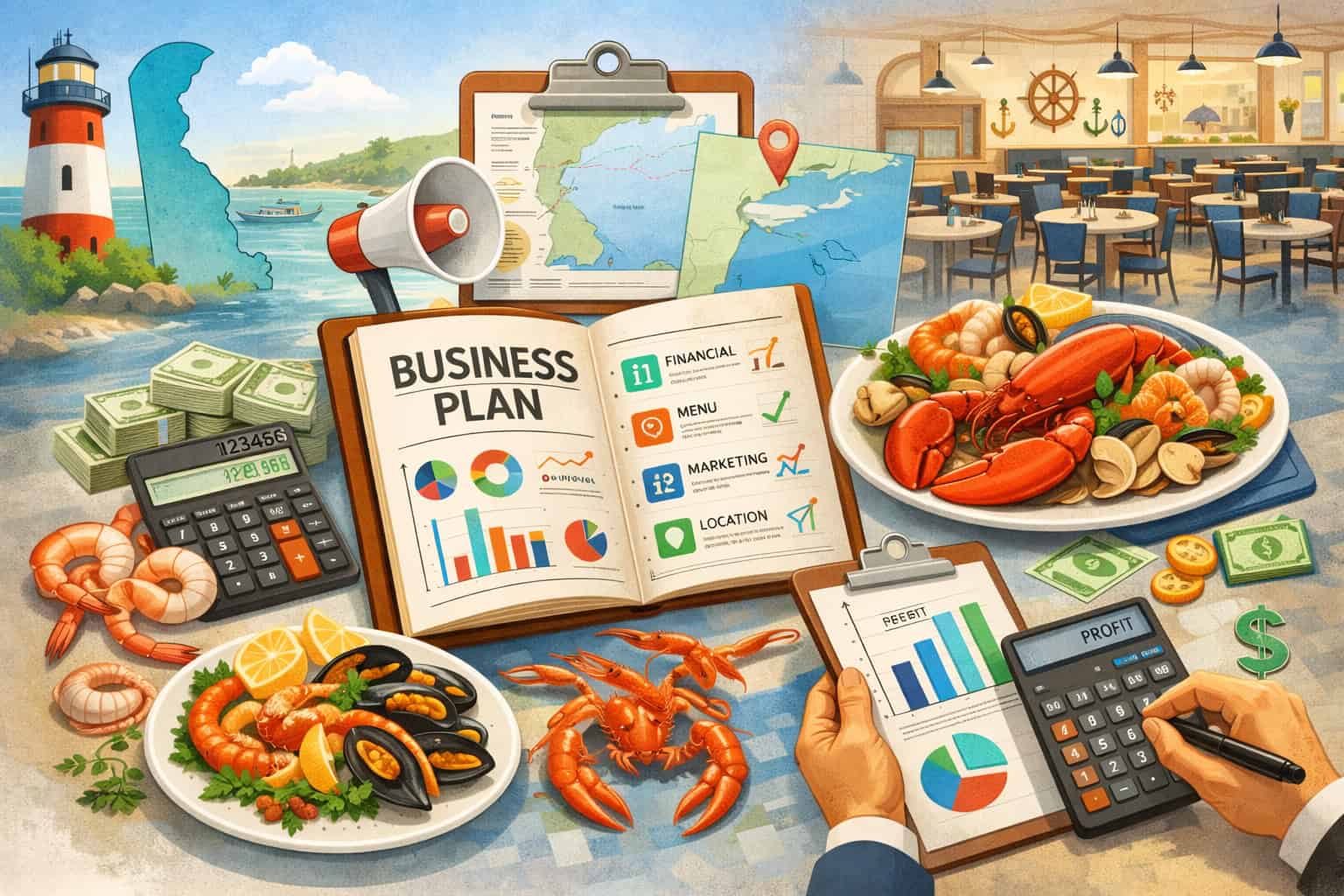
Business Plan for a Seafood Restaurant in Delaware
Opening a seafood restaurant can look simple from the outside: find a good location, create an appealing menu, hire a capable team, and start serving guests.
In reality, a successful Business Plan for a Seafood Restaurant in Delaware requires much more discipline than many first-time operators expect.
Seafood brings higher ingredient sensitivity, shorter shelf life, stricter handling standards, and more price volatility than many other restaurant categories. That means the planning process has to be more detailed from the beginning.
A seafood concept also depends on factors that can shift quickly. Guest traffic may rise and fall with tourism patterns, menu costs can change based on weather and supply conditions, and customer expectations around freshness, quality, and dining experience tend to be high.
If your concept includes dine-in service, bar sales, raw offerings, or premium seafood items, the complexity increases even more. A vague plan is rarely enough.
That is why a strong business plan for seafood restaurant owners should do more than describe a vision. It should show how the restaurant will work in real life. It should explain the concept, define the customer, outline startup costs, model the numbers, and prepare for everyday operational pressure.
Whether you are creating a dockside casual concept, a polished oyster-and-cocktail room, or a family-friendly seafood grill, the business plan should translate your idea into a clear operating framework.
For founders, this planning process helps prevent expensive mistakes. For lenders and investors, it shows whether the concept is grounded in research and realistic assumptions. For managers, it creates a roadmap for staffing, purchasing, pricing, marketing, and growth.
This guide breaks down how to build a practical, investor-ready Business Plan for a Seafood Restaurant in Delaware with a focus on real-world planning, startup costs, operations, financial structure, and long-term decision-making.
Why a Seafood Restaurant Business Plan Matters More Than Many Owners Expect
A restaurant business plan is not just a document created to satisfy a lender. At its best, it becomes a working model for how the business will launch, operate, and adapt.
For a seafood concept, that matters even more because the cost structure is more fragile than it is in many casual restaurant categories. Seafood quality can change quickly, holding times are tighter, and menu margins can swing if purchasing is not tightly managed.
Many owners start with a menu and a location in mind but do not fully define the business behind those ideas. A strong seafood restaurant business plan Delaware entrepreneurs can actually use should answer core questions.
What kind of seafood experience are you building? Who is the primary guest? How price-sensitive is that customer? What level of service can the concept support? How much working capital is needed before the restaurant reaches stable weekly sales? Without clear answers, even a promising concept can drift into inconsistent execution.
A well-built plan also forces honest decision-making. It can show when a menu is too broad, when rent is too high for the concept, or when labor assumptions are too optimistic. It helps you identify whether the restaurant can survive slower months, whether your menu mix is too dependent on volatile products, and whether your projected average check is realistic for the surrounding market.
It is also an essential funding tool. Banks, private investors, and even landlords often want to see that the business has been thought through carefully. They want to know how startup funds will be used, what the revenue drivers are, and how management plans to control risk. If you need outside capital, your plan should tell a clear story supported by practical detail.
What a Complete Seafood Restaurant Business Plan Should Include
A useful business plan for a seafood restaurant should include more than an executive summary and a few sales estimates.
It should cover the concept, target customer, market opportunity, competitive positioning, menu approach, sourcing model, staffing plan, operations framework, startup budget, and financial projections. Each section should connect to the others so the plan feels consistent rather than stitched together.
For example, if you describe the concept as premium casual seafood, your menu pricing, interior buildout, service model, labor structure, and marketing strategy should all support that claim.
If you say the restaurant will focus on freshness and quality, the sourcing section should explain how vendors will be selected, how receiving standards will work, and how inventory will be protected. If you expect strong dinner traffic, the staffing and kitchen workflow should reflect that pattern.
The best plans are specific enough to be credible but flexible enough to evolve. You do not need to predict every detail perfectly. You do need to show that you understand the pressures of the business. That includes seafood handling, waste control, seasonality, guest expectations, cash flow pressure, and labor intensity.
A strong plan usually includes:
- Executive summary
- Concept and brand positioning
- Market and customer analysis
- Location strategy
- Menu development and sourcing plan
- Operations and staffing structure
- Marketing and guest acquisition plan
- Startup cost budget
- Financial projections and break-even analysis
- Risk factors and contingency planning
How the Business Plan Supports Funding, Hiring, and Daily Decisions
Many owners think the business plan only matters before opening. In practice, it continues to shape the restaurant long after launch. It can guide lease negotiations, vendor conversations, equipment choices, staffing levels, menu revisions, and marketing priorities.
It also creates accountability. If labor costs are rising faster than planned or average check size is missing the target, management can compare actual performance to the plan and respond faster.
The plan is also useful for recruitment. A chef, operating partner, or investor is more likely to take the opportunity seriously when the concept is clearly defined. It signals that the business is being built thoughtfully rather than impulsively. That matters when you need strong people to commit early.
Most importantly, the business plan helps separate hopeful assumptions from workable ones. Seafood restaurants can perform very well, but they are not automatically profitable.
Success depends on concept fit, menu engineering, purchasing discipline, operations, local demand, and leadership quality. A careful plan does not guarantee success, but it greatly improves the odds that the restaurant starts from a realistic foundation.
Defining the Concept and Positioning for a Seafood Restaurant

One of the first and most important parts of a Business Plan for a Seafood Restaurant in Delaware is deciding exactly what kind of seafood restaurant you are building. “Seafood restaurant” is too broad to be a useful strategy by itself.
A business plan becomes much stronger when the concept is narrowed into a clear market position. That position influences startup costs, labor needs, menu structure, design choices, and customer expectations.
Your concept should answer a simple question: why will guests choose this restaurant instead of the existing alternatives? That answer should be clear enough that a first-time reader can understand the difference quickly.
Some seafood restaurants compete on freshness and local identity. Others focus on affordability, convenience, premium presentation, family dining, bar energy, or a refined occasion-driven experience.
Common concept directions include casual fried seafood houses, fast-casual seafood bowls and rolls, coastal-inspired grill concepts, oyster bars, polished full-service seafood restaurants, and hybrid seafood-and-bar operations.
Each model carries different economics. A fast-casual concept may require less front-of-house labor and simpler service training, while a full-service concept may support a higher average check but demand more payroll, stronger management, and a more expensive buildout.
Concept positioning should also define your tone. Is the restaurant family-friendly, date-night oriented, tourist friendly, neighborhood driven, or built for locals who want consistent quality? Is it a value seafood concept or a premium one? If the answer is “a little bit of everything,” the concept may not be focused enough yet.
Choosing Between Casual, Fast-Casual, and Full-Service Seafood Models
A casual seafood restaurant can work well when the goal is approachable pricing, broad appeal, and moderate service complexity. This type of concept often succeeds with familiar items such as fish sandwiches, crab cakes, shrimp platters, chowders, and seafood baskets.
The advantage is accessibility. The risk is that if the food quality and experience are not clearly stronger than nearby alternatives, the concept may struggle to stand out.
A fast-casual seafood restaurant usually depends on speed, efficiency, and a tighter menu. It may focus on counter service, lower buildout costs than traditional full service, and simpler labor models.
This can help in controlling payroll, but it also puts pressure on throughput, packaging, and operational consistency. Fast-casual seafood often works best when the menu is streamlined around bowls, tacos, rolls, grilled plates, and a few strong signature items.
A full-service seafood restaurant can support a higher check average and a more differentiated guest experience. It may include raw bar items, craft beverages, broader wine service, and a more developed atmosphere.
The tradeoff is complexity. You need stronger training, more polished service systems, and more capital up front. The plan should reflect whether the market can actually support those prices and service expectations.
Positioning Your Restaurant Around Value, Freshness, or Experience
Once the format is defined, the next layer is positioning. Some seafood restaurants win because they deliver strong value. Others win because they create trust around quality and freshness. Others build their appeal through atmosphere, service, and an occasion-based experience. Your business plan should identify which of these is primary.
A value-driven restaurant must control costs carefully because guests compare prices closely. The menu should use intelligent product mix, portion control, and limited waste.
A freshness-focused concept must build a strong sourcing and handling narrative into both operations and marketing. Guests need to feel that quality is visible in the food and credible in the way the restaurant operates. An experience-driven concept must invest more in design, service, ambience, and consistency.
Many owners try to position themselves as premium, affordable, casual, and upscale all at once. That creates confusion. It is better to choose a primary promise and support it thoroughly. You can still serve multiple guest types, but the restaurant should have a clear center.
Writing a Strong Concept Statement for the Business Plan
A concept statement is a short section that explains what the restaurant is, who it serves, how it is positioned, and why it matters. This is not marketing fluff. It should be practical and specific. A strong concept statement helps lenders, investors, partners, and managers understand the business quickly.
A weak concept statement sounds generic: “We will open a seafood restaurant with great food and excellent service.” A stronger version explains the format, guest, market fit, and differentiator.
For example, it might describe a mid-priced coastal seafood grill offering fresh grilled and fried seafood, seasonal specials, and a welcoming dine-in atmosphere for families, residents, and destination diners in a high-traffic area. That gives the reader a much clearer sense of what is being built.
The concept statement should align with the rest of the plan. If it describes a streamlined, efficient model, the staffing and financial sections should reflect that. If it promises premium seafood and elevated hospitality, the startup budget should include the necessary investment to support that standard.
Understanding the Delaware Market, Customer Base, and Seasonal Demand

A seafood concept needs to fit the local market, not just the owner’s personal vision. That is especially true for a Delaware seafood restaurant startup, where customer behavior can vary significantly by area, traffic pattern, season, and dining occasion.
Your business plan should show that demand has been considered carefully. It should explain who the target customer is, when they are likely to dine, what price range they are comfortable with, and what motivates their choice.
Delaware offers advantages for seafood restaurants because seafood is already familiar and relevant to many diners. Coastal influence, tourism zones, weekend traffic, beach-area dining culture, and interest in fresh seafood can create strong opportunity. At the same time, demand is not uniform across every location.
A concept that works well in a tourism-heavy area may not perform the same way in a more residential trade area. A refined oyster-and-cocktail concept may work in one market and fail in another where value and convenience matter more.
Your market analysis should identify the likely customer mix. That may include year-round local residents, seasonal visitors, families, retirees, professionals, beach traffic, or destination diners. The plan should also define daypart expectations.
Will the business depend mostly on dinner? Can lunch become a meaningful revenue stream? Will bar traffic play a role? These assumptions affect staffing, seating strategy, and revenue projections.
Understanding seasonality is equally important. Seafood restaurants in seasonal trade areas can perform strongly during peak periods and then experience much slower weeks during off-peak months.
A good plan should not just celebrate the busy season. It should explain how the business will handle shoulder periods, slower weekdays, and quieter months without relying on unrealistic volume assumptions.
Identifying the Ideal Customer Profile for Your Seafood Concept
A customer profile should go beyond age and income. It should describe buying behavior. Why does the guest go out to eat? What matters most to them? Speed, price, freshness, atmosphere, portion size, alcohol selection, family convenience, or a polished dining experience? The answers should shape your menu and service model.
For a casual seafood house, the core customer might be families and local residents seeking a dependable dinner option with familiar seafood dishes, moderate pricing, and relaxed service.
For a fast-casual concept, the customers may be younger professionals, lunch traffic, and convenience-driven diners who want seafood in a format that feels fast and modern. For a premium full-service concept, the target may include date-night guests, special-occasion diners, and customers willing to pay more for atmosphere and higher-end menu items.
The business plan should describe the primary customer and one or two secondary customer groups. Too many target audiences usually mean the concept is not focused enough. It is better to know exactly who the restaurant is built for and why that audience will return.
Delaware-Specific Demand Factors That Shape Seafood Restaurant Planning
A seafood restaurant business plan Delaware founders prepare should address the state’s dining patterns and trade-area realities. In some areas, seafood benefits from strong local familiarity and visitor interest. In others, demand may depend more on accessible pricing and strong convenience.
Coastal influence can help create natural interest in seafood dining, but that alone is not enough. The real question is whether the proposed location has the right customer flow, spending habits, and competitive gap.
Seasonality matters. Some locations may experience a meaningful boost during warmer-weather months, holidays, or visitor-heavy weekends. That can be a major advantage if the business uses those periods well.
But it can also create problems if the cost structure is too high to support slower stretches. Your plan should explain how labor, inventory, and marketing will adjust when traffic changes.
Weather, event traffic, and local routines can also influence demand. A seafood restaurant in a tourism-oriented corridor may need different staffing and inventory systems than one serving neighborhood repeat business.
A location with strong weekend dining may require a different menu mix than one built around both lunch and dinner. These details make the plan more realistic and more useful.
Researching Competition Without Copying Competitors
Competitive analysis should not just list nearby restaurants. It should explain what they do well, where they are positioned, and where your concept fits differently. Look at pricing, service model, menu breadth, online reviews, parking, hours, perceived quality, and guest experience. The goal is not to copy what already exists. It is to find the gap your concept can serve better or more clearly.
Your business plan should identify direct competitors and indirect competitors. Direct competitors are other seafood-focused restaurants or concepts appealing to the same guest occasion.
Indirect competitors may include steakhouses, family dining restaurants, waterfront dining spots, or fast-casual concepts competing for the same budget and mealtime.
A useful competitive section answers three questions:
- What choices already exist for the customer?
- What is your concept doing differently?
- Why is that difference meaningful enough to attract repeat business?
Choosing the Right Location and Evaluating Site Potential

Location can strengthen or weaken even a well-designed seafood concept. In a Business Plan for a Seafood Restaurant in Delaware, the location section should do more than say that the area has good traffic.
It should explain why the site fits the restaurant’s concept, customer, and economics. The right site is not always the one with the highest visibility or the trendiest address. It is the site where rent, access, demand, and operations work together.
Seafood restaurants need location decisions that match the business model. A destination-style full-service restaurant may benefit from atmosphere, parking, and the ability to support a longer dining experience.
A fast-casual seafood concept may need convenience, easy in-and-out traffic, strong lunch density, and high visibility. A family-oriented concept may need parking, approachable rent, and a surrounding customer base that can support repeat visits.
A site should also be evaluated from an operational point of view. Can deliveries be received easily? Is there enough kitchen and refrigeration capacity for the menu? Is the plumbing, ventilation, and utility infrastructure adequate? Can the space support seafood handling and storage without creating workflow problems? A restaurant that seems attractive from the dining room side can become expensive and inefficient if the back-of-house layout is wrong.
It is also important to think beyond opening day. The best locations support consistent guest behavior, not just initial excitement. A site that looks attractive during peak traffic but performs poorly during ordinary weeks may create long-term strain. The business plan should show that the location was chosen based on fit, not emotion.
You can strengthen this section further by learning from practical site-planning resources such as how to choose a great restaurant location, especially when comparing traffic, demographics, access, and lease tradeoffs.
Evaluating Foot Traffic, Parking, Access, and Trade Area Fit
Foot traffic matters, but only when it is the right kind of traffic. A site near heavy movement is not automatically strong if those people are not your likely guests or do not stop and dine.
A seafood restaurant business plan should evaluate traffic quality, not just traffic volume. Are people nearby likely to be local repeat guests, tourists, office workers, families, or destination diners? How does that match the concept?
Parking matters more than many owners want to admit. For full-service dining, difficult parking can reduce repeat visits. For carryout and fast-casual seafood, convenience is often part of the value proposition.
If access is frustrating, potential customers may choose easier alternatives. Visibility, signage, and entry flow also matter. Can a first-time guest find the restaurant quickly? Can they enter easily? Is the site intuitive?
The surrounding trade area should support the concept’s pricing and customer frequency. A premium oyster bar may need a different demographic base than a family seafood grill. A lunch-oriented concept may depend on nearby workers. A dinner-led concept may depend more on households, entertainment traffic, or weekend destination behavior.
Understanding Rent, Buildout Risk, and Space Suitability
The best-looking site can still become a weak choice if rent and buildout costs overwhelm the business. Many seafood restaurant operators underestimate the cost of converting a space into a kitchen capable of handling refrigeration, prep, hot line production, dish flow, storage, and service. A lower-rent second-generation restaurant space may be far more practical than a prettier shell requiring major work.
The business plan should address not only rent but occupancy cost as a percentage of projected sales. A location that requires high fixed monthly obligations may create too much pressure during slower periods. Seafood concepts already face product cost variability. Adding an overly aggressive rent structure can make the model fragile.
Space suitability is just as important. A concept that relies on prep-intensive seafood items needs enough refrigerated storage, prep room, and receiving efficiency.
A full-service seafood restaurant may need a bar, host area, waiting space, and dining room layout that supports table turns without crowding. A fast-casual concept may need a line setup designed for speed. The site should match the concept operationally, not just aesthetically.
Matching the Site to the Guest Experience You Want to Create
The right site should reinforce the kind of experience guests expect from the concept. A premium seafood restaurant benefits from a location that feels compatible with an elevated meal.
A value-focused seafood house can succeed in a more practical location if convenience and affordability are central to the brand. A location that sends the wrong signal can confuse customers before they even see the menu.
Your business plan should explain how the site supports the desired guest experience. That includes neighborhood feel, surrounding businesses, ease of arrival, and whether the setting helps the restaurant feel like an obvious choice.
If the concept is positioned around freshness, hospitality, and an enjoyable dine-in experience, the location should support lingering and comfort. If the concept is about fast, dependable seafood meals, the site should support speed and accessibility.
Location fit is never just about geography. It is about whether the restaurant can operate efficiently and whether customers will feel that the concept belongs there.
Building the Menu and Creating a Seafood Sourcing Strategy
Menu planning is one of the most important sections in a business plan for seafood restaurant owners put together because the menu defines both guest appeal and economic reality. A strong seafood menu should do more than sound impressive.
It should be operationally manageable, cost-aware, and strategically designed to balance guest expectations with margin protection. In seafood restaurants, menu mistakes can become expensive quickly because food costs are more volatile and spoilage risk is higher.
Start by deciding what the menu is supposed to do. Is it meant to communicate value, premium quality, regional identity, broad family appeal, or chef-driven differentiation? A well-structured menu should reflect the concept directly.
If you are building a casual seafood house, the menu should not be overloaded with too many high-skill or low-turn specialty items. If the concept is more refined, the menu should still be focused enough to support consistent execution and purchasing discipline.
Sourcing is equally critical. Your business plan should explain where seafood will come from, how vendors will be selected, how deliveries will be checked, and what standards will be used for freshness and handling.
This is where many plans become too vague. It is not enough to say the restaurant will buy high-quality seafood. The plan should explain how that quality will be protected from vendor to plate.
Menu development should also anticipate supply variability. A concept that depends heavily on a few highly volatile products may struggle if those prices rise sharply or supply tightens. Building flexibility into the menu through specials, interchangeable species, seasonal adjustments, and balanced product mix can make the business more resilient.
For broader planning ideas, it can help to review seasonal menus and local ingredients as part of menu design, guest interest, and cost control.
Designing a Menu That Fits the Concept and Kitchen Capacity
A seafood menu should match both the concept and the kitchen’s actual ability to produce it consistently. Many first-time owners try to create a large menu to please everyone. In practice, this often leads to slower ticket times, more waste, more prep complexity, and inventory problems. A business plan should show that the menu has been narrowed to a practical core.
Start with signature categories that define the restaurant. These may include grilled seafood plates, fried baskets, sandwiches, raw bar offerings, chowders, shareables, and a few non-seafood options for broader group appeal. The key is to create enough choice without introducing too many one-off ingredients or complicated cooking methods.
The menu should also consider line flow. Can the kitchen execute the menu well during a busy dinner rush? Are there too many items requiring separate cooking stations, special garnishes, or complex plating? Can ingredients overlap across multiple dishes to reduce waste and improve purchasing efficiency? The plan should address these questions because menu design is inseparable from operational design.
Creating a Flexible Seafood Sourcing Plan
A sourcing strategy should explain how the restaurant will maintain consistent quality while protecting the business from supply disruption and sudden price swings. In a seafood restaurant financial planning context, this section matters because purchasing decisions directly affect margin, waste, menu availability, and guest trust.
Your business plan should identify the types of suppliers you expect to use, such as broadline distributors, seafood specialists, local purveyors, or a mix of multiple sources. It should also explain why the sourcing mix supports the concept.
A premium restaurant may rely more heavily on specialty seafood vendors, while a value-oriented concept may need a broader purchasing strategy focused on consistency and cost control.
It is also smart to build menu flexibility into the sourcing plan. That means using seasonal features, market-price items where appropriate, and menu language that allows for responsible adjustments without disappointing guests. The restaurant should not be trapped by rigid menu promises that become unsustainable when costs shift.
Seafood Menu Pricing Strategy and Margin Protection
A realistic seafood menu pricing strategy balances guest expectations, competitor pricing, perceived value, and actual food cost. Many restaurant owners underprice seafood because they worry guests will resist higher menu prices. But when pricing is too low, the restaurant may appear busy while still struggling financially.
Menu prices should be based on more than ingredient cost alone. You also need to account for labor intensity, portion size, waste, prep time, service style, and overhead. Premium items may need stronger contribution margins, and lower-cost items can sometimes support profitability if they are popular and operationally efficient.
Below is a simple sample table showing how a seafood restaurant might think about menu cost structure:
| Menu Item | Estimated Plate Cost | Target Menu Price | Approx. Food Cost % | Notes |
| Fried Shrimp Basket | $5.50 | $17.00 | 32% | Value item with broad appeal |
| Grilled Salmon Plate | $8.25 | $24.00 | 34% | Premium casual core entrée |
| Crab Cake Sandwich | $6.40 | $19.00 | 34% | Signature item with strong branding value |
| Lobster Roll | $10.50 | $29.00 | 36% | Higher check item, depends on market tolerance |
| Fish Tacos | $4.20 | $15.00 | 28% | Good margin if prep is controlled |
| Clam Chowder Cup | $1.60 | $7.00 | 23% | Strong add-on and margin support |
This table is only a sample, but it illustrates an important principle: not every item needs the same food cost percentage. The menu should be engineered as a whole, not priced item by item in isolation.
Estimating Seafood Restaurant Startup Costs in Delaware
A serious Business Plan for a Seafood Restaurant in Delaware needs a startup budget that is detailed enough to guide funding and realistic enough to protect the business from early surprises.
Startup cost planning is where many promising concepts start to break down. Owners often underestimate buildout, refrigeration, staffing, pre-opening expenses, working capital, and the cost of carrying the business through its early months.
Seafood restaurants can require higher upfront investment than simpler concepts because of refrigeration, storage, prep, display, drainage, sanitation, and equipment needs.
If the concept includes raw seafood, bar service, or a high-volume kitchen, the capital requirements can rise further. The business plan should show where the money will go and why those costs are necessary for the concept.
This section should separate one-time opening costs from ongoing monthly costs. It should also include contingency capital. Too many founders budget only for opening day and forget that the restaurant may need time before sales become consistent.
A strong startup plan includes enough working capital to absorb slower weeks, training inefficiency, vendor terms, and early marketing spend.
The startup budget should match the concept honestly. A fast-casual seafood concept may need less front-of-house buildout than a polished full-service restaurant, but it still needs capable kitchen infrastructure.
A premium dine-in concept may need larger furniture, fixture, décor, and beverage setup budgets. The numbers should support the actual brand promise.
For additional budgeting context, many operators find it useful to compare their assumptions against resources such as how much it costs to open a restaurant in Delaware and a restaurant startup checklist while building out their own detailed pro forma.
Major Cost Categories for a Delaware Seafood Restaurant Startup
The seafood restaurant startup costs Delaware owners should typically fall into several major categories. Real numbers vary widely by location, square footage, condition of the site, and concept style, but the categories themselves are fairly consistent.
A typical startup budget may include:
- Lease deposit and initial rent
- Architectural, design, and plan review costs
- Construction and buildout
- Plumbing, electrical, and ventilation work
- Kitchen equipment and smallwares
- Refrigeration and freezer systems
- Furniture, fixtures, and décor
- Point-of-sale and technology systems
- Licenses, permits, and inspections
- Initial food, beverage, and packaging inventory
- Recruiting, training, and pre-opening payroll
- Branding, signage, photography, and launch marketing
- Insurance and professional fees
- Opening cash reserve and working capital
- Contingency fund for overruns
Each category should be estimated separately in the business plan. Rounded total numbers are not enough. Investors and lenders want to see that management understands what the business requires physically and financially.
Refrigeration, Equipment, Buildout, and Food Safety Infrastructure
Seafood restaurants rely heavily on cold-chain integrity. That means refrigeration is not a side issue. It is a core investment area.
Your plan should account for walk-ins, reach-ins, prep refrigeration, ice capacity, storage organization, and backup capacity where needed. If the concept includes raw service, shellfish handling, or specialty prep, the infrastructure needs may become more demanding.
Kitchen equipment should match menu design. A seafood grill concept may need a strong charbroil or flat-top setup. A fried seafood house may rely heavily on fryers, holding controls, and batter or breading workflow.
A raw bar or oyster-forward concept may need presentation and service equipment beyond the standard kitchen package. The startup budget should reflect the concept, not a generic restaurant list.
Buildout is often the biggest unknown. Spaces that appear restaurant-ready can still need expensive work. Flooring, grease systems, ventilation, drainage, restrooms, bar work, ADA-related adjustments, and utility upgrades can all affect the budget.
This is why the business plan should include contingency capital rather than pretending the initial estimate is final.
Sample Startup Cost Range by Category
Below is a sample planning table for a mid-sized full-service seafood concept. These are illustrative ranges only, but they show how costs are often grouped in a realistic startup model.
| Startup Category | Sample Estimated Range |
| Lease deposit and legal/setup costs | $10,000–$35,000 |
| Design, permits, and professional fees | $15,000–$45,000 |
| Buildout and site improvements | $120,000–$400,000 |
| Kitchen equipment and installation | $80,000–$220,000 |
| Refrigeration and cold storage | $20,000–$70,000 |
| Furniture, fixtures, décor, and signage | $35,000–$120,000 |
| POS, software, and back-office systems | $8,000–$25,000 |
| Initial food and beverage inventory | $12,000–$35,000 |
| Pre-opening payroll and training | $20,000–$60,000 |
| Launch marketing and opening promotion | $7,500–$30,000 |
| Insurance, licenses, and miscellaneous opening costs | $10,000–$30,000 |
| Working capital reserve | $50,000–$150,000 |
A simpler concept may land below these figures, while a polished premium concept may exceed them. The point is not to copy the numbers blindly. The point is to build a budget that reflects your real concept, site condition, and opening strategy.
Financial Planning: Revenue, Cost Structure, and Break-Even Reality
Financial planning is where the vision becomes measurable. A strong Business Plan for a Seafood Restaurant in Delaware should include clear revenue assumptions, realistic cost structure, and a defensible break-even model.
This section matters because even a great concept can fail if the numbers are based on hope rather than operating reality. Seafood restaurants, in particular, need careful modeling because ingredient costs can move quickly and margins can be squeezed by waste, pricing errors, and labor inefficiency.
Start with revenue drivers. Your projections should be built from seat count, expected turns, average check, operating days, and daypart mix. If the restaurant has both lunch and dinner, those sales should not be blended casually.
Dinner may carry a different check average, different menu mix, and different labor requirements than lunch. Bar revenue should also be separated if it is meaningful. Investors want to see how the revenue is expected to happen, not just a total sales number.
Then model the cost structure. For a seafood concept, food cost often deserves special attention because seafood pricing can shift faster than many other proteins.
Labor should include managers, kitchen staff, front-of-house employees, payroll taxes, training, and overtime risk. Occupancy, utilities, insurance, software, cleaning, linen, maintenance, and card processing should all be included as part of a realistic monthly operating picture.
The business plan should also state clearly that margins are not guaranteed. Profitability depends on concept fit, location economics, pricing discipline, vendor management, staffing efficiency, and guest traffic consistency. That balanced tone builds credibility and helps the plan feel more professional.
Creating Practical Revenue Projections for a Seafood Restaurant
A revenue projection should start with operational logic. Suppose a restaurant has 85 seats, a dinner-heavy sales pattern, and a projected average dinner check of $32 per person.
You can then estimate likely table turns on weekdays versus weekends and build a monthly sales forecast from those assumptions. This is much more credible than assigning a round annual number without explanation.
It is also helpful to build multiple cases:
- Conservative case
- Base case
- Strong-performance case
This gives owners and investors a better sense of downside protection and upside potential. A conservative case can help determine whether the business still functions if traffic builds more slowly than expected. A strong-performance case can help with staffing and purchasing plans during peak periods.
Seasonality should also be reflected in the revenue model. A seafood restaurant in a market with seasonal demand should not assume every month performs the same. Busy periods may support cash generation, but slow periods test the resilience of the cost structure. Showing that variation makes the plan more believable.
Understanding Food Cost, Labor Cost, and Prime Cost Pressure
For many seafood restaurants, the biggest controllable cost categories are food and labor. Together, they form prime cost, and this is where the business often wins or loses. A seafood restaurant financial planning section should explain how management will track and control these categories over time.
Food cost is affected by vendor pricing, yield loss, spoilage, theft, comped dishes, portion inconsistency, and menu mix. Labor cost is affected by schedule discipline, staffing levels, training, productivity, overtime, and sales volatility. A restaurant that looks profitable on paper can struggle quickly if either of these categories drifts without oversight.
Seafood concepts are especially vulnerable to underestimating food cost. High-ticket items can make revenue look strong, but actual margin may be thinner than expected. This is why menu engineering matters.
High-popularity, moderate-cost dishes can stabilize the menu, while premium seafood items can raise check average if priced correctly and sold with discipline.
Break-Even Analysis and Cash Flow Planning
Break-even analysis helps answer a simple question: how much revenue does the restaurant need each month to cover its fixed and variable operating costs? This is one of the most useful numbers in the plan because it shows how much pressure the business will face from rent, payroll, utilities, debt service, and overhead before owner profit is even possible.
A practical break-even model should include:
- Fixed monthly costs
- Estimated variable cost percentages
- Monthly revenue required to cover those costs
- Cushion needed for slower periods
Cash flow matters just as much as profit. A restaurant can be technically profitable on paper and still experience cash strain because of vendor timing, payroll frequency, seasonal dips, or pre-opening debt obligations. Your business plan should include enough working capital to protect the business during its early months and during naturally weaker stretches.
Planning Operations: Staffing, Workflow, Food Safety, and Vendor Management
A seafood restaurant can attract customers with a strong concept and menu, but long-term performance depends on operational control.
In a Business Plan for a Seafood Restaurant in Delaware, the operations section should explain how the restaurant will function day to day. This is where many plans become too vague, even though operations are what determine consistency, food safety, guest experience, and margin protection.
Seafood operations require precision. Product quality can decline quickly without disciplined receiving, storage, prep, and holding standards. Kitchen workflow matters because seafood is often cooked quickly, and timing affects both texture and guest satisfaction.
Inventory systems matter because spoilage and yield loss can erode margins faster than some owners realize. Staffing matters because labor is expensive and training standards need to be high.
Your operations plan should show how the restaurant will maintain quality during both busy and slow periods. It should describe team structure, opening and closing systems, purchasing routines, prep management, cleaning procedures, and manager oversight. It should also explain how food safety will be built into daily practice, not treated as a once-in-a-while checklist.
Vendor management is another critical piece. Seafood restaurants often depend on supplier consistency more than guests realize. Receiving poor-quality products, getting late deliveries, or relying too heavily on one vendor can create menu problems and operational stress.
A strong plan explains how vendor performance will be monitored and how backup options will be managed.
Staffing Structure and Labor Planning for Seafood Concepts
Labor planning should match the concept’s service level and traffic pattern. A fast-casual seafood concept may need a leaner front-of-house model, while a full-service concept will need hosts, servers, bartenders, expos, line cooks, prep cooks, dish staff, and managers. The business plan should outline both the management team and the core hourly staffing structure.
It is helpful to define responsibilities by role. Who manages ordering? Who checks seafood deliveries? Who owns prep lists and line readiness? Who tracks inventory and waste? Who handles food safety logs and corrective action? When responsibilities are unclear, accountability disappears.
Training is especially important. Seafood handling, allergen awareness, temperature control, cross-contamination prevention, guest communication, and menu knowledge all require deliberate onboarding. The plan should explain how staff will be trained before opening and how standards will be reinforced after launch.
Kitchen Workflow, Inventory Control, and Waste Reduction
Kitchen workflow should support speed, consistency, and cleanliness. In seafood restaurants, prep zones and cold storage layout matter more than many owners expect. If the team has to move inefficiently between prep, refrigeration, hot line, and plating stations, service slows and mistakes increase. The plan should address kitchen organization at a practical level.
Inventory management should include daily usage awareness, par levels, receiving procedures, dating systems, and count routines. It is not enough to say that inventory will be monitored. The plan should explain how it will be monitored. Seafood is too expensive and too sensitive for loose inventory control.
Waste reduction is one of the most direct ways to protect profit. That includes better yield management, portion consistency, disciplined prep, menu cross-utilization, and tighter production forecasting. A restaurant that reduces waste by small percentages across multiple categories can significantly improve margin over time.
Food Safety and Vendor Relationships as Core Business Systems
Food safety should be treated as a daily operating system, not an afterthought. That means receiving checks, temperature logs, storage standards, cleaning schedules, sanitation routines, and clear corrective actions when something goes wrong. Seafood concepts also need strong allergen awareness because menu items often include shellfish and other major allergens.
The vendor relationship section of the business plan should explain how suppliers will be selected and reviewed. Important factors may include quality consistency, communication, delivery reliability, price stability, credit terms, and responsiveness during shortages. It is wise to avoid overdependence on a single source for key products when possible.
Operational strength often shows up in ordinary details. How the restaurant receives product, tracks spoilage, organizes prep, communicates with staff, and builds vendor partnerships can matter just as much as branding and menu creativity.
Marketing, Branding, and Local Positioning for a Seafood Restaurant
Marketing in a seafood restaurant business plan should not be treated as a side section added at the end. It should explain how the restaurant will attract first-time guests, earn repeat business, and build a clear identity in the local market.
A seafood concept often has natural marketing advantages, including freshness, regional relevance, and strong visual menu appeal. But those advantages only work when they are translated into a consistent brand story and guest experience.
Branding starts with clarity. What do you want people to remember about the restaurant after they visit? Fresh seafood, strong hospitality, casual comfort, premium quality, local sourcing, family friendliness, waterfront feel, or polished date-night energy?
The brand should match the concept and location. A mismatch creates confusion. A restaurant that claims to be premium but looks generic, or claims to be approachable but prices aggressively, will struggle to build trust.
Marketing should also focus on real customer behavior. Guests often choose seafood restaurants based on occasion, craving, location convenience, group appeal, and confidence in freshness.
Your plan should explain how the restaurant will communicate its strengths before guests ever walk through the door. That may include photography, online presence, menu presentation, local partnerships, community involvement, reviews, loyalty efforts, and launch strategy.
Strong seafood marketing usually works best when it highlights specifics rather than vague claims. “Fresh seafood” by itself is not very persuasive. Guests respond more to the overall combination of menu appeal, atmosphere, reputation, and consistency. The restaurant should give people a reason to remember it and a reason to return.
Building a Brand Around Freshness, Trust, and Dining Experience
A seafood restaurant brand should create confidence. Guests want to believe the restaurant handles seafood well, prices it fairly, and serves it in a setting that fits the occasion. That means the brand should show up in the menu language, visual identity, service style, photography, and dining room environment.
Freshness can be part of the story, but it needs to feel credible. That may come through menu design, visible quality, seasonal features, and staff knowledge. Trust also comes from consistency. If guests have a great experience one night and an average one the next, the brand weakens quickly. This is why brand and operations are closely linked.
Experience matters too. Some seafood restaurants win because the space feels lively and memorable. Others win because the service is warm and dependable. Others win because the meal feels like a treat without being overly formal. Your plan should define what kind of emotional impression the restaurant wants to leave.
Local Marketing Channels and Repeat Business Strategy
A good opening week does not create a stable restaurant. The marketing plan should explain how the restaurant will create awareness before launch and sustain traffic after the novelty period fades. That may include social content, local press outreach, review generation, email capture, event partnerships, and neighborhood-level visibility.
Repeat business is especially valuable. A seafood concept that relies only on one-time guests becomes harder to stabilize. The plan should describe how the restaurant will encourage return visits.
That could involve rotating specials, seasonal menu features, consistent hospitality, bar programming, lunch offers, community engagement, or family-friendly promotions depending on the concept.
Digital presence also matters. Menu clarity, accurate hours, quality photos, and review response practices can influence whether a first-time guest chooses your restaurant. The plan should show that guest acquisition is being treated as an ongoing system, not a one-time ad spend.
Positioning Against Competitors Without Overpromising
A marketing plan should explain how the restaurant will stand apart, but it should avoid exaggerated claims. Promising to have the “best seafood” is vague and difficult to prove.
It is more useful to define the restaurant’s actual strengths: approachable pricing, strong grilled seafood selection, welcoming atmosphere, date-night appeal, efficient carryout, seasonal specials, or an especially polished service experience.
This balanced approach also strengthens credibility with lenders and investors. They want to see a practical strategy, not hype. A seafood restaurant can absolutely perform well, but success depends on execution, not slogans. The plan should reflect that maturity.
Common Mistakes in a Seafood Restaurant Business Plan
Many restaurant plans fail not because the concept is bad, but because key assumptions are weak. In a Business Plan for a Seafood Restaurant in Delaware, some mistakes show up repeatedly: underestimating startup costs, overestimating demand, mispricing the menu, assuming labor will stay low, and failing to plan for seafood volatility.
A useful business plan should not only present the opportunity. It should also acknowledge the risks and show how management will reduce them.
One common mistake is building the plan around ideal conditions. Busy weekends, perfect vendor consistency, stable seafood pricing, quick staff ramp-up, and immediate customer loyalty all sound appealing, but they rarely happen all at once.
Strong plans include friction. They allow for slower weekday traffic, training inefficiencies, initial waste, marketing learning curves, and purchasing surprises.
Another mistake is trying to create too broad a menu. Seafood restaurants already deal with ingredient complexity and perishability. When owners add too many menu categories, they often increase waste, weaken line execution, and lose purchasing leverage. A tighter menu is usually more sustainable.
Plans also go wrong when they ignore operational discipline. Beautiful branding and an exciting concept will not protect margin if inventory control is weak or receiving standards are loose. The business plan should show that leadership understands this clearly.
Learning from common startup errors can help sharpen your strategy. Resources such as restaurant startup mistakes to avoid can be useful when reviewing your assumptions before finalizing the plan.
Underestimating Food Costs and Menu Pricing Pressure
Many seafood restaurant owners underestimate the real cost of serving seafood. They may budget based on supplier quotes without allowing for trim loss, spoilage, comps, or price shifts. They may also underprice dishes to stay competitive, not realizing how little margin remains after labor and overhead are included.
This becomes especially dangerous when the concept depends on premium products with fluctuating costs. A menu that looks attractive to guests can quietly erode profit if pricing is not reviewed regularly. The business plan should explain how menu prices will be set, monitored, and adjusted over time.
Portion control also matters. Inconsistent portions can destroy profitability even if menu pricing looks correct on paper. The plan should show how recipes, plating standards, and staff training will help protect consistency.
Weak Demand Research and Poor Site Fit
Another common mistake is choosing a site based on personal preference rather than demand research. Owners sometimes fall in love with a town, a street, or a building and then try to force the concept into that environment. A seafood restaurant needs enough compatible demand to support the concept’s check average, hours, and fixed costs.
Weak demand research can also lead to the wrong concept format. A polished full-service seafood restaurant may be too ambitious for a market that is more convenience-driven.
A value seafood house may leave money on the table in a market where guests are willing to pay more for atmosphere and service. The plan should show that concept and market have been matched intentionally.
Overcomplicated Operations and Underfunded Launch Periods
Restaurants often struggle when they open with too many systems, too many menu items, and not enough capital. A launch period usually includes training gaps, slower service, minor equipment problems, and uneven early sales. If the business is underfunded, these ordinary opening challenges can become major stress points.
Overcomplicated operations can show up in several ways:
- Too many menu items
- Too many vendors
- Too many prep-intensive dishes
- Too little management coverage
- Too little training time
- Too little working capital
The business plan should aim for controlled complexity. That means building a concept that can actually be operated well with the available team and capital base.
Step-by-Step Outline for Building a Seafood Restaurant Business Plan
For many founders, the hardest part of writing a business plan is knowing where to start. The most effective approach is to build it step by step, with each section informing the next.
A strong Business Plan for a Seafood Restaurant in Delaware does not appear all at once. It comes together through concept decisions, market research, budgeting, operational planning, and financial modeling.
The process should begin with strategic clarity, not formatting. Before writing long sections, define the concept, service model, customer, and price point. Then test those choices against the location, startup budget, and market demand. Once the foundation makes sense, the written plan becomes much easier to assemble.
A step-by-step process also helps keep the document realistic. Too many founders start with revenue projections and then work backward to justify them. A better method is to define the concept, understand the site and costs, build the menu and operating structure, then project revenue based on actual capacity and demand assumptions.
This section can be especially useful for entrepreneurs creating their first formal plan or for investors reviewing how complete a proposal really is. A good plan is not just well written. It is well sequenced.
Step 1 Through Step 4: Concept, Market, Site, and Menu
Start with the concept. Decide what type of seafood restaurant you are opening, who it serves, and how it is positioned. Then define the target customer and research the market. Study traffic patterns, guest behavior, competitor positioning, and likely demand by daypart and season.
Next, evaluate location options. Look at access, parking, rent, buildout risk, trade area fit, and whether the site matches the concept. Do not commit too quickly to a beautiful site that does not support the numbers.
Then move into menu development. Build a menu that fits the concept, kitchen, and sourcing model. Keep it focused enough to execute consistently.
At this point, you should already be able to answer key questions about the restaurant:
- What it is
- Who it serves
- Where it belongs
- Why guests will choose it
- What the menu looks like
- How seafood sourcing will work
Step 5 Through Step 8: Costs, Operations, Marketing, and Financials
Once the concept and menu are clear, estimate startup costs in detail. Break down buildout, equipment, refrigeration, inventory, staffing, permits, opening marketing, and working capital. Then create the operations plan, including staffing structure, training, inventory control, food safety systems, and vendor management.
After operations, outline the marketing strategy. Explain how the restaurant will attract early guests, communicate its identity, and generate repeat visits. Then build the financial section. Project revenue based on realistic guest counts, average checks, and capacity.
Add food cost, labor, occupancy, utilities, and other operating expenses. Finally, run a break-even analysis and check whether the business still works under conservative assumptions.
Step 9: Final Review, Risk Check, and Plan Packaging
Before finalizing the plan, review it as if you were an investor or landlord seeing it for the first time. Are the sections aligned? Does the menu match the concept? Does the startup budget support the promised experience? Do the projections make sense given the size and service model? Have you addressed seasonality, food cost volatility, and working capital needs honestly?
This final review is also the time to tighten language. Remove vague claims and replace them with specific decisions. Add one or two sample scenarios if helpful. Keep the tone professional and practical. The finished plan should feel grounded, organized, and believable.
Practical Scenarios for Different Seafood Restaurant Models
One of the best ways to strengthen a business plan for seafood restaurant owners is to test the concept through real-world scenarios. This does not mean predicting the future perfectly. It means showing how different seafood models behave financially and operationally.
A seafood restaurant is not one thing. A fast-casual shrimp-and-fish concept, a family seafood grill, and a refined oyster-and-cocktail room all require different planning choices.
Using scenarios also helps investors and partners understand the tradeoffs in each model. Some concepts require less capital but depend on volume. Others support a higher average check but carry more labor and experience expectations.
Some benefit from seasonal traffic more than others. These comparisons can help founders make better concept decisions before too much money is committed.
The goal is not to present every possible model. It is to show how concept format changes the business plan. Once owners understand those differences, they can choose a path that matches their budget, market, and management strength.
Scenario 1: Fast-Casual Seafood Counter Concept
This concept focuses on speed, convenience, and moderate check averages. The menu may include fish tacos, seafood bowls, lobster rolls, fried shrimp baskets, chowders, and a few sides. Ordering happens at the counter, and the labor model is leaner than full service. This can reduce front-of-house complexity and make lunch or takeout more viable.
The strengths of this concept often include lower service labor, faster turns, and easier guest access. The risks include dependence on volume, packaging quality, and the need for a tightly engineered menu. Because the average check may be lower than in full service, the business must hit throughput and maintain strong margin discipline.
This model can work well in convenience-driven areas or where lunch traffic matters. It is especially useful when the owner wants to limit service complexity while still offering a distinctive seafood identity.
Scenario 2: Casual Full-Service Neighborhood Seafood Grill
A neighborhood seafood grill offers table service, broader menu appeal, and a dining room experience that supports families, couples, and local repeat guests.
The menu may combine grilled seafood plates, fried selections, sandwiches, pasta, soups, salads, and a limited bar program. This concept often depends on dinner traffic but can also build weekend lunch or brunch sales.
The advantage here is broad appeal. Guests may return more often because the menu has range and the price point is easier to access than premium fine dining. The challenge is balancing variety with operational control. If the menu becomes too large, food cost and labor efficiency can suffer.
This model often works best when the surrounding area can support repeat neighborhood dining rather than one-time destination traffic alone. It also requires strong consistency because repeat guests notice changes quickly.
Scenario 3: Premium Oyster Bar and Coastal Dining Room
This concept is more experience-driven. It may include raw bar offerings, specialty cocktails, wine service, premium entrées, and a more polished dining room atmosphere. The average check is higher, and the concept may attract date-night traffic, celebration dining, and guests looking for a stronger occasion-based experience.
The upside is that higher checks can create more revenue per guest and stronger brand differentiation. The downside is higher startup cost, more demanding service expectations, and narrower tolerance for mistakes. The plan for this model should include stronger staffing, better training, more refined design, and a more detailed beverage strategy.
This concept can be compelling in the right market, but it should not be chosen unless the location, demographics, and operational leadership can support it.
Checklist for Entrepreneurs Starting a Seafood Restaurant in Delaware
A business plan becomes much more useful when it leads to action. For founders building a Delaware seafood restaurant startup, a practical checklist can help turn planning into execution.
This checklist is not a substitute for a full business plan, but it can help ensure the most important pieces are covered before lease signing, funding requests, and launch.
Many seafood restaurant problems begin before opening. The concept may not be fully defined, the menu may be too broad, the site may require more work than expected, or the budget may ignore working capital. A checklist helps reduce the chance that critical steps are skipped while excitement is high.
Below is a practical planning checklist for entrepreneurs:
- Define the concept, service model, and customer clearly
- Study the local market, competitors, and likely traffic patterns
- Match the concept to the right trade area and site type
- Evaluate rent, parking, access, and buildout risk carefully
- Create a focused menu with a realistic sourcing strategy
- Identify primary and backup seafood vendors
- Estimate startup costs by category, including contingency
- Budget enough working capital for the early operating period
- Build a staffing plan with training responsibilities
- Create food safety and receiving standards before opening
- Develop menu pricing based on real cost and contribution margin
- Model revenue conservatively and test break-even assumptions
- Plan launch marketing and repeat-guest strategy
- Review the full plan for weak assumptions and missing costs
This checklist can also be useful when reviewing the final document with investors, lenders, or operating partners. If several items remain unclear, the business plan likely needs more work before capital is committed.
FAQs
What makes a seafood restaurant business plan different from other restaurant plans?
A seafood restaurant business plan needs more attention to sourcing, refrigeration, food safety, spoilage risk, and pricing volatility. Seafood costs can shift faster than many other ingredients, and quality issues can directly affect customer trust. That means the menu, vendor strategy, operating systems, and financial projections need tighter control than many other restaurant concepts.
How detailed should seafood restaurant startup costs be?
Startup costs should be detailed enough to show exactly where the money will go and how much working capital will be needed after opening. Instead of using one broad estimate, break costs into lease deposits, buildout, kitchen equipment, refrigeration, permits, inventory, payroll, marketing, insurance, and reserves. A detailed budget makes the business plan more useful and more credible to lenders or investors.
How do I handle seafood price fluctuations in the business plan?
Build flexibility into the menu and avoid depending too heavily on a small group of highly volatile seafood items. Use a balanced menu with signature dishes, seasonal specials, and products that support more stable margins. The business plan should also show that menu pricing, vendor relationships, and food cost reviews will be managed regularly rather than left unchanged.
What is the biggest mistake first-time seafood restaurant owners make?
One of the biggest mistakes is underestimating how much operational discipline a seafood restaurant requires. Many owners focus on concept and menu ideas but overlook inventory control, receiving standards, portion consistency, waste management, and working capital. Another common mistake is creating a menu that is too large, which makes purchasing and execution harder.
Should the business plan assume strong seasonal sales?
It is better to build the business plan around stable year-round performance and treat seasonal peaks as additional upside. If the numbers only work during busy periods, the restaurant may be too dependent on outside factors. A stronger plan explains how the business will manage staffing, inventory, and cash flow during slower months as well.
Is a lender or investor more likely to fund a seafood restaurant with a formal business plan?
Yes, a formal business plan usually improves credibility because it shows that the concept, market, startup costs, operating model, and financial assumptions have been carefully thought through. Lenders and investors want to understand how the restaurant will make money, control risk, and manage ongoing expenses. A detailed seafood restaurant business plan helps answer those questions clearly.
Conclusion
A strong Business Plan for a Seafood Restaurant in Delaware should do more than describe an exciting idea. It should explain how the restaurant will succeed in real operating conditions.
That means making clear choices about concept, target customer, site, menu, sourcing, staffing, pricing, startup capital, and financial structure. It also means being honest about the risks. Seafood restaurants can perform well, but they require tighter planning than many operators first expect.
The most effective plans are practical, not flashy. They show how the restaurant will manage seafood quality, pricing variability, labor demands, and seasonal traffic without relying on exaggerated assumptions.
They also show how the restaurant will earn repeat business through consistency, value, trust, and a clearly defined guest experience.
If you are building a seafood restaurant business plan Delaware lenders, investors, or operating partners will review, focus on clarity and operational realism. Define the concept sharply.
Keep the menu disciplined. Budget thoroughly. Model revenue conservatively. Build in working capital. Treat sourcing, food safety, and vendor relationships as core systems from day one.
Most importantly, remember that no business plan guarantees success. Results will depend on location, pricing, operations, menu control, management quality, and the ability to adapt when conditions change.
But a thoughtful, detailed, well-structured Business Plan for a Seafood Restaurant in Delaware gives you something every serious operator needs: a realistic foundation for smarter decisions, stronger execution, and more sustainable growth.